| Size | Price | Stock | Qty |
|---|---|---|---|
| 5mg |
|
||
| 10mg |
|
||
| 25mg |
|
||
| 50mg |
|
||
| 100mg |
|
||
| 250mg |
|
||
| 500mg | |||
| Other Sizes |


Purity: ≥98%
| Targets |
IPA-3 specifically targets p21-activated kinases (PAK) isoforms, with IC50 values of 2.5 μM (PAK1), 15 μM (PAK2), and 8 μM (PAK3) for inhibiting kinase activity [1][3]
IPA-3 exhibits minimal inhibition of PAK4-PAK6 (IC50 > 100 μM) and other kinases (e.g., ERK1, AKT, CDK1) with IC50 values > 50 μM [1][3] IPA-3 acts as an allosteric inhibitor that binds covalently to the autoregulatory domain of PAK, preventing kinase activation [1][3] |
|---|---|
| ln Vitro |
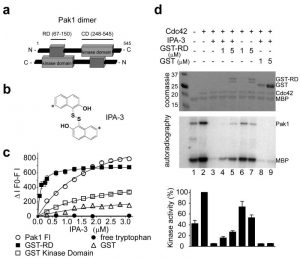
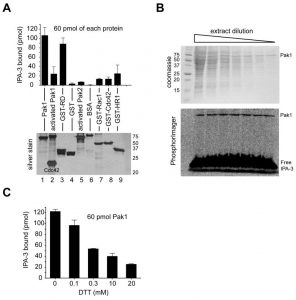
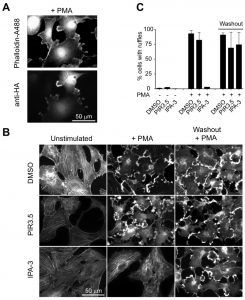
Part of the mechanism by which IPA-3 suppresses Pak1 activation is covalent attachment to Pak1's regulatory domain. Pak1 is covalently bound by IPA-3 in a temperature- and time-dependent manner. Binding of the Pak1 activator Cdc42 is inhibited by IPA-3. Direct binding of IPA-3 occurs with the Pak1 autoregulatory domain. In cells, IPA-3 reversibly prevents PMA-induced membrane ruffling[1]. Human primary Schwann and schwannoma cells exhibit reduced cell spreading in response to IPA-3 (2 μM, 5 μM, or 20 μM). In a dose-dependent manner, IPA-3 therapy dramatically lowers adherent Schwann and schwannoma cell counts[2]. IPA-3 is an allosteric inhibitor of p21-activated kinase 1 (Pak1) that is non-ATP-competitive. The IPA-3 control chemical is PIR3.5. On Thr423, IPA-3 inhibits the autophosphorylation of Pak1 induced by Cdc42. Additionally, sphingosine-dependent Pak1 autophosphorylation is inhibited by IPA-3. IPA-3 does not specifically target Pak1's exposed cysteine residues. The disulfide bond in IPA-3 is essential for the inhibition of Pak1, and Pak1 inhibition by IPA-3 is eliminated in vitro when the reducing agent dithiothreitol (DTT) is reduced. IPA-3 prevents different activators from activating Pak1, but it has no effect on Pak1 that has already been activated. In mouse embryonic fibroblasts, IPA-3 suppresses the activation of Pak in response to PDGF[3].
In human schwannoma cell lines (RT4, SW1088), IPA-3 inhibited proliferation with IC50 values of 5 μM (RT4) and 7 μM (SW1088), reducing cell viability by 60-70% at 10 μM after 72 hours [2] - IPA-3 (5 μM) blocked PAK1 autophosphorylation (Ser144) in RT4 cells, reducing p-PAK1 levels by 80% as detected by Western blot [2] - In MDA-MB-231 breast cancer cells, IPA-3 (10 μM) inhibited cell migration and invasion by 75% and 68%, respectively, via suppressing Rac GTPase-PAK signaling [1] - IPA-3 (8 μM) induced apoptosis in SW1088 schwannoma cells, increasing annexin V-positive cells from 5% to 38% after 48 hours [2] - IPA-3 (5-10 μM) reduced clonogenic growth of RT4 and MDA-MB-231 cells, decreasing colony formation efficiency by 72% and 65%, respectively [1][2] - IPA-3 (10 μM) disrupted PAK-mediated cytoskeletal rearrangement in fibroblasts, inhibiting lamellipodia formation by 85% [3] - Normal primary Schwann cells showed higher tolerance to IPA-3, with cell viability > 80% at 15 μM [2] |
| ln Vivo |
In rat schwannoma xenograft models (nu/nu mice), intraperitoneal administration of IPA-3 (20 mg/kg, q.d. for 14 days) resulted in 58% tumor growth inhibition (TGI) and reduced tumor weight by 52% at endpoint [2]
- Tumor tissues from IPA-3-treated mice showed reduced p-PAK1 levels (70% reduction vs vehicle) and increased TUNEL-positive apoptotic cells (32% vs 7% in vehicle) [2] - IPA-3 (20 mg/kg, i.p.) did not affect the growth of normal peripheral nerve tissue in mice [2] |
| Enzyme Assay |
Recombinant PAK kinase activity assay: Recombinant PAK1/2/3 was incubated with ATP (10 μM) and a fluorescently labeled peptide substrate. Serial concentrations of IPA-3 (0.5 μM to 50 μM) were added, and the mixture was incubated at 37°C for 60 minutes. Phosphorylated substrate was detected by fluorescence resonance energy transfer (FRET), and IC50 values were calculated via nonlinear regression [1][3]
- PAK covalent binding assay: Biotinylated IPA-3 was incubated with recombinant PAK1 at 25°C for 30 minutes. The mixture was subjected to SDS-PAGE, transferred to membranes, and probed with streptavidin-conjugated detection reagents to confirm covalent binding [1] - PAK autoregulatory domain binding assay: Purified PAK1 autoregulatory domain was immobilized on a sensor chip. Serial concentrations of IPA-3 (1 μM to 40 μM) were passed over the chip, and binding affinity was measured by surface plasmon resonance (SPR) [3] |
| Cell Assay |
Antiproliferative assay: Schwannoma or breast cancer cells were seeded in 96-well plates (4×10³ cells/well) and treated with serial concentrations of IPA-3 (1 μM to 50 μM) for 72 hours. Cell viability was assessed by a colorimetric assay based on tetrazolium salt reduction, and IC50 values were calculated [1][2]
- Western blot analysis: Cells were lysed in ice-cold RIPA buffer, and proteins were separated by SDS-PAGE, transferred to membranes, and probed with antibodies against p-PAK1 (Ser144), total PAK1, Rac1, phospho-AKT, and β-actin. Signals were detected by chemiluminescence and quantified by densitometry [1][2][3] - Apoptosis assay: Cells were treated with IPA-3 (5-10 μM) for 48 hours, stained with annexin V-FITC and propidium iodide, and analyzed by flow cytometry [2] - Migration and invasion assay: MDA-MB-231 cells were seeded in transwell chambers (migration) or Matrigel-coated transwell chambers (invasion) and treated with IPA-3 (10 μM). Migrated or invaded cells were stained and counted after 24 hours [1] - Clonogenic assay: Cells were treated with IPA-3 (5-8 μM) for 24 hours, seeded in 6-well plates (1×10³ cells/well) in drug-free medium, and incubated for 14 days. Colonies (> 50 cells) were stained and counted, with colony formation efficiency calculated relative to vehicle controls [1][2] |
| Animal Protocol |
Rat schwannoma xenograft model: Female nu/nu mice (6-8 weeks old) were subcutaneously implanted with 5×10⁶ RT4 schwannoma cells. When tumors reached 100-150 mm3, mice were randomized into groups (n=7/group) and treated with: (1) vehicle (10% DMSO + 40% Cremophor EL + 50% saline) i.p., (2) IPA-3 (20 mg/kg) i.p. once daily for 14 days. Tumor volume and body weight were measured every 2 days, and tumor tissues were collected for histology and Western blot analysis [2]
|
| Toxicity/Toxicokinetics |
IPA-3 showed low in vitro cytotoxicity in normal primary Schwann cells (IC50 > 20 μM) and fibroblasts (IC50 > 25 μM) [2][3] - In repeated-dose intraperitoneal toxicity studies in mice (14 days, 10–30 mg/kg/day), mild peritoneal irritation was observed at the maximum tolerated dose (MTD) of 25 mg/kg/day and the dose-limiting toxicity (DLT) of 30 mg/kg/day [2] - IPA-3 (20 mg/kg/day, intraperitoneal injection, for 14 days) did not cause significant weight loss (<5%) or histopathological abnormalities of the liver, kidneys, or heart in mice [2] - IPA-3 had a human plasma protein binding rate of 85% (10 mmol/L). μM concentration [1]
|
| References |
|
| Additional Infomation |
IPA-3 is an organic disulfide prepared by the oxidative dimerization of 1-mercaptonaphthalene-2-ol. It is an EC 2.7.11.1 (nonspecific serine/threonine protein kinase) inhibitor. It is an organic disulfide belonging to the naphthol family of compounds.
IPA-3 is a first-in-class isoform-selective allosteric inhibitor of PAK kinase that covalently targets its self-regulating domain[1][3] The mechanism of action of IPA-3 is to block PAK activation by preventing the release of the self-regulating domain from the kinase catalytic domain, thereby inhibiting downstream signaling pathways (Rac GTPase, AKT) involved in cell proliferation, migration and survival[1][2][3] IPA-3 has therapeutic potential against PAK-driven tumors (such as schwannomas and triple-negative breast cancer) and has very low toxicity to normal cells[1][2] IPA-3 is a valuable tool compound for studying PAK-mediated signaling pathways and validating PAK as a therapeutic target[1][3] |
| Molecular Formula |
C20H14O2S2
|
|
|---|---|---|
| Molecular Weight |
350.45
|
|
| Exact Mass |
350.043
|
|
| CAS # |
42521-82-4
|
|
| Related CAS # |
|
|
| PubChem CID |
521106
|
|
| Appearance |
Light yellow to yellow solid powder
|
|
| Density |
1.5±0.1 g/cm3
|
|
| Boiling Point |
543.7±35.0 °C at 760 mmHg
|
|
| Melting Point |
172℃
|
|
| Flash Point |
263.4±24.7 °C
|
|
| Vapour Pressure |
0.0±1.5 mmHg at 25°C
|
|
| Index of Refraction |
1.836
|
|
| LogP |
4.96
|
|
| Hydrogen Bond Donor Count |
2
|
|
| Hydrogen Bond Acceptor Count |
4
|
|
| Rotatable Bond Count |
3
|
|
| Heavy Atom Count |
24
|
|
| Complexity |
380
|
|
| Defined Atom Stereocenter Count |
0
|
|
| InChi Key |
RFAXLXKIAKIUDT-UHFFFAOYSA-N
|
|
| InChi Code |
InChI=1S/C20H14O2S2/c21-17-11-9-13-5-1-3-7-15(13)19(17)23-24-20-16-8-4-2-6-14(16)10-12-18(20)22/h1-12,21-22H
|
|
| Chemical Name |
1,1-disulfanediylbis(naphthalen-2-ol)
|
|
| Synonyms |
|
|
| HS Tariff Code |
2934.99.9001
|
|
| Storage |
Powder -20°C 3 years 4°C 2 years In solvent -80°C 6 months -20°C 1 month |
|
| Shipping Condition |
Room temperature (This product is stable at ambient temperature for a few days during ordinary shipping and time spent in Customs)
|
| Solubility (In Vitro) |
|
|||
|---|---|---|---|---|
| Solubility (In Vivo) |
Solubility in Formulation 1: 2.5 mg/mL (7.13 mM) in 10% DMSO + 40% PEG300 + 5% Tween80 + 45% Saline (add these co-solvents sequentially from left to right, and one by one), clear solution; with sonication.
For example, if 1 mL of working solution is to be prepared, you can add 100 μL of 25.0 mg/mL clear DMSO stock solution to 400 μL PEG300 and mix evenly; then add 50 μL Tween-80 to the above solution and mix evenly; then add 450 μL normal saline to adjust the volume to 1 mL. Preparation of saline: Dissolve 0.9 g of sodium chloride in 100 mL ddH₂ O to obtain a clear solution. Solubility in Formulation 2: 2.5 mg/mL (7.13 mM) in 10% DMSO + 90% (20% SBE-β-CD in Saline) (add these co-solvents sequentially from left to right, and one by one), suspension solution; with ultrasonication. For example, if 1 mL of working solution is to be prepared, you can add 100 μL of 25.0 mg/mL clear DMSO stock solution to 900 μL of 20% SBE-β-CD physiological saline solution and mix evenly. Preparation of 20% SBE-β-CD in Saline (4°C,1 week): Dissolve 2 g SBE-β-CD in 10 mL saline to obtain a clear solution. View More
Solubility in Formulation 3: ≥ 2.5 mg/mL (7.13 mM) (saturation unknown) in 10% DMSO + 90% Corn Oil (add these co-solvents sequentially from left to right, and one by one), clear solution. |
| Preparing Stock Solutions | 1 mg | 5 mg | 10 mg | |
| 1 mM | 2.8535 mL | 14.2674 mL | 28.5347 mL | |
| 5 mM | 0.5707 mL | 2.8535 mL | 5.7069 mL | |
| 10 mM | 0.2853 mL | 1.4267 mL | 2.8535 mL |
*Note: Please select an appropriate solvent for the preparation of stock solution based on your experiment needs. For most products, DMSO can be used for preparing stock solutions (e.g. 5 mM, 10 mM, or 20 mM concentration); some products with high aqueous solubility may be dissolved in water directly. Solubility information is available at the above Solubility Data section. Once the stock solution is prepared, aliquot it to routine usage volumes and store at -20°C or -80°C. Avoid repeated freeze and thaw cycles.
Calculation results
Working concentration: mg/mL;
Method for preparing DMSO stock solution: mg drug pre-dissolved in μL DMSO (stock solution concentration mg/mL). Please contact us first if the concentration exceeds the DMSO solubility of the batch of drug.
Method for preparing in vivo formulation::Take μL DMSO stock solution, next add μL PEG300, mix and clarify, next addμL Tween 80, mix and clarify, next add μL ddH2O,mix and clarify.
(1) Please be sure that the solution is clear before the addition of next solvent. Dissolution methods like vortex, ultrasound or warming and heat may be used to aid dissolving.
(2) Be sure to add the solvent(s) in order.
|
|---|
|
|
Products are for research use only; We do not sell to patients
Copyright 2020 InvivoChem LLC | All Rights Reserved


 COA
COA