| Size | Price | Stock | Qty |
|---|---|---|---|
| 50mg |
|
||
| 100mg |
|
||
| 250mg |
|
||
| Other Sizes |


| Targets |
Indican does not have a specific pharmacological target, as it is a natural product and a precursor to indigo dyes. Its biological effects are related to its metabolism to indoxyl sulfate, a uremic toxin that accumulates in patients with chronic kidney disease. It is used as a research tool for studying indole metabolism and the gut microbiome.
|
|---|---|
| ln Vitro |
In vitro, indican is used as a substrate to study the activity of enzymes such as β-glucosidase, which hydrolyzes the glycosidic bond to release indoxyl. Its conversion to indoxyl sulfate can be studied in cell-based or cell-free systems. It is also used as a precursor for the synthesis of indigo and indirubin dyes.
|
| ln Vivo |
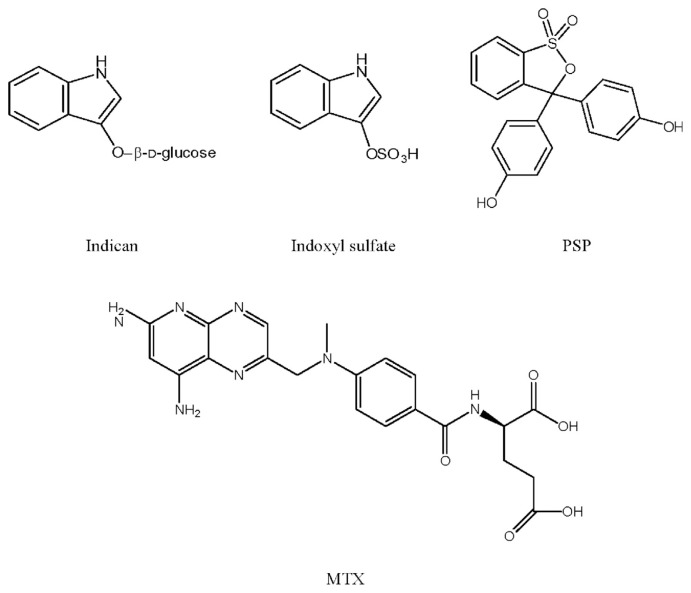
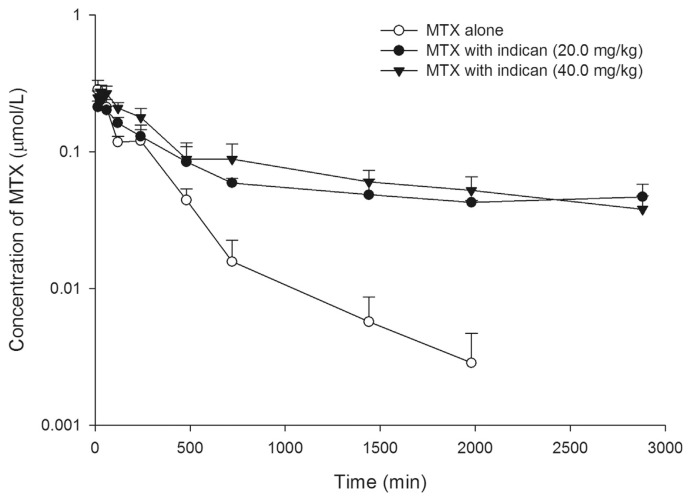
Indican ((Indolyl-beta-D-glucoside; Oral; 20, 40 mg/kg; Single dose) increases MTX by significant metabolite inhibition of numerous anion transporters, including OAT 1, OAT 3, and MRP 4 Systemic exposure and MRT IS[1].
In vivo, indican is metabolized to indoxyl sulfate, which is a uremic toxin that accumulates in patients with chronic kidney disease. It is used as a biomarker for gut microbial metabolism and as a research tool for studying the pathophysiology of kidney disease. Its levels can be measured in urine and plasma. |
| Enzyme Assay |
The in vitro assay for indican typically measures its hydrolysis by β-glucosidase or its conversion to indoxyl sulfate. These cell-free assays use purified enzyme and measure the release of indoxyl or the formation of indoxyl sulfate using colorimetric or chromatographic methods. Its stability and reactivity can be assessed in various buffer systems.
|
| Cell Assay |
In vitro cellular assays for indican are not commonly performed, as it is a natural product and a precursor to dyes. Its effects on cells may be related to its metabolism to indoxyl sulfate, which can have toxic effects on renal cells. These assays are typically used in toxicological studies rather than pharmacological research.
|
| Animal Protocol |
Animal/Disease Models: Male Spraguee Dawley rat, body weight 330-400 g[1]
Doses: 20, 40 mg/kg Route of Administration: Oral Experimental Results: Methotrexate (MTX) Increased systemic exposure and multidrug resistance-related protein (MRP; 5.0 mg/kg). In vivo animal studies for indican are conducted in models of chronic kidney disease to study the accumulation of indoxyl sulfate and its role in disease progression. However, specific details of these studies are not extensively detailed in the available literature. Its use is primarily in analytical and metabolic research. |
| ADME/Pharmacokinetics |
Metabolism / Metabolites
Uremic toxins often accumulate in the blood due to overeating or poor kidney filtration. Most uremic toxins are metabolic waste products that are normally excreted through urine or feces. Indican is a natural compound that is metabolized in the body to indoxyl sulfate, which is excreted in urine. Its pharmacokinetic properties are those of a natural glycoside. Its stability in solution is rarely reported. Its use is primarily as a research tool in natural product chemistry and metabolic studies. |
| Toxicity/Toxicokinetics |
Toxicity Summary
Uremic toxins (such as indophenol) are actively transported to the kidneys via organic ion transporters, particularly OAT3. Elevated uremic toxin levels can stimulate the production of reactive oxygen species (ROS). This appears to be mediated by the direct binding of uremic toxins to or inhibition of NADPH oxidases, particularly NOX4, which is abundant in the kidneys and heart (A7868). ROS can induce a variety of different DNA methyltransferases (DNMTs) involved in the silencing of the KLOTHO protein. KLOTHO has been shown to play an important role in anti-aging, mineral metabolism, and vitamin D metabolism. Multiple studies have shown that in acute or chronic kidney disease, KLOTHO mRNA and protein levels are decreased due to elevated local ROS levels (A7869). Indican is a natural compound and is generally considered to have low toxicity. However, its metabolite indoxyl sulfate is a uremic toxin that can accumulate in patients with kidney disease. Its safety profile is not applicable as it is not administered as a drug. |
| References | |
| Additional Infomation |
Indolone is an indole-based carbohydrate belonging to the β-D-glucosides and extracellular polysaccharides. It has been reported in Strobilanthes cusia, Calanthe discolor, and other organisms with relevant data. Indolone is a toxic metabolite derived from dietary protein and tryptophan. In the intestine, protein and tryptophan are converted to indole by organisms expressing tryptophanase. In the liver, indole is hydroxylated to indolephenol, and indolephenol is sulfated to indolone. Excessive production of indolone is associated with glomerulosclerosis, interstitial fibrosis, and renal failure. Indolone is a uremic toxin. Based on their chemical and physical properties, uremic toxins can be classified into three main categories: 1) small molecule, water-soluble, non-protein-bound compounds, such as urea; 2) small molecule, lipid-soluble compounds and/or protein-bound compounds, such as phenols; and 3) larger so-called medium molecules, such as β2-microglobulins. Long-term exposure to uremic toxins can lead to a variety of diseases, including kidney damage, chronic kidney disease, and cardiovascular disease. Indigo is a colorless organic compound that is soluble in water and is naturally found in plants of the genus Indigo. It is a precursor to indigo dye. Indigo interferes with many commercial methods for measuring total bilirubin[6], which can be a problem for patients with kidney failure who have elevated levels of indigo in their blood. It can also cause gastrointestinal symptoms in patients with reduced protein absorption, such as Hartnap disease, because bacteria more readily break down tryptophan into indole and convert it into indigo.
Indican (CAS 487-60-5), also known as Indoxyl-β-D-glucoside, is a natural glycoside found in various plants. It is a precursor of the dyes indigo and indirubin and has a major metabolite, indoxyl sulfate, which is a uremic toxin. It has a molecular formula of C14H17NO6 and a molecular weight of 295.29. It is used in natural product chemistry and metabolic research. |
| Molecular Formula |
C14H17NO6
|
|---|---|
| Molecular Weight |
295.29
|
| Exact Mass |
295.105
|
| CAS # |
487-60-5
|
| Related CAS # |
1328-73-0 (trihydrate);487-60-5;
|
| PubChem CID |
441564
|
| Appearance |
Off-white to light yellow solid powder
|
| Density |
1.6±0.1 g/cm3
|
| Boiling Point |
606.7±55.0 °C at 760 mmHg
|
| Melting Point |
57-58ºC
|
| Flash Point |
320.7±31.5 °C
|
| Vapour Pressure |
0.0±1.8 mmHg at 25°C
|
| Index of Refraction |
1.715
|
| Source |
Originated from plants: Leguminosae Indigofera
|
| LogP |
-0.75
|
| Hydrogen Bond Donor Count |
5
|
| Hydrogen Bond Acceptor Count |
6
|
| Rotatable Bond Count |
3
|
| Heavy Atom Count |
21
|
| Complexity |
356
|
| Defined Atom Stereocenter Count |
5
|
| SMILES |
C1=CC=C2C(=C1)C(=CN2)O[C@H]3[C@@H]([C@H]([C@@H]([C@H](O3)CO)O)O)O
|
| InChi Key |
XVARCVCWNFACQC-RKQHYHRCSA-N
|
| InChi Code |
InChI=1S/C14H17NO6/c16-6-10-11(17)12(18)13(19)14(21-10)20-9-5-15-8-4-2-1-3-7(8)9/h1-5,10-19H,6H2/t10-,11-,12+,13-,14-/m1/s1
|
| Chemical Name |
(2R,3S,4S,5R,6S)-2-(Hydroxymethyl)-6-(1H-indol-3-yloxy)oxane-3,4,5-triol
|
| Synonyms |
NSC87517 IndicanNSC 87517 NSC-87517
|
| HS Tariff Code |
2934.99.9001
|
| Storage |
Powder -20°C 3 years 4°C 2 years In solvent -80°C 6 months -20°C 1 month |
| Shipping Condition |
Room temperature (This product is stable at ambient temperature for a few days during ordinary shipping and time spent in Customs)
|
| Solubility (In Vitro) |
DMSO : ~100 mg/mL (~338.65 mM)
MEthanol : ~83.33 mg/mL (~282.20 mM) H2O : ~20 mg/mL (~67.73 mM) |
|---|---|
| Solubility (In Vivo) |
Solubility in Formulation 1: ≥ 2.5 mg/mL (8.47 mM) (saturation unknown) in 10% DMSO + 40% PEG300 + 5% Tween80 + 45% Saline (add these co-solvents sequentially from left to right, and one by one), clear solution.
For example, if 1 mL of working solution is to be prepared, you can add 100 μL of 25.0 mg/mL clear DMSO stock solution to 400 μL PEG300 and mix evenly; then add 50 μL Tween-80 to the above solution and mix evenly; then add 450 μL normal saline to adjust the volume to 1 mL. Preparation of saline: Dissolve 0.9 g of sodium chloride in 100 mL ddH₂ O to obtain a clear solution. Solubility in Formulation 2: ≥ 2.5 mg/mL (8.47 mM) (saturation unknown) in 10% DMSO + 90% (20% SBE-β-CD in Saline) (add these co-solvents sequentially from left to right, and one by one), clear solution. For example, if 1 mL of working solution is to be prepared, you can add 100 μL of 25.0 mg/mL clear DMSO stock solution to 900 μL of 20% SBE-β-CD physiological saline solution and mix evenly. Preparation of 20% SBE-β-CD in Saline (4°C,1 week): Dissolve 2 g SBE-β-CD in 10 mL saline to obtain a clear solution. View More
Solubility in Formulation 3: ≥ 2.5 mg/mL (8.47 mM) (saturation unknown) in 10% DMSO + 90% Corn Oil (add these co-solvents sequentially from left to right, and one by one), clear solution. Solubility in Formulation 4: 14.29 mg/mL (48.39 mM) in PBS (add these co-solvents sequentially from left to right, and one by one), clear solution; with ultrasonication. |
| Preparing Stock Solutions | 1 mg | 5 mg | 10 mg | |
| 1 mM | 3.3865 mL | 16.9325 mL | 33.8650 mL | |
| 5 mM | 0.6773 mL | 3.3865 mL | 6.7730 mL | |
| 10 mM | 0.3387 mL | 1.6933 mL | 3.3865 mL |
*Note: Please select an appropriate solvent for the preparation of stock solution based on your experiment needs. For most products, DMSO can be used for preparing stock solutions (e.g. 5 mM, 10 mM, or 20 mM concentration); some products with high aqueous solubility may be dissolved in water directly. Solubility information is available at the above Solubility Data section. Once the stock solution is prepared, aliquot it to routine usage volumes and store at -20°C or -80°C. Avoid repeated freeze and thaw cycles.
Calculation results
Working concentration: mg/mL;
Method for preparing DMSO stock solution: mg drug pre-dissolved in μL DMSO (stock solution concentration mg/mL). Please contact us first if the concentration exceeds the DMSO solubility of the batch of drug.
Method for preparing in vivo formulation::Take μL DMSO stock solution, next add μL PEG300, mix and clarify, next addμL Tween 80, mix and clarify, next add μL ddH2O,mix and clarify.
(1) Please be sure that the solution is clear before the addition of next solvent. Dissolution methods like vortex, ultrasound or warming and heat may be used to aid dissolving.
(2) Be sure to add the solvent(s) in order.
| NCT Number | Recruitment | interventions | Conditions | Sponsor/Collaborators | Start Date | Phases |
| NCT04117191 | Completed | Dietary Supplement: Doctor's Best L-Tryptophan | Chronic Kidney Diseases Healthy |
Taipei Tzu Chi Hospital, Buddhist Tzu Chi Medical Foundation | 2019-10-01 | Not Applicable |
| NCT02639624 | Withdrawn | Drug: Low bicarbonate dialysate First Drug: Normal bicarbonate dialysate First Drug: Normal bicarbonate dialysate Drug: Low bicarbonate dialysate |
Hemodialysis Renal Dialysis | NYU Langone Health | 2016-01 | Not Applicable |
| NCT05771350 | Completed | Procedure: online hemodiafiltration Procedure: high flux hemodialysis Procedure: low flux hemodialysis |
Hemodialysis | Ain Shams University | 2016-11-15 | Not Applicable |
| NCT03920982 | Recruiting | Diagnostic Test: Determination of the blood concentration of indoxyl sulfate (IS) |
Acute Kidney Injury Mortality Septic Shock Uremic; Toxemia |
Centre Hospitalier Universitaire, Amiens | 2019-12-10 | Not Applicable |
| NCT05634083 | Completed | Dietary Supplement: Uremic pateints with itching | Pruritus | Benha University | 2022-11-25 | Not Applicable |
|
|
Products are for research use only; We do not sell to patients
Copyright 2020 InvivoChem LLC | All Rights Reserved