| Size | Price | Stock | Qty |
|---|---|---|---|
| 2mg |
|
||
| 5mg |
|
||
| 10mg |
|
||
| 25mg |
|
||
| 50mg |
|
||
| 100mg |
|
||
| 250mg |
|
||
| 500mg | |||
| Other Sizes |


Purity: ≥98%
| Targets |
Bromodomain and PHD Finger-Containing Protein 1 (BRPF1) Bromodomain (Ki = 0.15 nM for human recombinant BRPF1 bromodomain; HTRF IC50 = 0.3 nM) [1]
- Bromodomain and PHD Finger-Containing Protein 2 (BRPF2) Bromodomain (Ki = 18 nM for human recombinant BRPF2 bromodomain) [1] - Bromodomain and PHD Finger-Containing Protein 3 (BRPF3) Bromodomain (Ki = 3.5 nM for human recombinant BRPF3 bromodomain) [1] - No significant binding to other bromodomains (e.g., BPTF, CREBBP, EP300, BRD4) with IC50 > 10 μM [1] |
|---|---|
| ln Vitro |
In vitro activity: Screening GSK6853 against a panel of 48 unrelated assays reveals only off-target activities that are relatively weak compared to the BRPF1 potency. However, to minimize the chance of off-target effects , the recommended concentration is no higher than 1 μM in cell-based assays.
Kinase Assay: GSK6853 is a novel, potent and selective benzimidazolone BRPF1 bromodomain inhibitor with pIC50 of 8.1 (TR-FRET) and showed greater than 1600-fold selectivity over all other bromodomains tested. The BRPF (Bromodomain and PHD Finger-containing) protein family are important scaffolding proteins for assembly of MYST histone acetyltransferase complexes. Screening GSK6853 against a panel of 48 unrelated assays reveals only off-target activities that are relatively weak compared to the BRPF1 potency. However, to minimize the chance of off-target effects , the recommended concentration is no higher than 1 μM in cell-based assays. Cell Assay: GSK6853 (0.01-100 nM) dose-dependently bound to human recombinant BRPF1 bromodomain, with 98% binding inhibition at 1 nM [1] - GSK6853 exhibited high selectivity for BRPF1 over BRPF2 (120-fold) and BRPF3 (23-fold), and >66,000-fold selectivity over non-BRPF bromodomains (e.g., BRD4, CREBBP) [1] - GSK6853 (1-20 μM) induced a concentration-dependent thermal stabilization of BRPF1 protein in HEK293T cells (ΔTm = 4.2°C at 10 μM) in Cellular Thermal Shift Assay (CETSA), confirming intracellular target engagement [1] - GSK6853 (5-50 μM) had no significant effect on proliferation of HEK293T, HeLa, or MCF-7 cells after 72 hours (cell viability >90%), indicating low intrinsic cytotoxicity [1] - GSK6853 (10 μM) did not disrupt the interaction of BRPF1 with other components of the MOZ/MORF acetyltransferase complex in co-immunoprecipitation assays [1] |
| ln Vivo |
In prospective PK/PD models, the ip route of administration would be appropriate for dosing GSK6853[1].
|
| Enzyme Assay |
Surface Plasmon Resonance (SPR) binding assay: Recombinant human BRPF1/BRPF2/BRPF3 bromodomain proteins were immobilized on a sensor chip. Serial concentrations of GSK6853 (0.001-100 nM) were injected over the chip at 25°C, and binding responses were recorded. Kinetic parameters (ka, kd) were calculated to derive Ki values [1]
- HTRF-based binding inhibition assay: Biotinylated acetylated histone H3 peptide (H3K9ac) was incubated with recombinant BRPF1 bromodomain and Eu-labeled anti-GST antibody, along with serial concentrations of GSK6853 (0.01-100 nM). Fluorescence resonance energy transfer (FRET) signal was measured (excitation = 320 nm, emission = 665 nm/620 nm), and IC50 values were calculated from dose-response curves [1] - Bromodomain selectivity panel assay: GSK6853 (0.01-10 μM) was tested against a panel of 48 human bromodomains using HTRF or AlphaScreen assays. Binding inhibition was measured to confirm selectivity for BRPF family bromodomains, particularly BRPF1 [1] |
| Cell Assay |
Cellular Thermal Shift Assay (CETSA): HEK293T cells were lysed, and the lysate was incubated with GSK6853 (1-20 μM) or vehicle for 30 minutes at room temperature. Samples were subjected to a temperature gradient (40-65°C), then centrifuged to separate soluble proteins. BRPF1 protein levels in soluble fractions were detected by Western blot, and melting curves were generated to calculate ΔTm values [1]
- Cell viability assay: HEK293T, HeLa, and MCF-7 cells were cultured in DMEM medium supplemented with fetal bovine serum. Cells were treated with GSK6853 (0.5-100 μM) for 72 hours, and cell viability was assessed by MTT assay [1] - Co-immunoprecipitation (Co-IP) assay: HEK293T cells were transfected with FLAG-tagged BRPF1 plasmid. After 24 hours, cells were treated with GSK6853 (10 μM) for 6 hours, then lysed. Anti-FLAG antibody was used to immunoprecipitate BRPF1, and Western blot was performed to detect interacting proteins (MOZ, MORF) [1] |
| Animal Protocol |
1 mg/kg (i.v); i.v, p.o, i.p
CD1 mice |
| Toxicity/Toxicokinetics |
GSK6853 (≤50 μM) showed low cytotoxicity to normal human foreskin fibroblasts (CCD-18Co) and mammary epithelial cells (MCF-10A), with cell viability >85% after 72 hours [1]. GSK6853 had a plasma protein binding rate of 95% in human plasma and 93% in rat plasma [1]. GSK6853 exhibited good metabolic stability in human liver microsomes, with a half-life (t1/2) of 3.2 hours [1].
|
| References | |
| Additional Infomation |
GSK6853 is a highly efficient and selective BRPF1 bromodomain chemical probe designed to specifically target the acetyl-lysine binding pocket of BRPF1[1]. Its mechanism of action is to competitively bind to the BRPF1 bromodomain, blocking its interaction with acetylated histone tails (e.g., H3K9ac) without disrupting the integrity of the MOZ/MORF acetyltransferase complex[1]. This drug is of great value for studying the biological functions of BRPF1 in epigenetic regulation, chromatin remodeling, and transcriptional control[1]. Compared with other bromodomains, the high selectivity of GSK6853 for BRPF1 minimizes off-target effects, making it a reliable tool for elucidating BRPF1-specific pathways[1]. GSK6853 has good in vitro properties (high binding affinity, metabolic stability, and low cytotoxicity), supporting its application in cell and biochemical studies[1].
|
| Molecular Formula |
C22H27N5O3
|
|
|---|---|---|
| Molecular Weight |
409.48
|
|
| Exact Mass |
409.211
|
|
| CAS # |
1910124-24-1
|
|
| Related CAS # |
|
|
| PubChem CID |
121232405
|
|
| Appearance |
White to off-white solid powder
|
|
| Density |
1.2±0.1 g/cm3
|
|
| Boiling Point |
545.9±50.0 °C at 760 mmHg
|
|
| Flash Point |
284.0±30.1 °C
|
|
| Vapour Pressure |
0.0±1.5 mmHg at 25°C
|
|
| Index of Refraction |
1.621
|
|
| LogP |
0.98
|
|
| Hydrogen Bond Donor Count |
2
|
|
| Hydrogen Bond Acceptor Count |
5
|
|
| Rotatable Bond Count |
4
|
|
| Heavy Atom Count |
30
|
|
| Complexity |
646
|
|
| Defined Atom Stereocenter Count |
1
|
|
| SMILES |
C[C@@H]1CNCCN1C2=CC3=C(C=C2NC(=O)C4=CC=CC=C4OC)N(C(=O)N3C)C
|
|
| InChi Key |
FQWDVNSBYDXPIO-CQSZACIVSA-N
|
|
| InChi Code |
InChI=1S/C22H27N5O3/c1-14-13-23-9-10-27(14)17-12-19-18(25(2)22(29)26(19)3)11-16(17)24-21(28)15-7-5-6-8-20(15)30-4/h5-8,11-12,14,23H,9-10,13H2,1-4H3,(H,24,28)/t14-/m1/s1
|
|
| Chemical Name |
N-[1,3-dimethyl-6-[(2R)-2-methylpiperazin-1-yl]-2-oxobenzimidazol-5-yl]-2-methoxybenzamide
|
|
| Synonyms |
|
|
| HS Tariff Code |
2934.99.9001
|
|
| Storage |
Powder -20°C 3 years 4°C 2 years In solvent -80°C 6 months -20°C 1 month |
|
| Shipping Condition |
Room temperature (This product is stable at ambient temperature for a few days during ordinary shipping and time spent in Customs)
|
| Solubility (In Vitro) |
DMSO: 81 mg/mL warmed (197.81 mM)
Water: 1 mg/mL (Insoluble) Ethanol: 81 mg/mL warmed (197.81 mM) |
|---|---|
| Solubility (In Vivo) |
Solubility in Formulation 1: ≥ 2.5 mg/mL (6.11 mM) (saturation unknown) in 10% DMSO + 40% PEG300 + 5% Tween80 + 45% Saline (add these co-solvents sequentially from left to right, and one by one), clear solution.
For example, if 1 mL of working solution is to be prepared, you can add 100 μL of 25.0 mg/mL clear DMSO stock solution to 400 μL PEG300 and mix evenly; then add 50 μL Tween-80 to the above solution and mix evenly; then add 450 μL normal saline to adjust the volume to 1 mL. Preparation of saline: Dissolve 0.9 g of sodium chloride in 100 mL ddH₂ O to obtain a clear solution. Solubility in Formulation 2: ≥ 2.5 mg/mL (6.11 mM) (saturation unknown) in 10% DMSO + 90% (20% SBE-β-CD in Saline) (add these co-solvents sequentially from left to right, and one by one), clear solution. For example, if 1 mL of working solution is to be prepared, you can add 100 μL of 25.0 mg/mL clear DMSO stock solution to 900 μL of 20% SBE-β-CD physiological saline solution and mix evenly. Preparation of 20% SBE-β-CD in Saline (4°C,1 week): Dissolve 2 g SBE-β-CD in 10 mL saline to obtain a clear solution. View More
Solubility in Formulation 3: ≥ 2.5 mg/mL (6.11 mM) (saturation unknown) in 10% DMSO + 90% Corn Oil (add these co-solvents sequentially from left to right, and one by one), clear solution. |
| Preparing Stock Solutions | 1 mg | 5 mg | 10 mg | |
| 1 mM | 2.4421 mL | 12.2106 mL | 24.4212 mL | |
| 5 mM | 0.4884 mL | 2.4421 mL | 4.8842 mL | |
| 10 mM | 0.2442 mL | 1.2211 mL | 2.4421 mL |
*Note: Please select an appropriate solvent for the preparation of stock solution based on your experiment needs. For most products, DMSO can be used for preparing stock solutions (e.g. 5 mM, 10 mM, or 20 mM concentration); some products with high aqueous solubility may be dissolved in water directly. Solubility information is available at the above Solubility Data section. Once the stock solution is prepared, aliquot it to routine usage volumes and store at -20°C or -80°C. Avoid repeated freeze and thaw cycles.
Calculation results
Working concentration: mg/mL;
Method for preparing DMSO stock solution: mg drug pre-dissolved in μL DMSO (stock solution concentration mg/mL). Please contact us first if the concentration exceeds the DMSO solubility of the batch of drug.
Method for preparing in vivo formulation::Take μL DMSO stock solution, next add μL PEG300, mix and clarify, next addμL Tween 80, mix and clarify, next add μL ddH2O,mix and clarify.
(1) Please be sure that the solution is clear before the addition of next solvent. Dissolution methods like vortex, ultrasound or warming and heat may be used to aid dissolving.
(2) Be sure to add the solvent(s) in order.
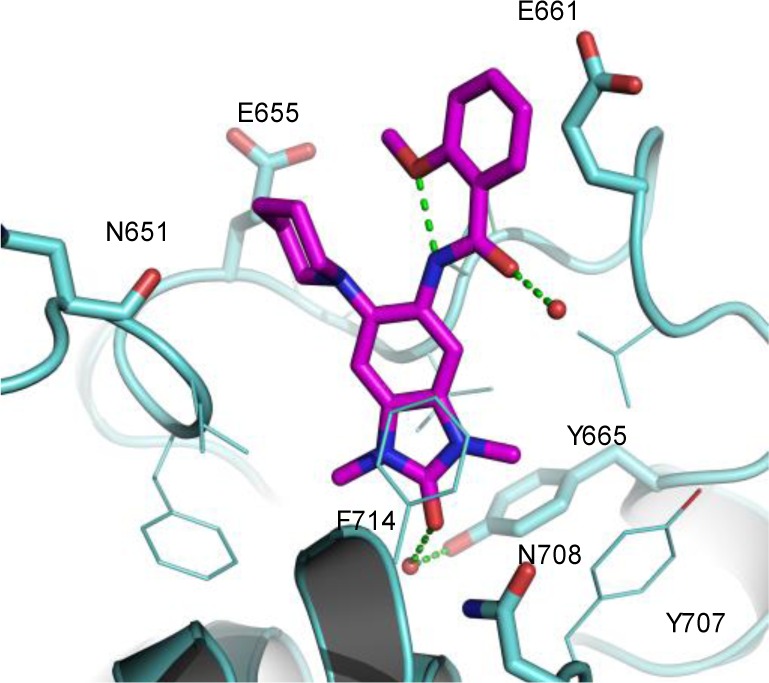
X-ray structure of BRPF1 with 1 (PDB 4UYE).ACS Med Chem Lett.2016 May 9;7(6):552-7. |
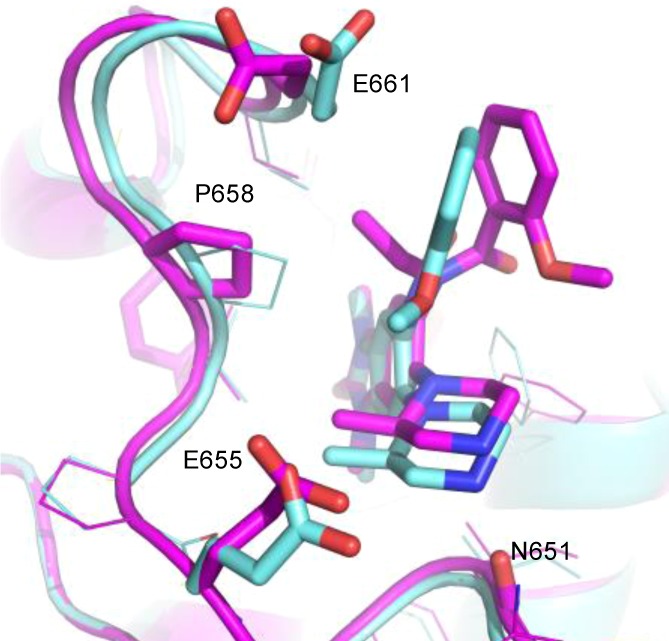
X-ray structures of BRPF1 with 34 (cyan, PDB 5G4R) and 38 (magenta, PDB 5G4S).ACS Med Chem Lett.2016 May 9;7(6):552-7. |
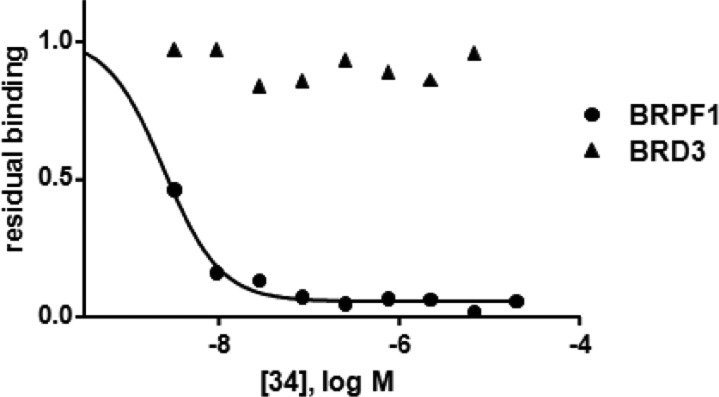
Potency for endogenous cellular BRPF1. pIC50 of 34 for BRPF1 and BRD3 measured in a chemoproteomic competition binding assay (Supplementary Methods, Supporting Information).ACS Med Chem Lett.2016 May 9;7(6):552-7. |
Products are for research use only; We do not sell to patients
Copyright 2020 InvivoChem LLC | All Rights Reserved


 COA
COA