| Size | Price | Stock | Qty |
|---|---|---|---|
| 5mg |
|
||
| 10mg |
|
||
| 25mg |
|
||
| 50mg |
|
||
| 100mg |
|
||
| 250mg |
|
||
| Other Sizes |


Purity: ≥98%
| Targets |
GSK429286A targets Rho-associated coiled kinase (ROCK) isoforms ROCK1 and ROCK2 (ROCK1 IC50 = 1.6 nM; ROCK2 IC50 = 4.3 nM) [1]
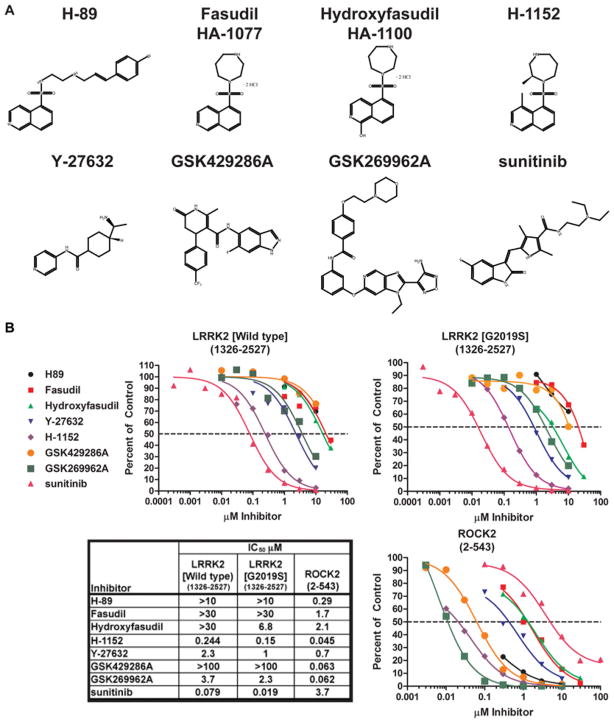
GSK429286A inhibits leucine-rich repeat kinase 2 (LRRK2) (wild-type LRRK2 IC50 = 600 nM; G2019S mutant LRRK2 IC50 = 580 nM) [2] |
|---|---|
| ln Vitro |
Under these circumstances, the only other kinase examined that is appreciably inhibited is MSK1, whose activity is lowered ~5-fold. GSK429286A at 1 μM lowers ROCK2 activity by nearly 20 times. According to the kinase-specificity panel, GSK429286A is a more selective ROCK2 inhibitor than the commonly used ROCK inhibitor Y-27632. It also does not appreciably inhibit LRRK2 even at dosages up to 30 μM (500-fold greater than the IC50 of ROCK2 inhibition). RSK and p70S6K are both mildly inhibited by GSK429286A, with IC50 values of 0.78 μM and 1.94 μM, respectively. Rat aortic ring dilatation is markedly inhibited by GSK429286A, with an IC50 of 190 nM[2].
In recombinant ROCK1/ROCK2 enzyme assays, GSK429286A dose-dependently inhibits kinase activity, with IC50 values of 1.6 nM (ROCK1) and 4.3 nM (ROCK2). It suppresses ROCK-mediated phosphorylation of myosin light chain (MLC) in rat aortic smooth muscle cells by 78% at 100 nM [1] - In recombinant wild-type and G2019S mutant LRRK2 enzyme assays, GSK429286A inhibits kinase activity with IC50 values of 600 nM and 580 nM respectively, showing similar potency against both isoforms [2] |
| ln Vivo |
In male Sprague-Dawley rats, GSK429286A has an oral bioavailability of 61%. When given orally to spontaneously hypertensive rats (SHRs) at single doses ranging from 3 to 30 mg/kg, GSK429286A significantly lowers mean arterial pressure in a dose-dependent manner. The highest reduction of 50 mmHg occurs approximately two hours after treatment at a dose of 30 mg/kg[1].
|
| Enzyme Assay |
ROCK1/ROCK2 kinase activity assay: Purified recombinant human ROCK1 or ROCK2 was incubated with MLC-derived substrate peptide and GSK429286A (0.01 nM-100 nM) in assay buffer (50 mM Tris-HCl, pH 7.5, 10 mM MgCl₂, 1 mM DTT, 0.1 mM ATP) at 30°C for 60 minutes. Phosphorylated substrate was detected by radiolabeled ATP counting, and IC50 values were calculated from dose-response curves [1]
- LRRK2 kinase activity assay: Purified recombinant human wild-type or G2019S mutant LRRK2 was incubated with recombinant Rab8a substrate and GSK429286A (0.1 μM-10 μM) in assay buffer (25 mM Tris-HCl, pH 7.4, 5 mM MgCl₂, 1 mM EGTA, 0.1 mM ATP) at 37°C for 90 minutes. Phosphorylated Rab8a was detected by Western blot using a phospho-specific antibody, and IC50 values were derived [2] - Kinase selectivity assay (ROCK): GSK429286A (10 μM) was screened against a panel of 20+ kinases (including PKA, PKC, MLCK) using respective substrate peptides. No significant inhibition (>50% activity reduction) was observed for off-target kinases [1] |
| Animal Protocol |
Formulated in 6% Hydroxypropyl-β-Cyclodextrin (pH4.0) and 5% DMSO solution ; 30 mg/kg; Oral gavage
Male spontaneously hypertensive rats (SHRs) |
| References | |
| Additional Infomation |
N-(6-fluoro-1H-indazol-5-yl)-6-methyl-2-oxo-4-[4-(trifluoromethyl)phenyl]-3,4-dihydro-1H-pyridine-5-carboxamide belongs to the (trifluoromethyl)benzene class of compounds.
GSK429286A is a small molecule inhibitor with dual selectivity for ROCK and LRRK2 kinases[1][2] - Its mechanism of action involves competitive binding to the ATP-binding pockets of ROCK and LRRK2, thereby inhibiting their kinase activity and downstream signaling pathways[1][2] - It was initially developed as a selective ROCK inhibitor and was later found to be a moderate inhibitor of LRRK2 (a kinase associated with Parkinson's disease)[1][2] - GSK429286A has been used as a tool compound to study ROCK-mediated cytoskeleton regulation and the mechanisms of LRRK2-related neurodegenerative diseases[1][2] |
| Molecular Formula |
C21H16F4N4O2
|
|
|---|---|---|
| Molecular Weight |
432.37
|
|
| Exact Mass |
432.12
|
|
| CAS # |
864082-47-3
|
|
| Related CAS # |
|
|
| PubChem CID |
11373846
|
|
| Appearance |
White to off-white solid powder
|
|
| Density |
1.5±0.1 g/cm3
|
|
| Boiling Point |
688.4±55.0 °C at 760 mmHg
|
|
| Flash Point |
370.2±31.5 °C
|
|
| Vapour Pressure |
0.0±2.1 mmHg at 25°C
|
|
| Index of Refraction |
1.627
|
|
| LogP |
3.97
|
|
| Hydrogen Bond Donor Count |
3
|
|
| Hydrogen Bond Acceptor Count |
7
|
|
| Rotatable Bond Count |
3
|
|
| Heavy Atom Count |
31
|
|
| Complexity |
748
|
|
| Defined Atom Stereocenter Count |
0
|
|
| SMILES |
O=C(C(C(C1=CC=C(C(F)(F)F)C=C1)C2)=C(C)NC2=O)NC3=CC4=C(NN=C4)C=C3F
|
|
| InChi Key |
OLIIUAHHAZEXEX-UHFFFAOYSA-N
|
|
| InChi Code |
InChI=1S/C21H16F4N4O2/c1-10-19(20(31)28-17-6-12-9-26-29-16(12)8-15(17)22)14(7-18(30)27-10)11-2-4-13(5-3-11)21(23,24)25/h2-6,8-9,14H,7H2,1H3,(H,26,29)(H,27,30)(H,28,31)
|
|
| Chemical Name |
N-(6-fluoro-1H-indazol-5-yl)-6-methyl-2-oxo-4-[4-(trifluoromethyl)phenyl]-3,4-dihydro-1H-pyridine-5-carboxamide
|
|
| Synonyms |
|
|
| HS Tariff Code |
2934.99.9001
|
|
| Storage |
Powder -20°C 3 years 4°C 2 years In solvent -80°C 6 months -20°C 1 month |
|
| Shipping Condition |
Room temperature (This product is stable at ambient temperature for a few days during ordinary shipping and time spent in Customs)
|
| Solubility (In Vitro) |
DMSO: 87 mg/mL (201.2 mM)
Water: 1 mg/mL (Insoluble) Ethanol: 4 mg/mL (9.23mM) |
|---|---|
| Solubility (In Vivo) |
Solubility in Formulation 1: ≥ 2.08 mg/mL (4.81 mM) (saturation unknown) in 10% DMSO + 40% PEG300 + 5% Tween80 + 45% Saline (add these co-solvents sequentially from left to right, and one by one), clear solution.
For example, if 1 mL of working solution is to be prepared, you can add 100 μL of 20.8 mg/mL clear DMSO stock solution to 400 μL PEG300 and mix evenly; then add 50 μL Tween-80 to the above solution and mix evenly; then add 450 μL normal saline to adjust the volume to 1 mL. Preparation of saline: Dissolve 0.9 g of sodium chloride in 100 mL ddH₂ O to obtain a clear solution. Solubility in Formulation 2: ≥ 2.08 mg/mL (4.81 mM) (saturation unknown) in 10% DMSO + 90% (20% SBE-β-CD in Saline) (add these co-solvents sequentially from left to right, and one by one), clear solution. For example, if 1 mL of working solution is to be prepared, you can add 100 μL of 20.8 mg/mL clear DMSO stock solution to 900 μL of 20% SBE-β-CD physiological saline solution and mix evenly. Preparation of 20% SBE-β-CD in Saline (4°C,1 week): Dissolve 2 g SBE-β-CD in 10 mL saline to obtain a clear solution. View More
Solubility in Formulation 3: ≥ 2.08 mg/mL (4.81 mM) (saturation unknown) in 10% DMSO + 90% Corn Oil (add these co-solvents sequentially from left to right, and one by one), clear solution. Solubility in Formulation 4: 15% Captisol+citrate vehicle:15 mg/mL |
| Preparing Stock Solutions | 1 mg | 5 mg | 10 mg | |
| 1 mM | 2.3128 mL | 11.5642 mL | 23.1283 mL | |
| 5 mM | 0.4626 mL | 2.3128 mL | 4.6257 mL | |
| 10 mM | 0.2313 mL | 1.1564 mL | 2.3128 mL |
*Note: Please select an appropriate solvent for the preparation of stock solution based on your experiment needs. For most products, DMSO can be used for preparing stock solutions (e.g. 5 mM, 10 mM, or 20 mM concentration); some products with high aqueous solubility may be dissolved in water directly. Solubility information is available at the above Solubility Data section. Once the stock solution is prepared, aliquot it to routine usage volumes and store at -20°C or -80°C. Avoid repeated freeze and thaw cycles.
Calculation results
Working concentration: mg/mL;
Method for preparing DMSO stock solution: mg drug pre-dissolved in μL DMSO (stock solution concentration mg/mL). Please contact us first if the concentration exceeds the DMSO solubility of the batch of drug.
Method for preparing in vivo formulation::Take μL DMSO stock solution, next add μL PEG300, mix and clarify, next addμL Tween 80, mix and clarify, next add μL ddH2O,mix and clarify.
(1) Please be sure that the solution is clear before the addition of next solvent. Dissolution methods like vortex, ultrasound or warming and heat may be used to aid dissolving.
(2) Be sure to add the solvent(s) in order.
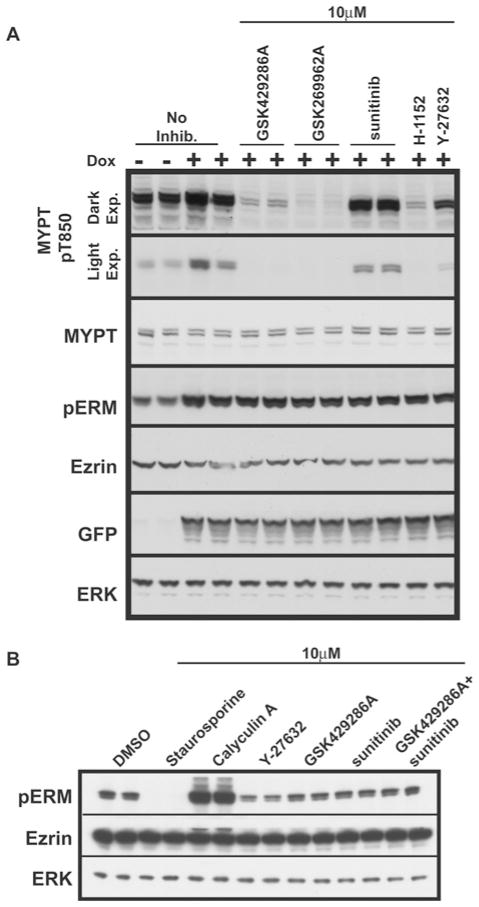 esting the efficacy of LRRK2 and ROCK inhibitorsin vivo. |
|---|
Characterization of ROCK inhibitors as LRRK2 inhibitors.Biochem J.2009 Oct 23;424(1):47-60. |
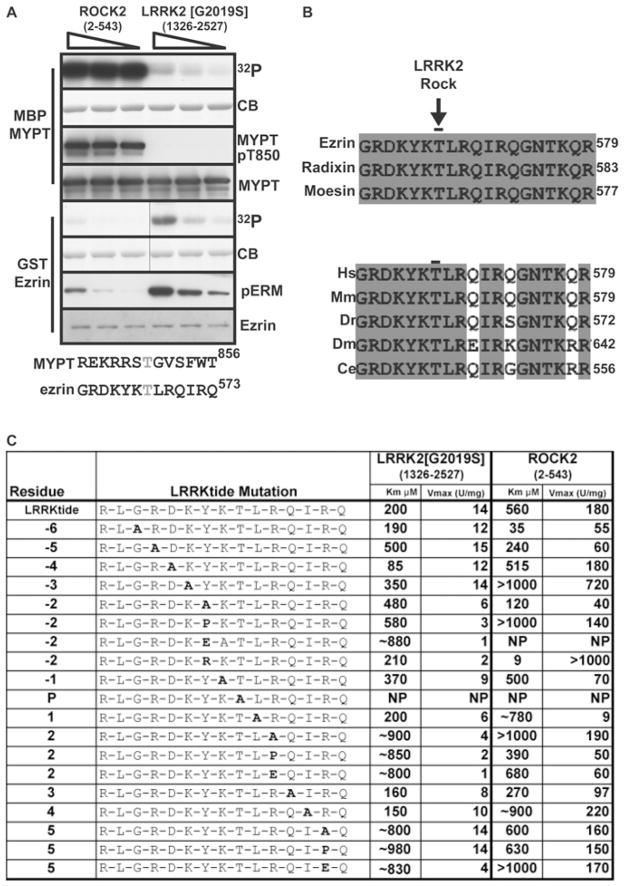 Comparison of ROCK substrates as substrates for LRRK2.Biochem J.2009 Oct 23;424(1):47-60. |
Products are for research use only; We do not sell to patients
Copyright 2020 InvivoChem LLC | All Rights Reserved


 COA
COA