| Size | Price | Stock | Qty |
|---|---|---|---|
| 5mg |
|
||
| 10mg |
|
||
| 25mg |
|
||
| 50mg | |||
| Other Sizes |
Purity: ≥98%
| Targets |
Fmk's primary target is p90 ribosomal protein S6 kinase 2 (RSK2). It inhibits RSK2 with an IC50 of 15 nM. It shows >600-fold selectivity for wild-type RSK2 over the C436V mutant and >200-fold selectivity over the T493M mutant.
|
|---|---|
| ln Vitro |
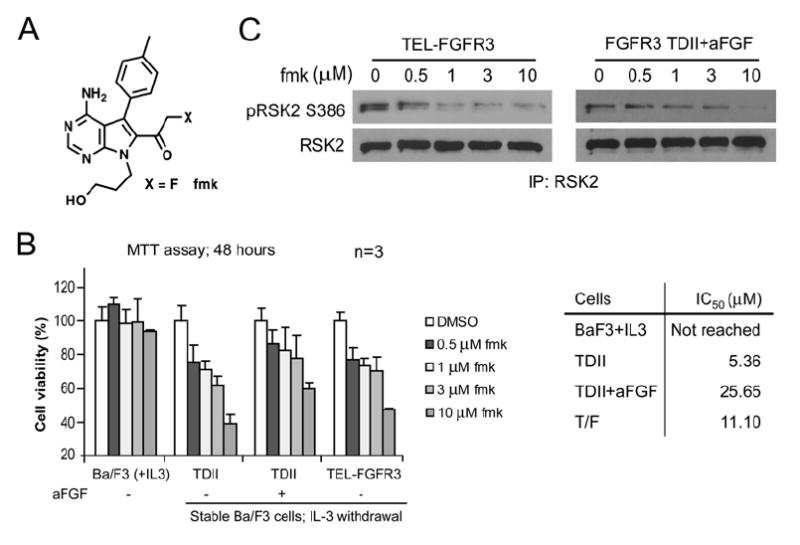
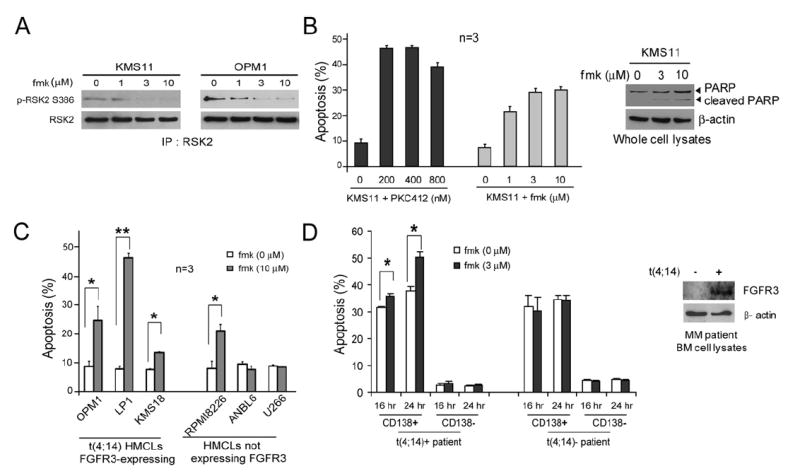
The pretreatment of ARVM with 3 μM fmk reduced the increase in phosphorylation of Ser386 but did not affect the increase in phosphorylation of Thr577 [1]. Only a small number of the protein kinases on the panel are inhibited by FMK; nevertheless, it does inhibit S6K1 as well as protein tyrosine kinases including Src, Lck, Yes, and Eph-A2. FMK will not inhibit RSK if the N-terminal kinase domain is activated by a mechanism distinct from that of the C-terminal domain[2]. In mammalian cells, Fmk strongly and selectively inhibits RSK1 and RSK2's CTD autokinase activity. By specifically targeting RSK2 with the small molecule RSK inhibitor fmk, FGFR3-induced cytokine-independent proliferation in Ba/F3 cells was inhibited. The cytokine-independent proliferation of Ba/F3 cells that FGFR3 confers is inhibited by FMK [3].
In vitro, Fmk is a potent and selective inhibitor of RSK2. It inhibits the C-terminal domain (CTD) kinase activity of RSK2. It also inhibits EGF-induced phosphorylation of RSK2 Ser386 in serum-starved COS-7 cells with an EC50 of approximately 200 nM. Fmk at 6 µM reduces invasion. |
| ln Vivo |
Specific in vivo activity data for Fmk is not detailed in the provided search results. As a research tool for studying RSK2 signaling, its primary application is in in vitro and cell-based assays.
|
| Enzyme Assay |
The in vitro activity of Fmk is assessed using cell-free kinase assays. Recombinant RSK2 enzyme is incubated with a substrate peptide and ATP in the presence of varying concentrations of Fmk. The phosphorylation of the substrate is measured to determine the IC50.
|
| Cell Assay |
For cellular assays, cells such as serum-starved COS-7 cells are used. Cells are treated with various concentrations of Fmk, and the phosphorylation of RSK2 Ser386 is analyzed by Western blotting using a phospho-specific antibody. The effect on cell invasion can also be assessed.
|
| Animal Protocol |
In vivo studies for Fmk are not described in the provided search results. As a research compound, its effects are primarily studied in cellular models to investigate the role of RSK2 in various biological processes.
|
| ADME/Pharmacokinetics |
Fmk has a molecular weight of 342.37 g/mol and a molecular formula of C18H19FN4O2. Its IUPAC name is 1-[4-Amino-7-(3-hydroxypropyl)-5-(4-methylphenyl)-7H-pyrrolo[2,3-d]pyrimidin-6-yl]-2-fluoroethanone.
|
| Toxicity/Toxicokinetics |
Specific toxicity data for Fmk is not available in the provided search results. As a research chemical, standard laboratory safety precautions should be followed when handling the compound. Its safety profile has not been fully established.
|
| References |
|
| Additional Infomation |
FMK belongs to the pyrrole class of compounds.
Fmk is a research compound used to study the role of RSK2 in cellular signaling, invasion, and cancer. Its high potency and selectivity for RSK2 make it a valuable tool for investigating the functions of this kinase. It is not approved for clinical use. |
| Molecular Formula |
C18H19FN4O2
|
|---|---|
| Molecular Weight |
342.367467164993
|
| Exact Mass |
342.149
|
| CAS # |
821794-92-7
|
| Related CAS # |
CMK;821794-90-5;FMK-MEA;1414811-15-6
|
| PubChem CID |
644243
|
| Appearance |
White to light yellow solid powder
|
| Density |
1.36g/cm3
|
| Boiling Point |
633.3ºC at 760 mmHg
|
| Flash Point |
336.8ºC
|
| Index of Refraction |
1.649
|
| LogP |
3.104
|
| Hydrogen Bond Donor Count |
2
|
| Hydrogen Bond Acceptor Count |
6
|
| Rotatable Bond Count |
6
|
| Heavy Atom Count |
25
|
| Complexity |
458
|
| Defined Atom Stereocenter Count |
0
|
| SMILES |
FCC(C1=C(C2=C(N=CN=C2N1CCCO)N)C3=CC=C(C=C3)C)=O
|
| InChi Key |
IKLGYJACVCXYIL-UHFFFAOYSA-N
|
| InChi Code |
InChI=1S/C18H19FN4O2/c1-11-3-5-12(6-4-11)14-15-17(20)21-10-22-18(15)23(7-2-8-24)16(14)13(25)9-19/h3-6,10,24H,2,7-9H2,1H3,(H2,20,21,22)
|
| Chemical Name |
1-[4-amino-7-(3-hydroxypropyl)-5-(4-methylphenyl)pyrrolo[2,3-d]pyrimidin-6-yl]-2-fluoroethanone
|
| HS Tariff Code |
2934.99.9001
|
| Storage |
Powder -20°C 3 years 4°C 2 years In solvent -80°C 6 months -20°C 1 month Note: Please store this product in a sealed and protected environment (e.g. under nitrogen), avoid exposure to moisture. |
| Shipping Condition |
Room temperature (This product is stable at ambient temperature for a few days during ordinary shipping and time spent in Customs)
|
| Solubility (In Vitro) |
DMSO : ~50 mg/mL (~146.04 mM)
|
|---|---|
| Solubility (In Vivo) |
Solubility in Formulation 1: ≥ 2.5 mg/mL (7.30 mM) (saturation unknown) in 10% DMSO + 40% PEG300 + 5% Tween80 + 45% Saline (add these co-solvents sequentially from left to right, and one by one), clear solution.
For example, if 1 mL of working solution is to be prepared, you can add 100 μL of 25.0 mg/mL clear DMSO stock solution to 400 μL PEG300 and mix evenly; then add 50 μL Tween-80 to the above solution and mix evenly; then add 450 μL normal saline to adjust the volume to 1 mL. Preparation of saline: Dissolve 0.9 g of sodium chloride in 100 mL ddH₂ O to obtain a clear solution. Solubility in Formulation 2: ≥ 2.5 mg/mL (7.30 mM) (saturation unknown) in 10% DMSO + 90% Corn Oil (add these co-solvents sequentially from left to right, and one by one), clear solution. For example, if 1 mL of working solution is to be prepared, you can add 100 μL of 25.0 mg/mL clear DMSO stock solution to 900 μL of corn oil and mix evenly. (Please use freshly prepared in vivo formulations for optimal results.) |
| Preparing Stock Solutions | 1 mg | 5 mg | 10 mg | |
| 1 mM | 2.9208 mL | 14.6041 mL | 29.2082 mL | |
| 5 mM | 0.5842 mL | 2.9208 mL | 5.8416 mL | |
| 10 mM | 0.2921 mL | 1.4604 mL | 2.9208 mL |
*Note: Please select an appropriate solvent for the preparation of stock solution based on your experiment needs. For most products, DMSO can be used for preparing stock solutions (e.g. 5 mM, 10 mM, or 20 mM concentration); some products with high aqueous solubility may be dissolved in water directly. Solubility information is available at the above Solubility Data section. Once the stock solution is prepared, aliquot it to routine usage volumes and store at -20°C or -80°C. Avoid repeated freeze and thaw cycles.
Calculation results
Working concentration: mg/mL;
Method for preparing DMSO stock solution: mg drug pre-dissolved in μL DMSO (stock solution concentration mg/mL). Please contact us first if the concentration exceeds the DMSO solubility of the batch of drug.
Method for preparing in vivo formulation::Take μL DMSO stock solution, next add μL PEG300, mix and clarify, next addμL Tween 80, mix and clarify, next add μL ddH2O,mix and clarify.
(1) Please be sure that the solution is clear before the addition of next solvent. Dissolution methods like vortex, ultrasound or warming and heat may be used to aid dissolving.
(2) Be sure to add the solvent(s) in order.
|
|
Products are for research use only; We do not sell to patients
Copyright 2020 InvivoChem LLC | All Rights Reserved


 COA
COA