| Size | Price | Stock | Qty |
|---|---|---|---|
| 50mg |
|
||
| 100mg |
|
||
| 250mg |
|
||
| 500mg |
|
||
| 1g |
|
||
| 2g | |||
| 10g | |||
| Other Sizes |


Purity: ≥98%
Eltrombopag Olamine (SB-497115-GR, SB497115; trade names: Promacta; Revolade), the olamine salt of Eltrombopag which is a member of the biarylhydrazone compounds, is a nonpeptide agonist of the thrombopoietin receptor (TpoR) approved as a medication to treat thrombocytopenia and severe aplastic anemia.
| Targets |
Thrombopoietin receptor (TpoR)
|
|---|---|
| ln Vitro |
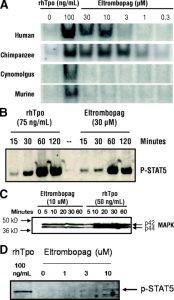
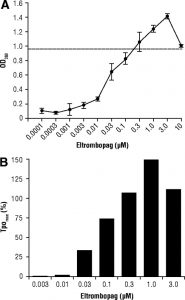
When luciferase reporter gene is transfected into murine BAF3 cells, eltrombopag (0.002-50 μM; 4 h) exhibits activity[1]. In N2C-Tpo cells, eltrombopag (30 μM; 120 min) had an impact on p-STAT5 activation[1]. In megakaryocytes, eltrombopag (30 μM; 120 min) stimulates p-STAT5[1]. The proliferation of BAF3/hTpoR cells is stimulated by eltrombopag (0.1 nM-10 μM; 30 min)[1]. Bone marrow CD34+ cells are more likely to differentiate into CD41+ megakaryocytes when treated with elotrombopag (0.03-3 μM) for ten days[1]. N2C-Tpo cell apoptosis is impacted by eltrombopag (0-3 μM; 72 h)[1]. With a MIC50 of 0.3 mg/L, eloxacoum effectively suppresses the growth of pneumococcal bacteria, while it has no effect on Gram-negative bacteria[3]. With a MIC50 of 1.5 mg/L, eltrombopag (0-200 mg/L; 24 h) suppresses the development of Staphylococcus aureus. When combined with vancomycin, which has a MIC50 of 1.2 mg/L, eltrombopag's potency is increased[3]. Eltrombopag strongly promotes G0/G1 phase arrest in Huh7 cells (0 or 10 μg/mL; 72 h)[5]. Eltrombopag has anti-proliferative effect against HCC cell lines at concentrations of 0.1-100 μg/mL for 72 hours[5].
|
| ln Vivo |
In chimpanzees, eltrombopag Olamine (10 mg/kg; po once daily for five days) exhibits good tolerance[1]. Mean S is greatly decreased by elotrombopag Olamine (17.6 mg/kg; IP; once daily for two days). Mouse nasal infections with numbers of aureus[3].
The in vivo activity of eltrombopag was demonstrated by an increase of up to 100% in platelet numbers when administered orally (10 mg/kg per day for 5 days) to chimpanzees. In conclusion, eltrombopag interacts selectively with the TpoR without competing with Tpo, leading to the increased proliferation and differentiation of human bone marrow progenitor cells into megakaryocytes and increased platelet production. These results suggest that eltrombopag and Tpo may be able to act additively to increase platelet production.[1] Repeat Dose Study in Chimpanzees [1] Given the distinct species specificity for STAT activation exhibited by eltrombopag in human and chimpanzee platelets, a 5-day, repeat-dose safety and pharmacology study was conducted in five female chimpanzees. Chimpanzees were administered either vehicle alone (n = 2) or eltrombopag in vehicle (n = 3; 10 mg/kg per day) by oral gavage. Administration of eltrombopag was well tolerated following repeat oral doses. There were no adverse effects on hematology, coagulation, or clinical chemistry parameters. In chimpanzees treated with eltrombopag, platelet counts were increased over twofold approximately 1 week after the last dose for one chimpanzee and approximately 1.5-fold for the other two chimpanzees. Platelet counts returned to near baseline values approximately 2 weeks after peak values were reached (Fig. 6). |
| Enzyme Assay |
Luciferase Reporter Gene Assay [1]
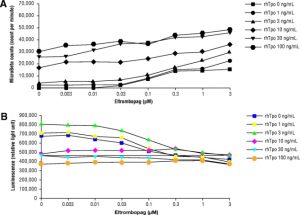
BAF3/hTpoR or 32D-mpl cells were washed and starved of rmIL-3 or rhTpo overnight prior to treatment. Starved parental BAF3 cells (1 × 10⁵ cells/ml) in Iscove's modified Dulbecco's medium (IMDM)/0.5% fetal bovine serum (FBS) and 30 μM ZnCl2 were treated with Eltrombopag (0.002–50 μM) or rhTpo (100 ng/ml) at 37°C, 5% CO2, for 4 hours. Cells were lysed in 100 μl lysis buffer (25 mM tris, 15% glycerol, 2% 3-[(3-cholamidopropyl)dimethylammonio]-1-propanesulfonic acid, 1% lecithin, 1% bovine serum albumin, 4 mM EGTA, 8 mM MgCl2, 10 mM dithiothreitol, and 0.4 mM phenylmethylsulfonyl fluoride, pH 7.8) for 15 minutes and added to a 96-well plate (30 μl per well). Promega Steady Glow (100 μl) was added to each well immediately before the plates were read using a chemiluminometer. Luciferase assay data are presented as the mean and standard error of quadruplicate wells. Caspase-3 and Caspase-7 Assays [1] The Caspase-Glo 3/7 assay (Promega) is a luminescent assay that measures caspase-3 and caspase-7 activity. The addition of the Caspase-Glo reagent results in cell lysis, followed by caspase cleavage of the substrate and generation of a luminescent signal; the amount of luminescence is proportional to the amount of caspase present. Cytokine-starved N2C-Tpo cells (1.4 × 10⁵ cells/ml final concentration) were grown in a white view plate and exposed to Eltrombopag (0.003–3 μM) and/or rhTpo (1–100 ng/ml) for 72 hours at 37°C. Caspase-Glo (100 μl) was added, and cells were incubated for 90 minutes at room temperature. |
| Cell Assay |
Cell Viability Assay[1]
Cell Types: Murine BAF3 cells Tested Concentrations: 0.002-50 μM Incubation Duration: 4 hrs (hours) Experimental Results: Effectively inhibited murine BAF3 cells with human TpoR with an EC50 value of 0.27 μM. Western Blot Analysis[1] Cell Types: N2C-Tpo cells and CD34+ Tested Concentrations: 30 μM for N2C-Tpo cells; 0, 1, 3 and 10 μM for CD34+ Incubation Duration: 120 min for N2C- Tpo cells; 30 min for CD34+ Experimental Results: Activated phospho-STAT5 and maximum signal intensity demonstrated at 60 minutes after treatment in N2C-Tpo cells. Dose-dependently activated STAT5 phosphorylation at 30 minutes after treatment in CD34+. Cell Proliferation Assay[1] Cell Types: BAF3/hTpoR cells Tested Concentrations: 0.1 nM-10 μM Incubation Duration: 2 days Experimental Results: Promoted BAF3/hTpoR cells proliferation after incubated for 2 days with an EC50 of 0.03 μM. Cell Differentiation Assay[1] Cell Types: CD34+ Tested Concentrations: 0.003, 0.01, 0.03, 0.1, 0.3, 1 and 3 μM Incubation Duration: 10 days Experimental Results: Dose-dependently stimulated the differentiation from bone m |
| Animal Protocol |
Animal/Disease Models: Female chimpanzees[1]
Doses: 10 mg/kg Route of Administration: po (oral gavage); 10 mg/kg one time/day; for 5 days Experimental Results: Appeared a goes up and then goes back tendency of platelet counts after treatment, and demonstrated no bad effects of hematology, coagulation, or clinical chemistry parameters on animal. Animal/Disease Models: C57BL/6 male mice (7 weeks, 20-22 g; injected S. aureus (5 × 10⁸ CFU suspended in 40 µL PBS) into the nasal cavities)[3] Doses: 17.6 mg/kg Route of Administration: IP; one time/day for 2 days Experimental Results: Dramatically decreased mean bacterial counts (5.0 × 10⁶ CFU/lung) in the nasal infection model compared with control PBS (5.2 × 10⁷ CFU/lung) mice. Female chimpanzees (approximately 7–8 years of age) were given either Eltrombopag (10 mg/kg) in aqueous 2% hydroxypropyl methylcellulose with 0.2% sodium lauryl sulfate vehicle or vehicle alone by oral gavage at a dose volume of 1 ml/kg. Chimpanzees were given five daily doses of vehicle alone (n = 2) or Eltrombopag (n = 3). Platelet counts and reticulated platelet counts were performed prior to, during, and following the treatment regimen. At the end of the study, all chimpanzees were returned to the stock colony.[1] |
| ADME/Pharmacokinetics |
Although limited pharmacokinetic sampling was conducted on only three chimpanzees, the data showed that in chimpanzees, the pharmacodynamic signal of eltrombopag causing a change in platelet count from baseline was detected at the lowest concentration (Cmin), highest concentration (Cmax), and area under the curve (AUC) of approximately 0.107 μg/ml, 0.525 μg/ml, and 12.1 μg·h/ml, respectively. [1]
|
| Toxicity/Toxicokinetics |
Effects During Pregnancy and Lactation
◉ Overview of Use During Lactation Limited information exists regarding the use of eltrombopag during lactation. One case of a breastfed infant being born with thrombocytosis may have been linked to eltrombopag in breast milk. Until more data are available, infants' blood parameters should be closely monitored during lactation, especially in newborns or preterm infants. The manufacturer recommends avoiding breastfeeding while taking eltrombopag. Based on the drug's half-life, the mother should be able to clear the drug from her body within 8 days of the last dose. ◉ Effects on Breastfed Infants A mother took eltrombopag during pregnancy at a maximum dose of 100 mg and subsequently gave birth to an infant with thrombocytosis that persisted for several weeks while the mother was breastfeeding. The extent of breastfeeding and the mother's dosage were not mentioned. The authors believe that the persistence of thrombocytosis in the infant was likely due to eltrombopag in the breast milk. ◉ Impact on breastfeeding and breast milk As of the revision date, no relevant published information was found. |
| References |
|
| Additional Infomation |
See also: Eltrombopag Olamine (note moved to).
Drug Indications Revolade is indicated for the treatment of adult patients with primary immune thrombocytopenic purpura (ITP) who are unresponsive to other treatments (e.g., corticosteroids, immunoglobulins) (see Sections 4.2 and 5.1). Revolade is indicated for the treatment of pediatric patients aged 1 year and older with a disease duration of 6 months or longer from diagnosis who are unresponsive to other treatments (e.g., corticosteroids, immunoglobulins) (see Sections 4.2 and 5.1). Revolade is indicated for the treatment of thrombocytopenia in adult patients with chronic hepatitis C virus (HCV) infection, where the degree of thrombocytopenia is a major factor preventing the initiation or limitation of maintenance optimal interferon therapy (see Sections 4.4 and 5.1). Revolade is indicated for adult patients with acquired severe aplastic anemia (SAA) who have failed prior immunosuppressive therapy or have received extensive pretreatment and are ineligible for hematopoietic stem cell transplantation (see Section 5.1). Eltrombopag is a hydrazine compound in which each nitrogen atom is substituted, with one nitrogen atom replaced by a 3'-carboxy-2-hydroxy[1,1'-biphenyl]-3-yl and the other nitrogen atom replaced by a 1-(3,4-dimethylphenyl)-3-methyl-5-oxo-1,5-dihydro-4H-pyrazole-4-subunit. Eltrombopag is a small molecule c-mpl (TpoR) receptor agonist (TpoR is the physiological target of thrombopoietin) and has been developed for the treatment of conditions such as thrombocytopenia (abnormally low platelet count). It is both a thrombopoietin receptor agonist and an exogenous substance. It belongs to the hydrazine, pyrazole, and benzoic acid classes. Eltrombopag is a thrombopoietin receptor agonist. Eltrombopag's mechanism of action is as a thrombopoietin receptor agonist, an inhibitor of organic anion transport peptide 1B1, an inhibitor of breast cancer resistance protein, an inhibitor of UGT1A1, UGT1A3, UGT1A4, UGT1A6, UGT1A9, UGT2B7, and UGT2B15. Eltrombopag's physiological effects are achieved by promoting megakaryocyte maturation and increasing platelet production. See also: Romilastine (note moved to) Eltrombopag (note moved to). Indications Revolad is indicated for the treatment of adult patients with primary immune thrombocytopenic purpura (ITP) who have not responded to other treatments (e.g., corticosteroids, immunoglobulins) (see Sections 4.2 and 5.1). Revolade is indicated for the treatment of children aged 1 year and older with primary immune thrombocytopenic purpura (ITP) with a disease duration of 6 months or longer from diagnosis who have failed other treatments (e.g., corticosteroids, immunoglobulins) (see Sections 4.2 and 5.1). Revolade is indicated for the treatment of thrombocytopenia in adult patients with chronic hepatitis C virus (HCV) infection where the degree of thrombocytopenia is a major factor preventing the initiation or limiting of maintenance optimal interferon therapy (see Sections 4.4 and 5.1). Revolade is also indicated for adult patients with acquired severe aplastic anemia (SAA) who have failed prior immunosuppressive therapy or have received extensive pretreatment and are ineligible for hematopoietic stem cell transplantation (see Section 5.1). Eltrombopag is a first-in-class, orally bioavailable, small-molecule, non-peptide thrombopoietin receptor (TpoR) agonist currently under development for the treatment of thrombocytopenia of various etiologies. In vitro studies have shown that the activity of eltrombopag depends on the expression of TpoR, which can activate the signal transduction and transcription activator (STAT) and mitogen-activated protein kinase (MAPK) signal transduction pathways. This preclinical study aimed to determine whether eltrombopag selectively interacts with TpoR to promote the differentiation of megakaryocytes in platelets. Its thrombolytic function was confirmed by the proliferation and differentiation of primary human CD34(+) bone marrow cells into CD41(+) megakaryocytes. Platelet measurements in multiple species showed that eltrombopag specifically activates the STAT pathway in humans and chimpanzees only. [1] The continued rise in antibiotic resistance urgently requires new therapeutics to protect human health. Drug repositioning is an attractive strategy that can significantly shorten the time to bring new antibiotics to the clinic. We screened 182 FDA-approved drugs to find potential antibiotic candidates against Staphylococcus aureus, a major pathogen. The screening results showed that three small molecule drugs had significant antibacterial activity against Staphylococcus aureus: (1) LDK378 (ceretinib), an anaplastic lymphoma kinase (ALK) inhibitor used to treat lung cancer; (2) dronedarone hydrochloride, an antiarrhythmic drug used to treat atrial fibrillation; and (3) eltrombopag, a thrombopoietin receptor agonist used to treat thrombocytopenia. Among them, eltrombopag not only showed the highest antibacterial activity against a drug-sensitive Staphylococcus aureus strain, but also showed the highest antibacterial activity against 55 clinical isolates, including 35 methicillin-resistant Staphylococcus aureus strains (minimum inhibitory concentration [MIC50] = 1.4-3.2 mg/L). In addition, we also demonstrated that eltrombopag inhibited bacterial growth and reduced bacterial load in infected mice in a cell infection model, indicating its potential as a novel anti-Staphylococcus aureus antibiotic that can overcome the current problem of antibiotic resistance. [3] Staphylococcus epidermidis is a common pathogen causing hospital-acquired infections. It readily adheres to medical devices, forming biofilms composed of highly resistant, persistent cells. The development of novel antimicrobial agents is crucial due to the refractory infections caused by Staphylococcus epidermidis biofilms and persistent cells in immunosuppressed patients. This study analyzed the antimicrobial effects of the thrombopoietin receptor agonist eltrombopag (EP) on Staphylococcus epidermidis planktling cells, biofilms, and persistent cells. EP exhibited significant toxicity to Staphylococcus epidermidis, with a minimum inhibitory concentration of 8 μg/ml, and effectively inhibited the growth of biofilms and persistent cells in a strain-dependent manner. Furthermore, EP showed only mild toxicity to mammalian cells 12 to 24 hours after treatment. EP showed partial synergistic effects against Staphylococcus epidermidis when used in combination with vancomycin, enhancing its antimicrobial efficacy and reducing its toxicity to mammalian cells. In conclusion, EP is a potential antibiotic for treating refractory infections caused by Staphylococcus epidermidis. [4] Currently, sorafenib is the only chemotherapy drug available for the treatment of advanced hepatocellular carcinoma (HCC), but it cannot be used in patients with cirrhosis (LC) or thrombocytopenia. In these cases, sorafenib may be effective when used in combination with treatments that increase platelet counts, such as thrombopoietin (TPO) receptor agonists. Increasing platelet counts through TPO therapy can reduce the degree of cirrhosis. The TPO receptor agonist eltrombopag (EP) has been reported to have antitumor effects against certain cancers, even those lacking TPO receptor expression. We hypothesize that EP may have antitumor activity against HCC in addition to inhibiting liver fibrosis by increasing platelet counts. This study investigated the antitumor activity of EP by evaluating its inhibitory effect on the proliferation of HepG2, Hep3B, and Huh7 cells and exploring whether iron supplementation could reverse these inhibitory effects. In addition, this study used flow cytometry for cell cycle analysis and evaluated signal transduction by analyzing the expression of cell cycle-related proteins. The antitumor activity of EP was compared with that of deferoxamine (DFO), the most commonly used iron chelator. In addition, the efficacy of EP in combination with sorafenib was also evaluated. The results showed that EP exerts its antitumor activity against hepatocellular carcinoma (HCC) by regulating intracellular iron content. EP inhibits the expression of the cell cycle-related protein cyclin D1 and induces cell cycle arrest at the G0/G1 phase. The activity of EP in HCC is comparable to that of DFO and does not compete with sorafenib at low concentrations. In conclusion, our results suggest that EP is a good candidate chemotherapy drug for the treatment of HCC in patients with cirrhosis and thrombocytopenia. [5] |
| Molecular Formula |
C29H36N6O6
|
|---|---|
| Molecular Weight |
564.63
|
| Exact Mass |
564.269
|
| Elemental Analysis |
C, 61.69; H, 6.43; N, 14.88; O, 17.00
|
| CAS # |
496775-62-3
|
| Related CAS # |
Eltrombopag;496775-61-2;(E/Z)-Eltrombopag-13C4;1217230-31-3
|
| PubChem CID |
135449331
|
| Appearance |
Purple to black solid powder
|
| LogP |
3.127
|
| Hydrogen Bond Donor Count |
7
|
| Hydrogen Bond Acceptor Count |
11
|
| Rotatable Bond Count |
7
|
| Heavy Atom Count |
41
|
| Complexity |
822
|
| Defined Atom Stereocenter Count |
0
|
| SMILES |
O=C(C1=CC(C2=CC=CC(N/N=C3C(C)=NN(C4=CC=C(C)C(C)=C4)C/3=O)=C2O)=CC=C1)O.NCCO.NCCO
|
| InChi Key |
PLILLUUXAVKBPY-SBIAVEDLSA-N
|
| InChi Code |
InChI=1S/C25H22N4O4.2C2H7NO/c1-14-10-11-19(12-15(14)2)29-24(31)22(16(3)28-29)27-26-21-9-5-8-20(23(21)30)17-6-4-7-18(13-17)25(32)33;2*3-1-2-4/h4-13,26,30H,1-3H3,(H,32,33);2*4H,1-3H2/b27-22-
|
| Chemical Name |
(Z)-3-(2-(1-(3,4-dimethylphenyl)-3-methyl-5-oxo-1,5-dihydro-4H-pyrazol-4-ylidene)hydrazinyl)-2-hydroxy-[1,1-biphenyl]-3-carboxyiic acid;2-aminoethan-1-ol (1:2)
|
| Synonyms |
SB-497115-GR Ethanolamine, SB497115GR; Eltrombopag ethanolamine; Eltrombopag Mono-Ethanolamine; CHEMBL461806; SCHEMBL2236368; SCHEMBL2236372; SB497115; SB-497115; SB 497115; trade name: PROMACTA
|
| HS Tariff Code |
2934.99.9001
|
| Storage |
Powder -20°C 3 years 4°C 2 years In solvent -80°C 6 months -20°C 1 month Note: Please store this product in a sealed and protected environment, avoid exposure to moisture. |
| Shipping Condition |
Room temperature (This product is stable at ambient temperature for a few days during ordinary shipping and time spent in Customs)
|
| Solubility (In Vitro) |
DMSO: 89 mg/mL (157.6 mM)
Water: 1 mg/mL (Insoluble) Ethanol: 1 mg/mL |
|---|---|
| Solubility (In Vivo) |
Solubility in Formulation 1: ≥ 1.07 mg/mL (1.90 mM) (saturation unknown) in 10% DMSO + 40% PEG300 + 5% Tween80 + 45% Saline (add these co-solvents sequentially from left to right, and one by one), clear solution.
For example, if 1 mL of working solution is to be prepared, you can add 100 μL of 10.7 mg/mL clear DMSO stock solution to 400 μL of PEG300 and mix evenly; then add 50 μL of Tween-80 to the above solution and mix evenly; then add 450 μL of normal saline to adjust the volume to 1 mL. Preparation of saline: Dissolve 0.9 g of sodium chloride in 100 mL ddH₂ O to obtain a clear solution. Solubility in Formulation 2: 1.07 mg/mL (1.90 mM) in 10% DMSO + 90% (20% SBE-β-CD in Saline) (add these co-solvents sequentially from left to right, and one by one), suspension solution; with ultrasonication. For example, if 1 mL of working solution is to be prepared, you can add 100 μL of 10.7 mg/mL clear DMSO stock solution to 900 μL of 20% SBE-β-CD physiological saline solution and mix evenly. Preparation of 20% SBE-β-CD in Saline (4°C,1 week): Dissolve 2 g SBE-β-CD in 10 mL saline to obtain a clear solution. View More
Solubility in Formulation 3: 10 mg/mL (17.71 mM) in 50% PEG300 50% Saline (add these co-solvents sequentially from left to right, and one by one), suspension solution; with ultrasonication (<60°C). |
| Preparing Stock Solutions | 1 mg | 5 mg | 10 mg | |
| 1 mM | 1.7711 mL | 8.8554 mL | 17.7107 mL | |
| 5 mM | 0.3542 mL | 1.7711 mL | 3.5421 mL | |
| 10 mM | 0.1771 mL | 0.8855 mL | 1.7711 mL |
*Note: Please select an appropriate solvent for the preparation of stock solution based on your experiment needs. For most products, DMSO can be used for preparing stock solutions (e.g. 5 mM, 10 mM, or 20 mM concentration); some products with high aqueous solubility may be dissolved in water directly. Solubility information is available at the above Solubility Data section. Once the stock solution is prepared, aliquot it to routine usage volumes and store at -20°C or -80°C. Avoid repeated freeze and thaw cycles.
Calculation results
Working concentration: mg/mL;
Method for preparing DMSO stock solution: mg drug pre-dissolved in μL DMSO (stock solution concentration mg/mL). Please contact us first if the concentration exceeds the DMSO solubility of the batch of drug.
Method for preparing in vivo formulation::Take μL DMSO stock solution, next add μL PEG300, mix and clarify, next addμL Tween 80, mix and clarify, next add μL ddH2O,mix and clarify.
(1) Please be sure that the solution is clear before the addition of next solvent. Dissolution methods like vortex, ultrasound or warming and heat may be used to aid dissolving.
(2) Be sure to add the solvent(s) in order.
|
|---|
|
|
Products are for research use only; We do not sell to patients
Copyright 2020 InvivoChem LLC | All Rights Reserved


 COA
COA