| Size | Price | Stock | Qty |
|---|---|---|---|
| 1mg |
|
||
| 5mg |
|
||
| 10mg |
|
||
| 25mg |
|
||
| 50mg |
|
||
| 100mg |
|
||
| 250mg | |||
| Other Sizes |


Purity: ≥98%
| Targets |
Escherichia coli LpxC(Ki= 4 nM)
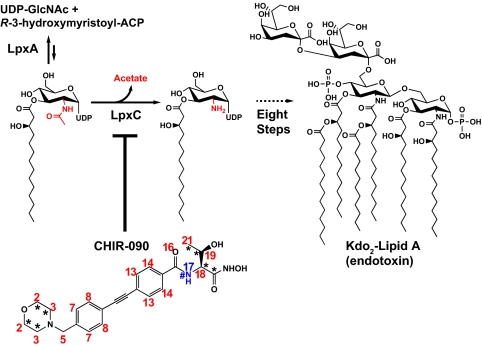
CHIR-090 targets UDP-3-O-(R-3-hydroxymyristoyl)-N-acetylglucosamine deacetylase (LpxC) (Ki = 0.3 nM for Escherichia coli LpxC, IC50 = 1.8 nM for Pseudomonas aeruginosa LpxC) [1] CHIR-090 targets LpxC (time-dependent inhibitor, Ki = 0.012 nM for Escherichia coli LpxC) [2] CHIR-090 targets LpxC (MIC = 0.25 μg/mL for planktonic Pseudomonas aeruginosa, MBIC90 = 4 μg/mL for Pseudomonas aeruginosa biofilm) [3] |
|---|---|
| ln Vitro |
Disk diffusion assays have demonstrated that CHIR-090 has excellent antibiotic activity against P. aeruginosa and E. coli. It is a potent, slow, tight-binding inhibitor of the LpxC deacetylase from the hyperthermophile Aquifex aeolicus. Another two-step slow, tight-binding inhibitor of Escherichia coli LpxC with a Ki value of 4 nM is CHIR-090. Low nanometer concentrations of CHIR-090 inhibit LpxC orthologues from a variety of Gram-negative pathogens, such as Helicobacter pylori, Neisseria meningitidis, and Pseudomonas aeruginosa.On the other hand, Rhizobium leguminosarum (Ki=340 nM), a Gram-negative plant endosymbiont that is resistant to this compound, is resistant to LpxC from CHIR-090, a relatively weak competitive and conventional inhibitor (lacking slow, tight-binding kinetics). An E. Coli construct resistant to CHIR-090 up to 100 μg/mL, or 400 times higher than the minimal inhibitory concentration for wild-type E. Coli, has the chromosomal lpxC gene substituted with R. leguminosarum lpxC. The highly effective, slow-acting, tight-binding inhibitor CHIR-090 inhibits Aquifex aeolicus LpxC, whose sequence is 31% identical to that of E. coli LpxC. Disk diffusion assays have demonstrated that CHIR-090 possesses antibiotic activity against E. coli and P. aeruginosa that is comparable to that of ciprofloxacin[1].
1. CHIR-090 inhibited the growth of Escherichia coli with an MIC of 0.06 μg/mL; treatment with CHIR-090 led to a dose-dependent decrease in lipid A biosynthesis in Escherichia coli, as measured by [³H]acetate incorporation into lipid A [1] 2. CHIR-090 caused rapid depletion of lipid A in Escherichia coli (within 15 min of exposure), accompanied by accumulation of the LpxC substrate UDP-3-O-(R-3-hydroxymyristoyl)-N-acetylglucosamine and reduction of downstream lipid A precursors [1] 3. CHIR-090 showed time-dependent inhibition of Escherichia coli LpxC activity; the inhibitory potency increased over time (kobs/[I] = 0.048 μM⁻¹s⁻¹), and the inhibition was irreversible under experimental conditions [2] 4. X-ray crystallography revealed that CHIR-090 bound to the active site of LpxC, forming a covalent adduct with the zinc ion in the catalytic center and interacting with conserved residues (His79, Asp247) in the active site [2] 5. CHIR-090 exhibited antibacterial activity against planktonic Pseudomonas aeruginosa with an MIC range of 0.125-0.5 μg/mL (MIC50 = 0.25 μg/mL); it inhibited Pseudomonas aeruginosa biofilm formation with an MBIC50 of 2 μg/mL and MBIC90 of 4 μg/mL [3] 6. Combination of CHIR-090 with colistin showed synergistic antibacterial activity against planktonic Pseudomonas aeruginosa (FICI = 0.375-0.5) and synergistic inhibition of Pseudomonas aeruginosa biofilm formation (FICI = 0.375-0.75) [3] 7. CHIR-090 reduced the viability of preformed Pseudomonas aeruginosa biofilms with an MBEC50 of 8 μg/mL and MBEC90 of 16 μg/mL; combination with colistin further reduced MBEC values (MBEC50 = 2 μg/mL, MBEC90 = 4 μg/mL) [3] |
| ln Vivo |
Strong against E. coli, CHIR-090 suppresses E. coli LpxC activity in vitro at low nanometers (nM). Without prior chemical mutagenesis, E. Coli W3110 colonies resistant to 1 μg/mL CHIR-090 are not observed. On LB agar plates containing 1 to 10 μg/mL CHIR-090, a strain of E. coli W3110 can grow, exceeding the MIC of 0.25 μg/mL for wild-type E. coli W3110 by 4 to 40 times. In the presence of 1 μg/mL CHIR-090, W3110RL doubles in 40 minutes, which is precisely the same rate as wild-type in the absence of inhibitor. After roughly two hours in the presence of 1 μg/mL CHIR-090, wild-type cells stopped growing[1].
1. In a murine acute pneumonia model of Pseudomonas aeruginosa infection, intraperitoneal administration of CHIR-090 (10 mg/kg every 8 h for 3 days) reduced bacterial load in the lungs by 1.5 log10 CFU/g; combination with colistin (2.5 mg/kg every 8 h for 3 days) reduced bacterial load by 2.5 log10 CFU/g, showing synergistic in vivo efficacy [3] |
| Enzyme Assay |
Disk diffusion is done, but each filter contains 10 μg of each antibiotic compound. Cells from overnight cultures are inoculated into 50 mL portions of LB broth at an A600 of 0.02 and grown with shaking at 30°C to assess growth in liquid medium in the presence of CHIR-090. Once the A600 reaches 0.15, 6 μL of 500 μg/mL CHIR-090 in DMSO or 6 μL of DMSO are added to the parallel cultures. When the A600 hits0.4, cultures are kept in log phase growth by 10-fold dilution into pre-warmed medium with the same concentrations of DMSO or DMSO/CHIR-090. This allows for the assessment of cumulative growth. When inoculating at an initial density of A600=0.01, the minimal inhibitory concentration is the lowest antibiotic concentration at which no detectable bacterial growth is seen in LB medium containing 1% DMSO (v/v). Cultures are incubated with CHIR-090 for 24 hours at 30°C while being shaken. Triplicates of each experiment are carried out[1].
1. LpxC enzyme activity assays were performed using recombinant Escherichia coli LpxC and UDP-3-O-(R-3-hydroxymyristoyl)-N-acetylglucosamine as substrate; the deacetylase activity of LpxC was measured by detecting the release of acetate, and the inhibitory effect of CHIR-090 on LpxC activity was evaluated by determining IC50 and Ki values [1] 2. Time-dependent inhibition assays of LpxC were conducted by incubating CHIR-090 with recombinant Escherichia coli LpxC for different time periods (0-300 s) before adding substrate; the residual enzyme activity was measured to calculate kobs (observed rate constant) and Ki (time-dependent inhibition constant) [2] 3. X-ray crystallography was used to determine the three-dimensional structure of LpxC in complex with CHIR-090; LpxC crystals were soaked with CHIR-090, diffraction data were collected, and the structure was refined to a resolution of 1.8 Å to analyze the binding mode of CHIR-090 to LpxC [2] 4. Enzyme activity assays for Pseudomonas aeruginosa LpxC were performed using recombinant protein and specific substrate; the inhibitory activity of CHIR-090 was measured to determine IC50 values [3] |
| Cell Assay |
Antimicrobial susceptibility of biofilm-embedded cells (MBEC). [3]
The minimum biofilm eradication concentration (MBEC) values of colistin and CHIR-090 against P. aeruginosa biofilms were evaluated in triplicate, as described by Naparstek et al.. Briefly, biofilms were grown in 96-well microplates for 24 h at 37°C in MH medium and then washed twice with 0.9% NaCl to remove the planktonic cells. Attached biofilms were then subjected to treatment with combinations of different antimicrobial concentrations in a checkerboard assay format. The antimicrobial concentrations tested varied from 0 to 512 and 0 to 128 μg/ml for colistin and CHIR-090, respectively. The plates were incubated for 24 h at 37°C. After antimicrobial challenge, the wells were thoroughly washed with 0.9% NaCl to remove any antimicrobial residue. Two hundred microliters of fresh MH growth medium was added to the washed wells, and then the plates were incubated for 24 h at 37°C. MBEC values were determined to be the lowest antibiotic concentrations that prevented bacterial growth from the treated biofilm. The potential for synergy was also evaluated by calculating the index of the fractional inhibitory concentration (ΣFIC) from the resulting biofilm checkerboard assay. All experiments were performed in triplicate. 1. Escherichia coli cultures were treated with different concentrations of CHIR-090 (0-1 μg/mL); [³H]acetate was added to the culture medium, and lipid A was extracted and quantified to evaluate the effect of CHIR-090 on lipid A biosynthesis [1] 2. Planktonic Pseudomonas aeruginosa cultures were treated with CHIR-090 (0-16 μg/mL) alone or in combination with colistin (0-4 μg/mL); bacterial viability was measured by serial dilution and colony counting to determine MIC values and fractional inhibitory concentration index (FICI) [3] 3. Pseudomonas aeruginosa biofilm formation assays were conducted in 96-well plates; bacteria were cultured with CHIR-090 (0-16 μg/mL) alone or with colistin (0-4 μg/mL) for 24 h, biofilms were washed and stained with crystal violet, and absorbance was measured to calculate MBIC values [3] 4. Preformed Pseudomonas aeruginosa biofilms in 96-well plates were treated with CHIR-090 (0-32 μg/mL) alone or with colistin (0-8 μg/mL) for 24 h; viable bacteria in biofilms were quantified by serial dilution and colony counting to determine MBEC values [3] |
| Animal Protocol |
Mouse biofilm implant model of infection. [3]
Seven-week-old female BALB/c mice were used in this study. The experimental setup and preparation were conducted on the basis of the protocol described by Chua et al. In summary, PAO1 biofilms were grown on cylindrical implants (3 mm by 5 mm in diameter) in 0.9% NaCl at 37°C with shaking at 110 rpm for 20 h. After incubation, biofilm-coated implants were washed three times with 0.9% NaCl and transplanted into the peritoneum of anesthetized mice. Antibiotic regimens were injected as a single dose at the implantation site of groups of five mice. Treatments and the associated groups included the control group, which was treated with no antibiotic (injection of 0.2 ml of 0.04% DMSO); test group 1, which was treated with 10 mg kg−1 of body weight colistin (which is well below the lethal dose of 86 mg kg−1 in mice); test group 2, which was treated with 4 mg kg−1 CHIR-090; and test group 3, which was treated with 10 mg kg−1 colistin and 4 mg kg−1 CHIR-090. After 24 h, mice were euthanized and the implants were retrieved from the peritoneum and washed with 0.9% NaCl. The implants were then sonicated in an ice water bath using an Elmasonic P120H sonicator at 50% power and 37 KHz for 10 min, followed by vortexing of the samples three times for 10 s each time. The spleens were also collected and homogenized using a Bio-Gen PRO200 homogenizer (Pro Scientific, USA) at maximum power on ice. The implants and spleen tissue samples were then serially diluted in 0.9% NaCl, plated onto LB agar, and incubated overnight at 37°C. The number of CFU was calculated and plotted versus treatment using Prism (version 7.0) software). Results are presented as means ± standard deviations. 1. C57BL/6 mice were intranasally inoculated with Pseudomonas aeruginosa (1 × 10⁷ CFU/mouse) to establish an acute pneumonia model; CHIR-090 was administered intraperitoneally at 10 mg/kg every 8 h for 3 days (dissolved in 10% DMSO/90% saline), and colistin was administered intraperitoneally at 2.5 mg/kg every 8 h for 3 days (alone or in combination with CHIR-090); control mice received vehicle (10% DMSO/90% saline) [3] 2. At 72 h post-infection, mice were euthanized, lungs were homogenized, and serial dilutions of homogenates were plated on agar plates for colony counting to determine bacterial load in lung tissues [3] |
| References |
|
| Additional Infomation |
CHIR-090 is an L-threonine derivative formed by the condensation of the carboxyl group of 4-({4-[(morpholino-4-yl)methyl]phenyl}ethynyl)benzoic acid with the amino group of N-hydroxy-L-threonamide. It possesses antibacterial, lipopolysaccharide biosynthesis inhibitor, and EC 3.5.1.108 (UDP-3-O-acyl-N-acetylglucosamine deacetylase) inhibitor functions. It is an alkyne compound belonging to the morpholino group, benzamide group, L-threonine derivative, and hydroxyoxime acid group.
1. Lipid A is an important component of the outer membrane of Gram-negative bacteria, and LpxC is the rate-limiting enzyme in lipid A biosynthesis; inhibition of LpxC leads to lipid A depletion and destruction of bacterial outer membrane integrity, resulting in bacterial death [1] 2. CHIR-090 is a potent, selective, and time-dependent LpxC inhibitor with no significant inhibitory activity against other zinc-dependent metalloenzymes (such as matrix metalloproteinases and angiotensin-converting enzymes) [2] 3. Pseudomonas aeruginosa biofilm is a major cause of chronic infection and antibiotic resistance; CHIR-090 targets lipid A biosynthesis (an essential pathway for Pseudomonas aeruginosa survival) and is active against both planktonic bacteria and biofilms [3] 4. CHIR-090 exhibits synergistic antibacterial activity when used in combination with colistin (a polymyxin antibiotic that targets the bacterial outer membrane), potentially overcoming colistin resistance in Pseudomonas aeruginosa biofilms [3] |
| Molecular Formula |
C24H27N3O5
|
|
|---|---|---|
| Molecular Weight |
437.49
|
|
| Exact Mass |
437.195
|
|
| Elemental Analysis |
C, 65.89; H, 6.22; N, 9.60; O, 18.28
|
|
| CAS # |
728865-23-4
|
|
| Related CAS # |
|
|
| PubChem CID |
11546620
|
|
| Appearance |
White to off-white solid powder
|
|
| Density |
1.3±0.1 g/cm3
|
|
| Index of Refraction |
1.650
|
|
| LogP |
1.23
|
|
| Hydrogen Bond Donor Count |
4
|
|
| Hydrogen Bond Acceptor Count |
6
|
|
| Rotatable Bond Count |
8
|
|
| Heavy Atom Count |
32
|
|
| Complexity |
680
|
|
| Defined Atom Stereocenter Count |
2
|
|
| SMILES |
O1C([H])([H])C([H])([H])N(C([H])([H])C2C([H])=C([H])C(C#CC3C([H])=C([H])C(=C([H])C=3[H])C(N([H])[C@]([H])(C(N([H])O[H])=O)[C@@]([H])(C([H])([H])[H])O[H])=O)=C([H])C=2[H])C([H])([H])C1([H])[H]
|
|
| InChi Key |
FQYBTYFKOHPWQT-VGSWGCGISA-N
|
|
| InChi Code |
InChI=1S/C24H27N3O5/c1-17(28)22(24(30)26-31)25-23(29)21-10-8-19(9-11-21)3-2-18-4-6-20(7-5-18)16-27-12-14-32-15-13-27/h4-11,17,22,28,31H,12-16H2,1H3,(H,25,29)(H,26,30)/t17-,22+/m1/s1
|
|
| Chemical Name |
N-[(2S,3R)-3-hydroxy-1-(hydroxyamino)-1-oxobutan-2-yl]-4-[2-[4-(morpholin-4-ylmethyl)phenyl]ethynyl]benzamide
|
|
| Synonyms |
|
|
| HS Tariff Code |
2934.99.9001
|
|
| Storage |
Powder -20°C 3 years 4°C 2 years In solvent -80°C 6 months -20°C 1 month |
|
| Shipping Condition |
Room temperature (This product is stable at ambient temperature for a few days during ordinary shipping and time spent in Customs)
|
| Solubility (In Vitro) |
DMSO : 4~5 mg/mL ( 9.14~11.43 mM)
|
|---|---|
| Solubility (In Vivo) |
Solubility in Formulation 1: ≥ 0.5 mg/mL (1.14 mM) (saturation unknown) in 10% DMSO + 40% PEG300 + 5% Tween80 + 45% Saline (add these co-solvents sequentially from left to right, and one by one), clear solution.
For example, if 1 mL of working solution is to be prepared, you can add 100 μL of 5.0 mg/mL clear DMSO stock solution to 400 μL PEG300 and mix evenly; then add 50 μL Tween-80 to the above solution and mix evenly; then add 450 μL normal saline to adjust the volume to 1 mL. Preparation of saline: Dissolve 0.9 g of sodium chloride in 100 mL ddH₂ O to obtain a clear solution. Solubility in Formulation 2: ≥ 0.5 mg/mL (1.14 mM) (saturation unknown) in 10% DMSO + 90% (20% SBE-β-CD in Saline) (add these co-solvents sequentially from left to right, and one by one), clear solution. For example, if 1 mL of working solution is to be prepared, you can add 100 μL of 5.0 mg/mL clear DMSO stock solution to 900 μL of 20% SBE-β-CD physiological saline solution and mix evenly. Preparation of 20% SBE-β-CD in Saline (4°C,1 week): Dissolve 2 g SBE-β-CD in 10 mL saline to obtain a clear solution. View More
Solubility in Formulation 3: ≥ 0.5 mg/mL (1.14 mM) (saturation unknown) in 10% DMSO + 90% Corn Oil (add these co-solvents sequentially from left to right, and one by one), clear solution. Solubility in Formulation 4: 10% DMSO+40% PEG300+5% Tween-80+45% Saline: ≥ 0.5 mg/mL (1.14 mM) |
| Preparing Stock Solutions | 1 mg | 5 mg | 10 mg | |
| 1 mM | 2.2858 mL | 11.4288 mL | 22.8577 mL | |
| 5 mM | 0.4572 mL | 2.2858 mL | 4.5715 mL | |
| 10 mM | 0.2286 mL | 1.1429 mL | 2.2858 mL |
*Note: Please select an appropriate solvent for the preparation of stock solution based on your experiment needs. For most products, DMSO can be used for preparing stock solutions (e.g. 5 mM, 10 mM, or 20 mM concentration); some products with high aqueous solubility may be dissolved in water directly. Solubility information is available at the above Solubility Data section. Once the stock solution is prepared, aliquot it to routine usage volumes and store at -20°C or -80°C. Avoid repeated freeze and thaw cycles.
Calculation results
Working concentration: mg/mL;
Method for preparing DMSO stock solution: mg drug pre-dissolved in μL DMSO (stock solution concentration mg/mL). Please contact us first if the concentration exceeds the DMSO solubility of the batch of drug.
Method for preparing in vivo formulation::Take μL DMSO stock solution, next add μL PEG300, mix and clarify, next addμL Tween 80, mix and clarify, next add μL ddH2O,mix and clarify.
(1) Please be sure that the solution is clear before the addition of next solvent. Dissolution methods like vortex, ultrasound or warming and heat may be used to aid dissolving.
(2) Be sure to add the solvent(s) in order.
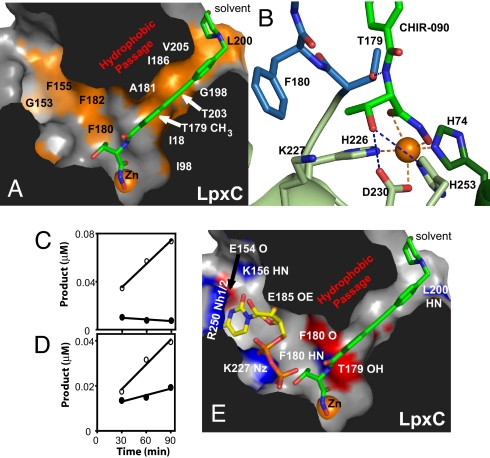
Interface between CHIR-090 and LpxC.Proc Natl Acad Sci U S A.2007 Nov 20;104(47):18433-8. |
|---|
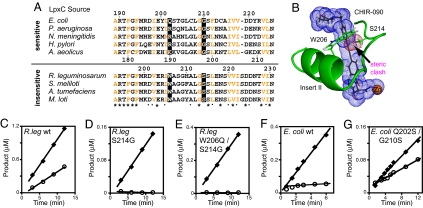
LpxC Insert II residues in the hydrophobic passage are critical for CHIR-090 resistance and time-dependent inhibition.
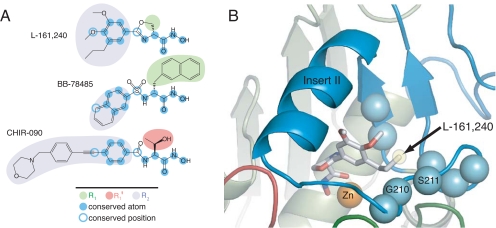
Common features of structurally diverse LpxC inhibitors.Proc Natl Acad Sci U S A.2007 Nov 20;104(47):18433-8. |
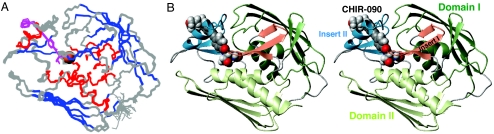
Solution structure of theA. aeolicusLpxC–CHIR-090 complex.
The potent Gram-negative selective antibiotic CHIR-090 inhibits LpxC, which catalyzes the committed step of lipid A biosynthesis.Proc Natl Acad Sci U S A.2007 Nov 20;104(47):18433-8. |
Products are for research use only; We do not sell to patients
Copyright 2020 InvivoChem LLC | All Rights Reserved


 COA
COA