| Size | Price | Stock | Qty |
|---|---|---|---|
| 5mg |
|
||
| 10mg |
|
||
| 50mg |
|
||
| 100mg |
|
||
| 250mg |
|
||
| 500mg |
|
||
| Other Sizes |


Purity: ≥98%
| Targets |
The specific target of BTB06584 is the mitochondrial F₁Fₒ-ATPase, and its inhibitory activity is dependent on the mitochondrial ATPase inhibitory factor 1 (IF1). For purified human mitochondrial F₁Fₒ-ATPase in the presence of IF1, the IC₅₀ for inhibiting ATP hydrolysis activity is 1.2 μM; in HeLa cells, the EC₅₀ for inhibiting mitochondrial F₁Fₒ-ATPase activity and reducing cellular ATP levels is 0.8 μM. In the absence of IF1, the IC₅₀ for purified F₁Fₒ-ATPase exceeds 50 μM, demonstrating IF1-dependent selectivity [1]
|
|---|---|
| ln Vitro |
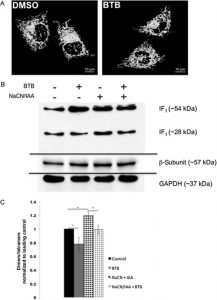
BTB06584 (100 μM) has no effect on O2 consumption or the mitochondrial membrane potential (ΔΨm) but suppresses F1Fo-ATPase activity in HL-1 cells. Before an ischemia phase, HL-1 cells are protected from ischemic cell death by BTB06584 (100 μM) pretreatment. After suppression of respiration, there is a decrease in ATP consumption and ischemia cell death[1]. Overexpressing IF1 increases BTB06584 efficiency, but protein silencing decreases it[1].
Inhibition of mitochondrial F₁Fₒ-ATPase activity: In the presence of IF1 (50 nM), BTB06584 inhibited the activity of purified human mitochondrial F₁Fₒ-ATPase in a dose-dependent manner. At 1 μM, it inhibited enzyme activity by 70%; at 2 μM, the inhibition rate reached 90%. In contrast, in the absence of IF1, 10 μM BTB06584 only inhibited enzyme activity by 10%, and even at 50 μM, the inhibition rate remained below 20%, confirming its IF1-dependent selectivity [1] - Reduction of cellular ATP levels: HeLa cells treated with 0.5 μM BTB06584 for 24 hours showed a 45% decrease in intracellular ATP levels compared to the vehicle control; at 1 μM, ATP levels decreased by 75%. Similarly, A549 non-small cell lung cancer cells treated with 1 μM BTB06584 for 24 hours exhibited a 70% reduction in ATP levels (detected by a fluorescent ATP assay kit) [1] - Disruption of mitochondrial membrane potential (ΔΨₘ): JC-1 staining was used to assess mitochondrial function in HeLa cells. After 12-hour treatment with 1 μM BTB06584, the ratio of red fluorescence (indicating high ΔΨₘ) to green fluorescence (indicating low ΔΨₘ) decreased from 3.5 (control) to 1.2, indicating significant mitochondrial depolarization and impaired mitochondrial function [1] - Antiproliferative activity and apoptosis induction in cancer cells: The CC₅₀ of BTB06584 against HeLa cells was 1.5 μM (MTT assay, 72-hour treatment). After 48-hour treatment with 1 μM BTB06584, the proportion of early apoptotic cells (Annexin V⁺/PI⁻) increased from 5% (control) to 30% (Annexin V-FITC/PI double staining). Western blot analysis showed that the expression of cleaved caspase-3 (a key apoptotic marker) was upregulated by 2.8-fold compared to the control [1] - Selectivity for cancer cells: The CC₅₀ of BTB06584 against normal human foreskin fibroblasts (HFF) was 12 μM, which is 8-fold higher than that against HeLa cells, indicating good selectivity for cancer cells [1] |
| ln Vivo |
Zebrafish pinotage (pnt) mutants, which lack Atpif1a gene expression, showed improved hemoglobin production after receiving BTB06584 (1 μM) therapy for 24 hours. In living fish, the doses of BTB06584 that restore hemoglobin biosynthesis also change the bioenergetics of the mitochondria[1].
Antitumor efficacy in HeLa xenograft mice: Female BALB/c nude mice (6–8 weeks old) were subcutaneously injected with 5×10⁶ HeLa cells (mixed with Matrigel at a 1:1 ratio) into the right flank. When tumors grew to ~100 mm³, mice were randomized into 3 groups (n=6/group): vehicle control (DMSO:PEG400:normal saline = 1:4:5), BTB06584 5 mg/kg, and BTB06584 10 mg/kg. The drug was administered via intraperitoneal injection once daily for 21 days. Results: (1) The 5 mg/kg group showed a 55% tumor growth inhibition (TGI) rate (mean tumor volume: 380 mm³ vs. 840 mm³ in the control group); (2) The 10 mg/kg group showed an 80% TGI rate (mean tumor volume: 170 mm³ vs. 840 mm³ in the control group); (3) In tumor tissues from the 10 mg/kg group, ATP levels decreased by 65% and mitochondrial F₁Fₒ-ATPase activity decreased by 70% compared to the control; (4) No significant weight loss (<5% vs. baseline) was observed in the treated groups [1] |
| Enzyme Assay |
Purification of mitochondrial F₁Fₒ-ATPase and activity inhibition assay:
1. Enzyme purification: Mitochondria were isolated from human placental tissue by differential centrifugation (600 × g for 10 minutes to remove nuclei, then 12,000 × g for 20 minutes to collect mitochondria). Mitochondrial membranes were solubilized with a mild detergent, and the F₁Fₒ-ATPase complex was purified by ion-exchange chromatography (DEAE-Sepharose resin) and gel filtration chromatography (Sephacryl S-300 resin). Protein concentration was determined by the BCA assay, and enzyme purity was verified by 10% SDS-PAGE [1]
2. Reaction system preparation: The total reaction volume was 100 μL, containing 50 mM Tris-HCl (pH 7.4), 5 mM MgCl₂, 2 mM ATP (substrate), 100 ng purified F₁Fₒ-ATPase, and serial concentrations of BTB06584 (0.1–50 μM). Two control groups were set up: one with 50 nM IF1 (to mimic the IF1-rich environment in cancer cells) and one without IF1 [1] 3. Incubation and detection: The reaction mixture was incubated at 37°C for 30 minutes to allow ATP hydrolysis. The reaction was terminated by adding 200 μL of ammonium molybdate reagent (to detect inorganic phosphate (Pi) released from ATP hydrolysis). The absorbance was measured at 620 nm using a microplate reader, and Pi concentration was calculated based on a standard curve. Enzyme inhibition rate = [(Pi amount in control group – Pi amount in drug group) / Pi amount in control group] × 100%. The IC₅₀ was derived by fitting the dose-response curve [1] |
| Cell Assay |
MTT cell viability assay:
1. Cell seeding: HeLa, A549, and HFF cells were seeded in 96-well plates at a density of 5×10³ cells/well and incubated at 37°C with 5% CO₂ overnight to allow adhesion [1]
2. Drug treatment: BTB06584 was dissolved in DMSO and diluted with complete medium to concentrations of 0.01–50 μM. 100 μL of the diluted drug was added to each well (3 replicates per concentration), and a vehicle control group (0.1% DMSO) was set up [1] 3. Incubation and MTT reaction: After 72-hour incubation, 20 μL of MTT solution (5 mg/mL in PBS) was added to each well, followed by 4-hour incubation at 37°C. The supernatant was carefully aspirated, and 150 μL of DMSO was added to dissolve formazan crystals [1] 4. Detection and calculation: Absorbance was measured at 570 nm using a microplate reader. Cell viability = (A₅₇₀ of drug group / A₅₇₀ of control group) × 100%, and CC₅₀ values were calculated by fitting the dose-response curve [1] - Intracellular ATP level detection: 1. Cell seeding and treatment: HeLa cells were seeded in 24-well plates at 2×10⁴ cells/well and treated with BTB06584 (0.1–2 μM) for 24 hours [1] 2. ATP extraction and detection: Cells were lysed with 100 μL of ice-cold ATP lysis buffer for 10 minutes. 50 μL of the lysate was mixed with 50 μL of ATP detection reagent (fluorescent substrate) and incubated at room temperature in the dark for 10 minutes. Fluorescence intensity was measured using a microplate reader (excitation wavelength 560 nm, emission wavelength 590 nm). ATP concentration was determined using an ATP standard curve, and results were expressed as a percentage of the control group [1] - Mitochondrial membrane potential (ΔΨₘ) detection (JC-1 staining): 1. Cell treatment and staining: HeLa cells were seeded in 6-well plates at 5×10⁵ cells/well and treated with 1 μM BTB06584 for 12 hours. Cells were washed twice with PBS, then incubated with 5 μM JC-1 staining solution at 37°C for 20 minutes [1] 2. Flow cytometry analysis: Cells were harvested by trypsinization, washed with PBS, and resuspended in 500 μL of PBS. Red fluorescence (FL2 channel, high ΔΨₘ) and green fluorescence (FL1 channel, low ΔΨₘ) were detected by flow cytometry. The ratio of red to green fluorescence was calculated to evaluate ΔΨₘ [1] - Apoptosis assay (Annexin V-FITC/PI double staining): 1. Cell treatment and collection: HeLa cells were treated with 1 μM BTB06584 for 48 hours, then harvested by trypsinization and washed twice with ice-cold PBS [1] 2. Staining and analysis: Cells were resuspended in 1× binding buffer at a density of 1×10⁶ cells/mL. 5 μL of Annexin V-FITC and 5 μL of PI were added to 100 μL of the cell suspension, followed by 15-minute incubation at room temperature in the dark. Apoptosis rate was analyzed by flow cytometry within 1 hour, with early apoptosis defined as Annexin V⁺/PI⁻ and late apoptosis/necrosis as Annexin V⁺/PI⁺ [1] |
| Animal Protocol |
HeLa xenograft model in nude mice:
1. Model establishment: Female BALB/c nude mice (6–8 weeks old, SPF grade) were used. HeLa cells in the logarithmic growth phase were harvested, washed with PBS, and resuspended in PBS mixed with Matrigel (1:1) to a concentration of 5×10⁶ cells/mL. Each mouse received a subcutaneous injection of 0.2 mL of the cell suspension into the right flank. Tumors were allowed to grow to ~100 mm³ before initiating treatment [1]
2. Grouping and drug administration: Mice were randomized into 3 groups (n=6/group): vehicle control, BTB06584 5 mg/kg, and BTB06584 10 mg/kg. BTB06584 was dissolved in a mixture of DMSO, PEG400, and normal saline (volume ratio 1:4:5) to prepare solutions of 1 mg/mL and 2 mg/mL. The drug was administered via intraperitoneal injection once daily for 21 days; the control group received the same volume of the vehicle mixture [1] 3. Data collection and sample processing: Tumor volume (calculated as length × width² / 2) and mouse body weight were measured twice weekly. At the end of treatment, mice were euthanized by cervical dislocation. Tumors were excised, weighed, and divided into two parts: one part was used to detect ATP levels (using the same method as in cell assays), and the other part was homogenized to measure mitochondrial F₁Fₒ-ATPase activity (using the enzyme assay method described above). Livers, kidneys, and spleens were collected for histological analysis (HE staining) [1] |
| Toxicity/Toxicokinetics |
In vitro toxicity: The CC₅₀ of BTB06584 against normal human foreskin fibroblasts (HFF) was 12 μM, which was 8 times higher than that against HeLa cancer cells (1.5 μM), indicating that it had low toxicity to normal cells and good selectivity for cancer cells [1]. In vivo toxicity: Nude mice treated with BTB06584 (5–10 mg/kg/day, intraperitoneal injection, for 21 days) did not show significant weight loss (<5% vs. baseline). Serum alanine aminotransferase (ALT), aspartate aminotransferase (AST), blood urea nitrogen (BUN), and serum creatinine (Scr) (indicators of liver and kidney function) were all within the normal range. Histological examination of the liver, kidneys, spleen, and normal tissues surrounding the tumor showed no obvious pathological damage (e.g., inflammation, necrosis) [1]
|
| References | |
| Additional Infomation |
Mechanism of action: BTB06584 is an IF1-dependent selective inhibitor of mitochondrial F₁Fₒ-ATPase. It specifically binds to the F₁Fₒ-ATPase-IF1 complex (but not to free F₁Fₒ-ATPase) and inhibits the ATP hydrolysis activity of the complex (without affecting its ATP synthesis function). Since IF1 is highly expressed in cancer cells (compared to normal cells), BTB06584 can more effectively inhibit the production of mitochondrial ATP in cancer cells, leading to ATP depletion, mitochondrial dysfunction, and ultimately inducing apoptosis in cancer cells [1]. Anti-tumor potential: As a candidate drug targeting mitochondrial metabolism, BTB06584 has shown strong anti-tumor activity in various cancer cell lines (HeLa, A549) and HeLa xenograft mouse models. Its low toxicity to normal cells and IF1-dependent selectivity make it a candidate drug worthy of further study in the field of cancer treatment [1].
|
| Molecular Formula |
C19H12CLNO6S
|
|
|---|---|---|
| Molecular Weight |
417.82
|
|
| Exact Mass |
417.007
|
|
| Elemental Analysis |
C, 54.62; H, 2.90; Cl, 8.48; N, 3.35; O, 22.98; S, 7.67
|
|
| CAS # |
219793-45-0
|
|
| Related CAS # |
|
|
| PubChem CID |
2799764
|
|
| Appearance |
White to off-white solid powder
|
|
| Density |
1.5±0.1 g/cm3
|
|
| Boiling Point |
664.8±55.0 °C at 760 mmHg
|
|
| Flash Point |
355.9±31.5 °C
|
|
| Vapour Pressure |
0.0±2.0 mmHg at 25°C
|
|
| Index of Refraction |
1.637
|
|
| LogP |
5.23
|
|
| Hydrogen Bond Donor Count |
0
|
|
| Hydrogen Bond Acceptor Count |
6
|
|
| Rotatable Bond Count |
5
|
|
| Heavy Atom Count |
28
|
|
| Complexity |
659
|
|
| Defined Atom Stereocenter Count |
0
|
|
| SMILES |
ClC1=CC=C(C(OC2=C([N+]([O-])=O)C=CC(S(C3=CC=CC=C3)(=O)=O)=C2)=O)C=C1
|
|
| InChi Key |
WNDWKKPBLAKXMI-UHFFFAOYSA-N
|
|
| InChi Code |
InChI=1S/C19H12ClNO6S/c20-14-8-6-13(7-9-14)19(22)27-18-12-16(10-11-17(18)21(23)24)28(25,26)15-4-2-1-3-5-15/h1-12H
|
|
| Chemical Name |
2-nitro-5-(phenylsulfonyl)phenyl 4-chlorobenzoate
|
|
| Synonyms |
|
|
| HS Tariff Code |
2934.99.9001
|
|
| Storage |
Powder -20°C 3 years 4°C 2 years In solvent -80°C 6 months -20°C 1 month |
|
| Shipping Condition |
Room temperature (This product is stable at ambient temperature for a few days during ordinary shipping and time spent in Customs)
|
| Solubility (In Vitro) |
DMSO: 84 mg/mL (201.0 mM)
Water: 1 mg/mL (Insoluble) Ethanol: 1 mg/mL |
|---|---|
| Solubility (In Vivo) |
Solubility in Formulation 1: ≥ 2.5 mg/mL (5.98 mM) (saturation unknown) in 10% DMSO + 40% PEG300 +5% Tween-80 + 45% Saline (add these co-solvents sequentially from left to right, and one by one), clear solution.
For example, if 1 mL of working solution is to be prepared, you can add 100 μL of 25.0 mg/mL clear DMSO stock solution to 400 μL PEG300 and mix evenly; then add 50 μL Tween-80 + to the above solution and mix evenly; then add 450 μL normal saline to adjust the volume to 1 mL. Preparation of saline: Dissolve 0.9 g of sodium chloride in 100 mL ddH₂ O to obtain a clear solution. (Please use freshly prepared in vivo formulations for optimal results.) |
| Preparing Stock Solutions | 1 mg | 5 mg | 10 mg | |
| 1 mM | 2.3934 mL | 11.9669 mL | 23.9338 mL | |
| 5 mM | 0.4787 mL | 2.3934 mL | 4.7868 mL | |
| 10 mM | 0.2393 mL | 1.1967 mL | 2.3934 mL |
*Note: Please select an appropriate solvent for the preparation of stock solution based on your experiment needs. For most products, DMSO can be used for preparing stock solutions (e.g. 5 mM, 10 mM, or 20 mM concentration); some products with high aqueous solubility may be dissolved in water directly. Solubility information is available at the above Solubility Data section. Once the stock solution is prepared, aliquot it to routine usage volumes and store at -20°C or -80°C. Avoid repeated freeze and thaw cycles.
Calculation results
Working concentration: mg/mL;
Method for preparing DMSO stock solution: mg drug pre-dissolved in μL DMSO (stock solution concentration mg/mL). Please contact us first if the concentration exceeds the DMSO solubility of the batch of drug.
Method for preparing in vivo formulation::Take μL DMSO stock solution, next add μL PEG300, mix and clarify, next addμL Tween 80, mix and clarify, next add μL ddH2O,mix and clarify.
(1) Please be sure that the solution is clear before the addition of next solvent. Dissolution methods like vortex, ultrasound or warming and heat may be used to aid dissolving.
(2) Be sure to add the solvent(s) in order.
|
|---|
|
Products are for research use only; We do not sell to patients
Copyright 2020 InvivoChem LLC | All Rights Reserved


 COA
COA