| Size | Price | Stock | Qty |
|---|---|---|---|
| 1mg |
|
||
| 5mg |
|
||
| 10mg |
|
||
| 100mg | |||
| Other Sizes |
| Targets |
BPN-15606 targets γ-secretase, a multi-subunit protease complex involved in the cleavage of amyloid precursor protein (APP) to produce Aβ peptides. It acts as a modulator rather than an inhibitor, shifting the cleavage site to reduce the production of the pathogenic Aβ42 peptide while maintaining the processing of other substrates like Notch.
|
|---|---|
| ln Vitro |
In vitro, BPN-15606 attenuates the production of Aβ42 and Aβ40 in SHSY5Y neuroblastoma cells with IC50 values of 7 nM and 17 nM, respectively. This demonstrates its high potency in modulating γ-secretase activity to reduce the production of pathogenic amyloid peptides.
|
| ln Vivo |
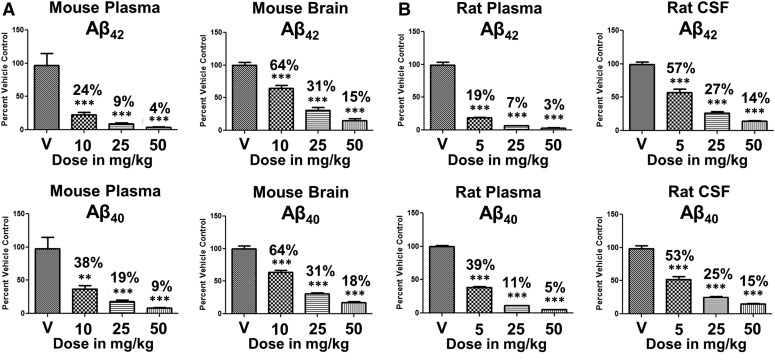
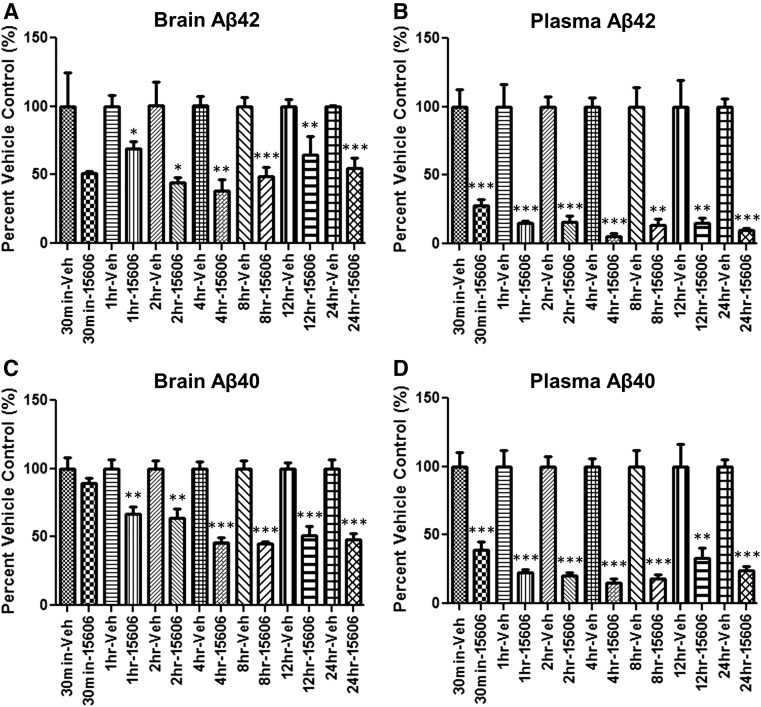
BPN-15606 showed good dose-dependent efficacy in lowering Aβ42 and Aβ40 levels in mouse plasma and brain when given orally for seven days at doses of 10 mg/kg, 25 mg/kg, and 50 mg/kg [1]. Rat cerebrospinal fluid's Aβ42 and Aβ40 levels are dose-dependently decreased by BPN-15606 (orally administered at 5 mg/kg, 25 mg/kg, and 50 mg/kg for nine days) [1]. Orally given at a dose of 25 mg/kg, BPN-15606 exhibits strong effects on brain and plasma Aβ42 and Aβ40 levels. These effects start to manifest about 30 to 60 minutes after the single dose is administered, and they last in C57BL mice for about 24 hours/6 mice [1].
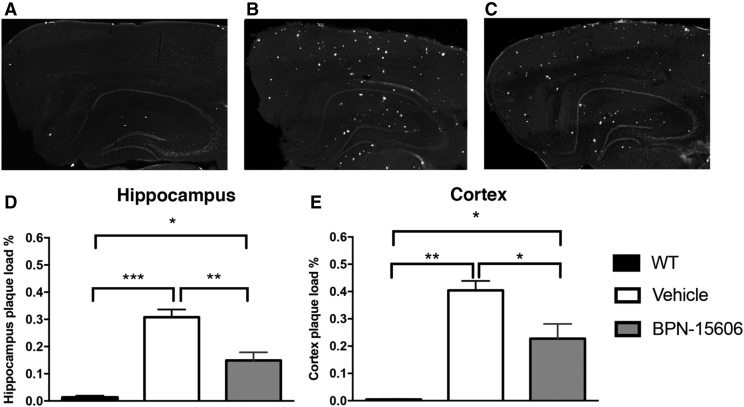
In vivo, BPN-15606 shows excellent dose-dependent efficacy in lowering Aβ42 and Aβ40 levels in both plasma and brain in mice and rats following oral administration. A single oral dose of 25 mg/kg in mice produces a robust effect on brain and plasma Aβ levels that begins within 30-60 minutes and lasts for ≥24 hours. It effectively reduces amyloid plaque burden and improves cognitive outcomes in Alzheimer's models. |
| Enzyme Assay |
Cell-free assays for BPN-15606 are not the primary method for characterizing its activity, as it is a modulator of a multi-subunit membrane-bound enzyme complex. Its binding to γ-secretase could be studied using biophysical techniques, but functional activity is typically assessed in cell-based assays.
|
| Cell Assay |
In vitro cell-based assays for BPN-15606 are performed to measure its modulation of γ-secretase activity. SHSY5Y neuroblastoma cells or other cell lines expressing APP are treated with varying concentrations of the compound. The levels of Aβ42 and Aβ40 secreted into the culture medium are measured using ELISA, and the IC50 values are calculated.
|
| Animal Protocol |
In vivo animal experiments for BPN-15606 are conducted in rodents. The compound is administered orally, and the levels of Aβ42 and Aβ40 in plasma and brain tissue are measured. In Alzheimer's disease models, the effect on amyloid plaque burden and cognitive function can also be assessed.
|
| ADME/Pharmacokinetics |
BPN-15606 has favorable pharmacokinetic properties, including oral bioavailability, half-life, and clearance. It is brain-penetrant and demonstrates dose-dependent efficacy in both plasma and brain. The compound should be stored at -20°C under nitrogen.
|
| Toxicity/Toxicokinetics |
Toxicological data for BPN-15606 is not detailed in the available literature. As a γ-secretase modulator, it is designed to have a reduced toxicity risk compared to γ-secretase inhibitors by sparing Notch processing. However, specific toxicity studies are not detailed.
|
| References | |
| Additional Infomation |
BPN-15606 is a research-grade compound and a highly potent, orally active γ-secretase modulator for Alzheimer's disease research. It selectively lowers Aβ42 production with IC50 values of 7 nM in cells. It has not been approved for clinical use. All information is for research reference only.
|
| Molecular Formula |
C23H23FN6O
|
|---|---|
| Molecular Weight |
418.47
|
| Exact Mass |
418.191
|
| CAS # |
1914989-49-3
|
| Related CAS # |
BPN-15606 besylate;2436239-00-6
|
| PubChem CID |
121305852
|
| Appearance |
White to yellow solid powder
|
| LogP |
3.6
|
| Hydrogen Bond Donor Count |
1
|
| Hydrogen Bond Acceptor Count |
7
|
| Rotatable Bond Count |
6
|
| Heavy Atom Count |
31
|
| Complexity |
562
|
| Defined Atom Stereocenter Count |
1
|
| SMILES |
C1(N[C@H](C2=CC=C(F)C=C2)C)=NN=C(C2=NC(OC)=C(N3C=NC(C)=C3)C=C2)C=C1C
|
| InChi Key |
JZCREVMHGYOLRL-INIZCTEOSA-N
|
| InChi Code |
InChI=1S/C23H23FN6O/c1-14-11-20(28-29-22(14)26-16(3)17-5-7-18(24)8-6-17)19-9-10-21(23(27-19)31-4)30-12-15(2)25-13-30/h5-13,16H,1-4H3,(H,26,29)/t16-/m0/s1
|
| Chemical Name |
N-[(1S)-1-(4-fluorophenyl)ethyl]-6-[6-methoxy-5-(4-methylimidazol-1-yl)pyridin-2-yl]-4-methylpyridazin-3-amine
|
| Synonyms |
BPN 15606; BPN15606; BPN-15606
|
| HS Tariff Code |
2934.99.9001
|
| Storage |
Powder -20°C 3 years 4°C 2 years In solvent -80°C 6 months -20°C 1 month Note: (1). This product requires protection from light (avoid light exposure) during transportation and storage. (2). Please store this product in a sealed and protected environment (e.g. under nitrogen), avoid exposure to moisture. |
| Shipping Condition |
Room temperature (This product is stable at ambient temperature for a few days during ordinary shipping and time spent in Customs)
|
| Solubility (In Vitro) |
DMSO : ~100 mg/mL (~238.97 mM)
|
|---|---|
| Solubility (In Vivo) |
Solubility in Formulation 1: ≥ 2.5 mg/mL (5.97 mM) (saturation unknown) in 10% DMSO + 40% PEG300 + 5% Tween80 + 45% Saline (add these co-solvents sequentially from left to right, and one by one), clear solution.
For example, if 1 mL of working solution is to be prepared, you can add 100 μL of 25.0 mg/mL clear DMSO stock solution to 400 μL PEG300 and mix evenly; then add 50 μL Tween-80 to the above solution and mix evenly; then add 450 μL normal saline to adjust the volume to 1 mL. Preparation of saline: Dissolve 0.9 g of sodium chloride in 100 mL ddH₂ O to obtain a clear solution. Solubility in Formulation 2: ≥ 2.5 mg/mL (5.97 mM) (saturation unknown) in 10% DMSO + 90% Corn Oil (add these co-solvents sequentially from left to right, and one by one), clear solution. For example, if 1 mL of working solution is to be prepared, you can add 100 μL of 25.0 mg/mL clear DMSO stock solution to 900 μL of corn oil and mix evenly. (Please use freshly prepared in vivo formulations for optimal results.) |
| Preparing Stock Solutions | 1 mg | 5 mg | 10 mg | |
| 1 mM | 2.3897 mL | 11.9483 mL | 23.8966 mL | |
| 5 mM | 0.4779 mL | 2.3897 mL | 4.7793 mL | |
| 10 mM | 0.2390 mL | 1.1948 mL | 2.3897 mL |
*Note: Please select an appropriate solvent for the preparation of stock solution based on your experiment needs. For most products, DMSO can be used for preparing stock solutions (e.g. 5 mM, 10 mM, or 20 mM concentration); some products with high aqueous solubility may be dissolved in water directly. Solubility information is available at the above Solubility Data section. Once the stock solution is prepared, aliquot it to routine usage volumes and store at -20°C or -80°C. Avoid repeated freeze and thaw cycles.
Calculation results
Working concentration: mg/mL;
Method for preparing DMSO stock solution: mg drug pre-dissolved in μL DMSO (stock solution concentration mg/mL). Please contact us first if the concentration exceeds the DMSO solubility of the batch of drug.
Method for preparing in vivo formulation::Take μL DMSO stock solution, next add μL PEG300, mix and clarify, next addμL Tween 80, mix and clarify, next add μL ddH2O,mix and clarify.
(1) Please be sure that the solution is clear before the addition of next solvent. Dissolution methods like vortex, ultrasound or warming and heat may be used to aid dissolving.
(2) Be sure to add the solvent(s) in order.
|
|
|
Products are for research use only; We do not sell to patients
Copyright 2020 InvivoChem LLC | All Rights Reserved