| Size | Price | Stock | Qty |
|---|---|---|---|
| 5mg |
|
||
| 10mg |
|
||
| 25mg |
|
||
| 50mg |
|
||
| 100mg |
|
||
| 250mg |
|
||
| Other Sizes |


Purity: ≥98%
| Targets |
BIBF0775 targets transforming growth factor β receptor I (TGFβRI/ALK5) (IC50 = 14 nM in kinase activity assay); it also exhibits inhibitory activity against ALK4 (IC50 = 59 nM) and ALK7 (IC50 = 110 nM) [1]
|
|---|---|
| ln Vitro |
1. In a radiometric kinase assay, BIBF0775 potently inhibits the kinase activity of recombinant human TGFβRI (ALK5) with an IC50 of 14 nM; it also inhibits ALK4 (IC50 = 59 nM) and ALK7 (IC50 = 110 nM), while showing weak or no inhibition against other kinases (e.g., ALK1, ALK2, ALK3, EGFR, VEGFR2, PDGFRβ) at concentrations up to 10 μM [1]
2. In A549 lung adenocarcinoma cells, BIBF0775 (100 nM) completely blocks TGF-β1-induced phosphorylation of Smad2 (detected by Western blot) and inhibits TGF-β1-induced transcriptional activation of a Smad-binding element (SBE) reporter gene with an IC50 of 23 nM [1] 3. BIBF0775 (0.1–10 μM) inhibits TGF-β1-induced proliferation of human lung fibroblasts (MRC-5 cells) in a dose-dependent manner, with an IC50 of 45 nM for anti-proliferative activity [1] 4. In primary human renal proximal tubular epithelial cells (HRPTEpiC), BIBF0775 (1 μM) suppresses TGF-β1-induced upregulation of fibronectin and α-smooth muscle actin (α-SMA) (detected by Western blot), which are markers of epithelial-mesenchymal transition (EMT) [1] |
| Enzyme Assay |
1. TGFβRI (ALK5) kinase activity assay: Recombinant human TGFβRI cytoplasmic domain was incubated with ATP (20 μM), [γ-³³P]ATP, and a synthetic peptide substrate (derived from Smad3) in the presence of different concentrations of BIBF0775. The reaction was terminated by adding a stop solution, and the phosphorylated substrate was captured on a filter membrane. The radioactivity associated with the membrane was measured using a scintillation counter to determine kinase activity, and dose-response curves were generated to calculate the IC50 value [1]
2. ALK4 and ALK7 kinase activity assays: The same radiometric kinase assay protocol as the TGFβRI assay was used, with recombinant human ALK4 or ALK7 cytoplasmic domain as the enzyme source and corresponding peptide substrates. Different concentrations of BIBF0775 were tested, and the IC50 values for ALK4 and ALK7 inhibition were calculated from dose-response data [1] 3. Kinase selectivity assay: A panel of 26 different kinases (including ALK1, ALK2, ALK3, EGFR, VEGFR2, PDGFRβ, etc.) was screened using the radiometric kinase assay method. BIBF0775 was tested at a concentration of 10 μM, and the percentage of kinase inhibition was determined to evaluate its selectivity for TGFβRI/ALK5 [1] |
| Cell Assay |
1. Smad2 phosphorylation Western blot assay in A549 cells: A549 cells were serum-starved for 24 hours, then pre-treated with different concentrations of BIBF0775 for 1 hour before stimulation with TGF-β1 (5 ng/mL) for 30 minutes. Cells were lysed, and protein extracts were separated by SDS-PAGE, transferred to a membrane, and probed with antibodies against phosphorylated Smad2 (p-Smad2) and total Smad2. The band intensity was quantified by densitometry to assess the inhibition of Smad2 phosphorylation [1]
2. SBE reporter gene assay in A549 cells: A549 cells were transiently transfected with a Smad-binding element (SBE) luciferase reporter plasmid and a Renilla luciferase plasmid (as an internal control). After 24 hours of transfection, cells were pre-treated with BIBF0775 for 1 hour, then stimulated with TGF-β1 (5 ng/mL) for 16 hours. Luciferase activity was measured using a dual-luciferase reporter assay system, and the ratio of firefly to Renilla luciferase activity was calculated to determine transcriptional activation; dose-response curves were used to calculate the IC50 for SBE reporter inhibition [1] 3. MRC-5 cell proliferation assay: Human lung fibroblasts (MRC-5 cells) were seeded in 96-well plates and serum-starved for 24 hours. Cells were treated with different concentrations of BIBF0775 for 1 hour, then stimulated with TGF-β1 (5 ng/mL) for 72 hours. Cell proliferation was assessed using a colorimetric cell viability assay, and the absorbance was measured at a specific wavelength to calculate the IC50 for anti-proliferative activity [1] 4. EMT marker Western blot assay in HRPTEpiC: Primary human renal proximal tubular epithelial cells (HRPTEpiC) were serum-starved for 24 hours, pre-treated with 1 μM BIBF0775 for 1 hour, then stimulated with TGF-β1 (5 ng/mL) for 48 hours. Cells were lysed, and protein extracts were analyzed by Western blot using antibodies against fibronectin, α-smooth muscle actin (α-SMA), and GAPDH (as a loading control). Band intensity was quantified to evaluate the inhibition of EMT marker upregulation [1] |
| References | |
| Additional Infomation |
1. BIBF0775 is a 3-substituted indololinone derivative designed and synthesized as a potent and selective inhibitor of TGFβRI (ALK5)[1] 2. BIBF0775 was designed based on structure-activity relationship (SAR) studies of indololinone analogs, modifying the 3-position of the indololinone core to enhance its potency and selectivity against TGFβRI[1] 3. BIBF0775 exerts its biological effects by inhibiting the kinase activity of TGFβRI, thereby blocking the TGF-β/Smad signaling pathway involved in fibrosis, epithelial-mesenchymal transition (EMT), and cell proliferation[1] 4. BIBF0775 inhibits the TGFβ superfamily I This compound is active against ALK4 and ALK7 receptors, but exhibits very low activity against other tyrosine and serine/threonine kinases, indicating good selectivity, which is beneficial for drug development [1].
|
| Molecular Formula |
C31H34N4O2
|
|
|---|---|---|
| Molecular Weight |
494.64
|
|
| Exact Mass |
494.27
|
|
| Elemental Analysis |
C, 75.28; H, 6.93; N, 11.33; O, 6.47
|
|
| CAS # |
334951-90-5
|
|
| Related CAS # |
|
|
| PubChem CID |
135837779
|
|
| Appearance |
Light yellow to yellow solid powder
|
|
| LogP |
5.7
|
|
| Hydrogen Bond Donor Count |
2
|
|
| Hydrogen Bond Acceptor Count |
4
|
|
| Rotatable Bond Count |
7
|
|
| Heavy Atom Count |
37
|
|
| Complexity |
767
|
|
| Defined Atom Stereocenter Count |
0
|
|
| SMILES |
CCN(C)C(=O)C1=CC2=C(C=C1)C(=C(N2)O)C(=NC3=CC=C(C=C3)CN4CCCCC4)C5=CC=CC=C5
|
|
| InChi Key |
JGQSLTZPBLZNBX-UHFFFAOYSA-N
|
|
| InChi Code |
InChI=1S/C31H34N4O2/c1-3-34(2)31(37)24-14-17-26-27(20-24)33-30(36)28(26)29(23-10-6-4-7-11-23)32-25-15-12-22(13-16-25)21-35-18-8-5-9-19-35/h4,6-7,10-17,20,33,36H,3,5,8-9,18-19,21H2,1-2H3
|
|
| Chemical Name |
|
|
| Synonyms |
|
|
| HS Tariff Code |
2934.99.9001
|
|
| Storage |
Powder -20°C 3 years 4°C 2 years In solvent -80°C 6 months -20°C 1 month |
|
| Shipping Condition |
Room temperature (This product is stable at ambient temperature for a few days during ordinary shipping and time spent in Customs)
|
| Solubility (In Vitro) |
|
|||
|---|---|---|---|---|
| Solubility (In Vivo) |
Solubility in Formulation 1: ≥ 2.08 mg/mL (4.21 mM) (saturation unknown) in 10% DMSO + 40% PEG300 + 5% Tween80 + 45% Saline (add these co-solvents sequentially from left to right, and one by one), clear solution.
For example, if 1 mL of working solution is to be prepared, you can add 100 μL of 20.8 mg/mL clear DMSO stock solution to 400 μL PEG300 and mix evenly; then add 50 μL Tween-80 to the above solution and mix evenly; then add 450 μL normal saline to adjust the volume to 1 mL. Preparation of saline: Dissolve 0.9 g of sodium chloride in 100 mL ddH₂ O to obtain a clear solution. Solubility in Formulation 2: ≥ 2.08 mg/mL (4.21 mM) (saturation unknown) in 10% DMSO + 90% (20% SBE-β-CD in Saline) (add these co-solvents sequentially from left to right, and one by one), clear solution. For example, if 1 mL of working solution is to be prepared, you can add 100 μL of 20.8 mg/mL clear DMSO stock solution to 900 μL of 20% SBE-β-CD physiological saline solution and mix evenly. Preparation of 20% SBE-β-CD in Saline (4°C,1 week): Dissolve 2 g SBE-β-CD in 10 mL saline to obtain a clear solution. View More
Solubility in Formulation 3: ≥ 2.08 mg/mL (4.21 mM) (saturation unknown) in 10% DMSO + 90% Corn Oil (add these co-solvents sequentially from left to right, and one by one), clear solution. |
| Preparing Stock Solutions | 1 mg | 5 mg | 10 mg | |
| 1 mM | 2.0217 mL | 10.1084 mL | 20.2167 mL | |
| 5 mM | 0.4043 mL | 2.0217 mL | 4.0433 mL | |
| 10 mM | 0.2022 mL | 1.0108 mL | 2.0217 mL |
*Note: Please select an appropriate solvent for the preparation of stock solution based on your experiment needs. For most products, DMSO can be used for preparing stock solutions (e.g. 5 mM, 10 mM, or 20 mM concentration); some products with high aqueous solubility may be dissolved in water directly. Solubility information is available at the above Solubility Data section. Once the stock solution is prepared, aliquot it to routine usage volumes and store at -20°C or -80°C. Avoid repeated freeze and thaw cycles.
Calculation results
Working concentration: mg/mL;
Method for preparing DMSO stock solution: mg drug pre-dissolved in μL DMSO (stock solution concentration mg/mL). Please contact us first if the concentration exceeds the DMSO solubility of the batch of drug.
Method for preparing in vivo formulation::Take μL DMSO stock solution, next add μL PEG300, mix and clarify, next addμL Tween 80, mix and clarify, next add μL ddH2O,mix and clarify.
(1) Please be sure that the solution is clear before the addition of next solvent. Dissolution methods like vortex, ultrasound or warming and heat may be used to aid dissolving.
(2) Be sure to add the solvent(s) in order.
J Med Chem.2010 Oct 28;53(20):7287-95. |
|---|
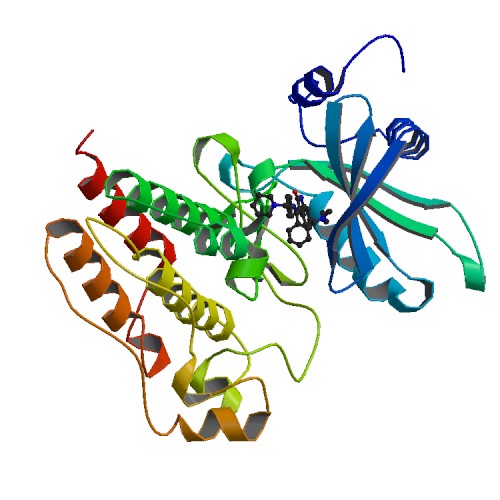
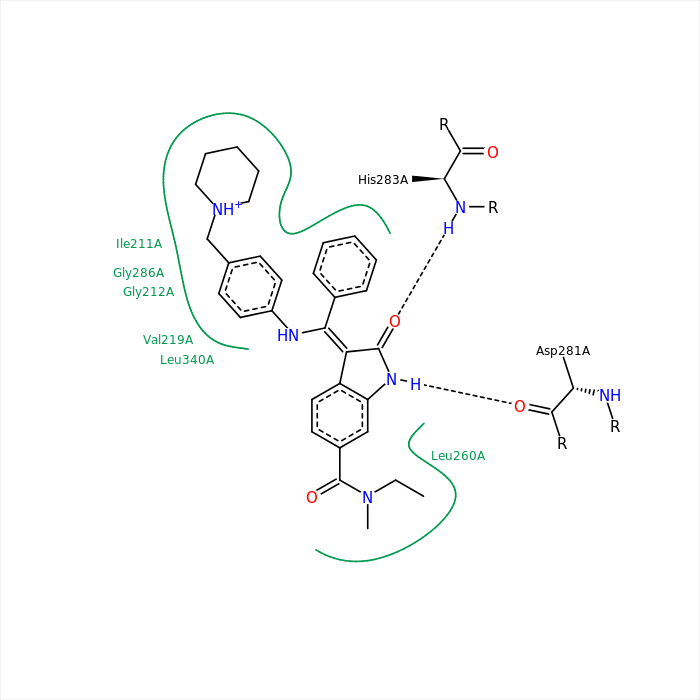
Crystal structure of TGFbRI complexed with an indolinone inhibitor.J Med Chem.2010 Oct 28;53(20):7287-95. |
Crystal structure of TGFbRI complexed with an indolinone inhibitor.J Med Chem.2010 Oct 28;53(20):7287-95. |
Products are for research use only; We do not sell to patients
Copyright 2020 InvivoChem LLC | All Rights Reserved


 COA
COA