| Size | Price | Stock | Qty |
|---|---|---|---|
| 1mg |
|
||
| 5mg |
|
||
| 10mg |
|
||
| 50mg |
|
||
| 500mg | |||
| Other Sizes |


Purity: ≥98%
| Targets |
BCI-215 targets dual specificity MAPK phosphatases (DUSP-MKPs), specifically DUSP1 and DUSP6. By inhibiting these phosphatases, BCI-215 restores defective MAPK activity in mammalian cells where these phosphatases are overexpressed. Some sources also identify SHP2 (Src homology region 2-containing protein tyrosine phosphatase-2) as a target, though the primary mechanism is via DUSP-MKP inhibition.
|
|---|---|
| ln Vitro |
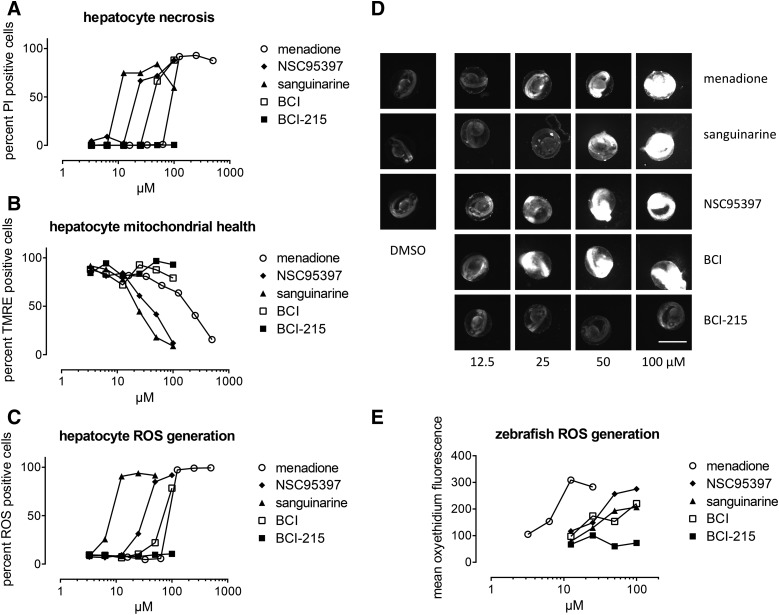
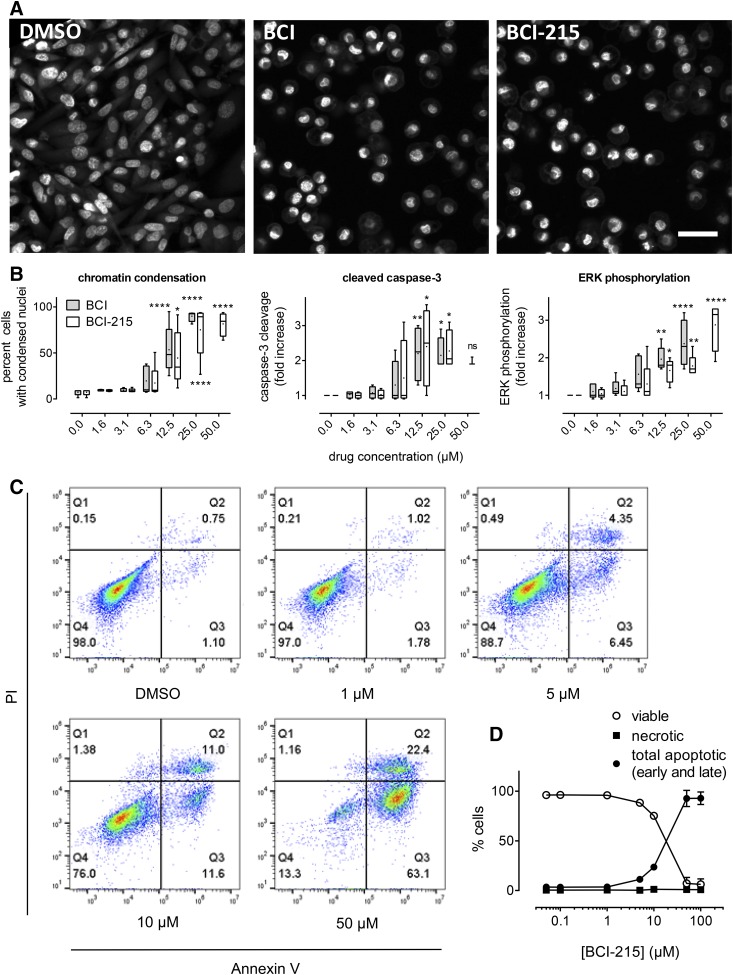
In DUSP-overexpressing cells, BCI-215 concentration-dependently raises pERK levels with IC50 values in the micromolar range [1]. BCI-215 (1–20 μM; 6 hours) is harmless to zebrafish embryos and endothelial cell lines, but it maintains fibroblast growth factor hyperactivation and cellular DUSP6/MKP-3 and DUSP1/MKP-1 inhibitory action [1]. BCI-215 does not impact the viability of cultured hepatocytes, however it does impair the survival and motility of MDA-MB-231 human breast cancer cells [2]. When used at concentrations up to 100 µM, BCI-215 is totally non-hepatotoxic [2]. Neither growing zebrafish larvae nor hepatocytes produced ROS in response to BCI-215. In breast cancer cells, BCI-215 (22 µM) exhibits pro-apoptotic and anti-migratory properties that are linked to the activation of ERK phosphorylation [2]. BCI-215 (20 µM; 1 h) stimulates stress signaling and mitosis in cancer cells without producing reactive oxygen species (ROS) [2].
In vitro, BCI-215 exhibits potent cytotoxicity against various tumor cell lines while showing no toxicity to normal cells. In MDA-MB-231 human breast cancer cells, it inhibits cell motility, induces apoptosis (but not primary necrosis), and sensitizes cells to lymphokine-activated killer (LAK) cell activity. The selectivity is attributed to the 5-position bromine substitution on the molecule. |
| ln Vivo |
In vivo, the selectivity of BCI-215 for tumor cells was established through structure-activity relationship (SAR) studies in transgenic zebrafish. It has been shown to cause selective cancer cell cytotoxicity, in part through non-redox-mediated activation of MAPK signaling. This mechanism also identifies an intersection with immune cell killing, suggesting potential for combination with immunotherapy.
|
| Enzyme Assay |
The in vitro enzyme inhibition assay for BCI-215 involves measuring its ability to inhibit the phosphatase activity of DUSP-MKP enzymes. This is typically performed using a colorimetric or fluorometric phosphatase assay. The enzyme (e.g., recombinant DUSP1 or DUSP6) is incubated with a synthetic phosphatase substrate (e.g., para-nitrophenyl phosphate, pNPP) in the presence of increasing concentrations of BCI-215. The IC50 is determined by measuring the decrease in substrate hydrolysis.
|
| Cell Assay |
Apoptosis analysis[2]
Cell Types: MDA-MB-231 Cell Tested Concentrations: 22 µM Incubation Duration: Experimental Results: Caused apoptosis at concentrations that induce ERK phosphorylation. Western Blot Analysis[2] Cell Types: MDA-MB-231 Cell Tested Concentrations: 20 µM Incubation Duration: 1 hour Experimental Results: Induction of oxidative-independent stress response. The in vitro cellular activity of BCI-215 is assessed using a panel of cancer cell lines and normal cells to confirm its selectivity. Cells are treated with BCI-215 for 24-72 hours, and cell viability is measured using MTT, CCK-8, or ATP-lite assays. The selectivity index is calculated by comparing the IC50 values in cancer cells versus normal cells. Apoptosis is confirmed using annexin V/PI staining and flow cytometry. |
| Animal Protocol |
In vivo animal studies for BCI-215 are primarily conducted using xenograft mouse models. Cancer cells (e.g., MDA-MB-231 breast cancer cells) are implanted into immunodeficient mice. Once tumors are established, BCI-215 is administered (likely via intraperitoneal injection) and tumor growth is monitored. The in vivo SAR studies in zebrafish embryos were also used to optimize the compound's selectivity and potency.
|
| ADME/Pharmacokinetics |
Specific pharmacokinetic parameters for BCI-215 have not been extensively detailed in the available literature. As a small molecule with a molecular weight of 396.32 g/mol, it is expected to have reasonable membrane permeability. The compound is a research chemical, and its formulation for in vivo studies would typically involve solvents like DMSO, PEG300, and Tween 80 to create a suitable vehicle for administration.
|
| Toxicity/Toxicokinetics |
Specific toxicity data for BCI-215 are not readily available in the public domain. Its key feature is its lack of cytotoxicity towards normal cells, which suggests a potentially favorable safety profile. No acute or chronic toxicity studies have been detailed. As with all research chemicals, standard laboratory safety practices should be followed.
|
| References |
|
| Additional Infomation |
BCI-215 is an aromatic ketone with the structure 2,3-dihydro-1H-inden-1-one, where the 2, 3, and 5 positions are substituted with (E)-benzylene, cyclohexylamino, and bromine, respectively. In transgenic zebrafish, BCI-215 acts as a hyperactivator of the fibroblast growth factor signaling pathway without developmental toxicity and can restore MAPK activity defects caused by DUSP1 and DUSP6 overexpression in mammalian cells. It exhibits antitumor activity and apoptosis-inducing effects. BCI-215 is a secondary amino compound, an aromatic ketone, an organobromine compound, an enone, and also an indenone.
BCI-215 is a research compound developed to overcome the limitations of its parent compound, BCI, which was less selective. Its tumor cell-selective cytotoxicity makes it a valuable tool for studying the role of DUSP-MKPs in cancer and for developing targeted cancer therapies. It is not an approved drug and is used exclusively for research purposes. Some sources also describe it as a SHP2 inhibitor. |
| Molecular Formula |
C22H22BRNO
|
|---|---|
| Molecular Weight |
396.320185184479
|
| Exact Mass |
395.088
|
| CAS # |
1245792-67-9
|
| PubChem CID |
46912328
|
| Appearance |
White to light yellow solid powder
|
| LogP |
5.4
|
| Hydrogen Bond Donor Count |
1
|
| Hydrogen Bond Acceptor Count |
2
|
| Rotatable Bond Count |
3
|
| Heavy Atom Count |
25
|
| Complexity |
504
|
| Defined Atom Stereocenter Count |
0
|
| SMILES |
BrC1C=CC2C(/C(=C/C3C=CC=CC=3)/C(C=2C=1)NC1CCCCC1)=O
|
| InChi Key |
JGWQWVVSCQBAFC-DEDYPNTBSA-N
|
| InChi Code |
InChI=1S/C22H22BrNO/c23-16-11-12-18-19(14-16)21(24-17-9-5-2-6-10-17)20(22(18)25)13-15-7-3-1-4-8-15/h1,3-4,7-8,11-14,17,21,24H,2,5-6,9-10H2/b20-13+
|
| Chemical Name |
(E)-2-Benzylidene-5-bromo-3-cyclohexylamino-indan-1-one
|
| Synonyms |
BCI-215 BCI 215 BCI215
|
| HS Tariff Code |
2934.99.9001
|
| Storage |
Powder -20°C 3 years 4°C 2 years In solvent -80°C 6 months -20°C 1 month |
| Shipping Condition |
Room temperature (This product is stable at ambient temperature for a few days during ordinary shipping and time spent in Customs)
|
| Solubility (In Vitro) |
DMSO : ~33.33 mg/mL (~84.10 mM)
|
|---|---|
| Solubility (In Vivo) |
Solubility in Formulation 1: ≥ 0.83 mg/mL (2.09 mM) (saturation unknown) in 10% DMSO + 40% PEG300 + 5% Tween80 + 45% Saline (add these co-solvents sequentially from left to right, and one by one), clear solution.
For example, if 1 mL of working solution is to be prepared, you can add 100 μL of 8.3 mg/mL clear DMSO stock solution to 400 μL of PEG300 and mix evenly; then add 50 μL of Tween-80 to the above solution and mix evenly; then add 450 μL of normal saline to adjust the volume to 1 mL. Preparation of saline: Dissolve 0.9 g of sodium chloride in 100 mL ddH₂ O to obtain a clear solution. Solubility in Formulation 2: ≥ 0.83 mg/mL (2.09 mM) (saturation unknown) in 10% DMSO + 90% Corn Oil (add these co-solvents sequentially from left to right, and one by one), clear solution. For example, if 1 mL of working solution is to be prepared, you can add 100 μL of 8.3 mg/mL clear DMSO stock solution to 900 μL of corn oil and mix evenly. (Please use freshly prepared in vivo formulations for optimal results.) |
| Preparing Stock Solutions | 1 mg | 5 mg | 10 mg | |
| 1 mM | 2.5232 mL | 12.6161 mL | 25.2321 mL | |
| 5 mM | 0.5046 mL | 2.5232 mL | 5.0464 mL | |
| 10 mM | 0.2523 mL | 1.2616 mL | 2.5232 mL |
*Note: Please select an appropriate solvent for the preparation of stock solution based on your experiment needs. For most products, DMSO can be used for preparing stock solutions (e.g. 5 mM, 10 mM, or 20 mM concentration); some products with high aqueous solubility may be dissolved in water directly. Solubility information is available at the above Solubility Data section. Once the stock solution is prepared, aliquot it to routine usage volumes and store at -20°C or -80°C. Avoid repeated freeze and thaw cycles.
Calculation results
Working concentration: mg/mL;
Method for preparing DMSO stock solution: mg drug pre-dissolved in μL DMSO (stock solution concentration mg/mL). Please contact us first if the concentration exceeds the DMSO solubility of the batch of drug.
Method for preparing in vivo formulation::Take μL DMSO stock solution, next add μL PEG300, mix and clarify, next addμL Tween 80, mix and clarify, next add μL ddH2O,mix and clarify.
(1) Please be sure that the solution is clear before the addition of next solvent. Dissolution methods like vortex, ultrasound or warming and heat may be used to aid dissolving.
(2) Be sure to add the solvent(s) in order.
|
|
|
Products are for research use only; We do not sell to patients
Copyright 2020 InvivoChem LLC | All Rights Reserved


 COA
COA