| Size | Price | Stock | Qty |
|---|---|---|---|
| 5mg |
|
||
| 10mg |
|
||
| 100mg | |||
| Other Sizes |


| Targets |
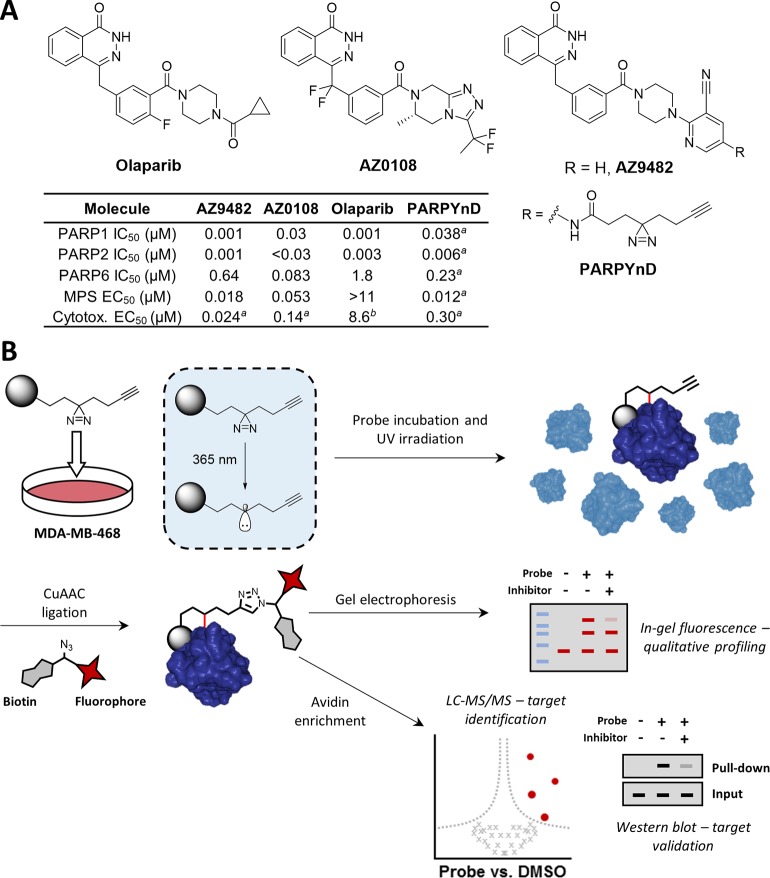
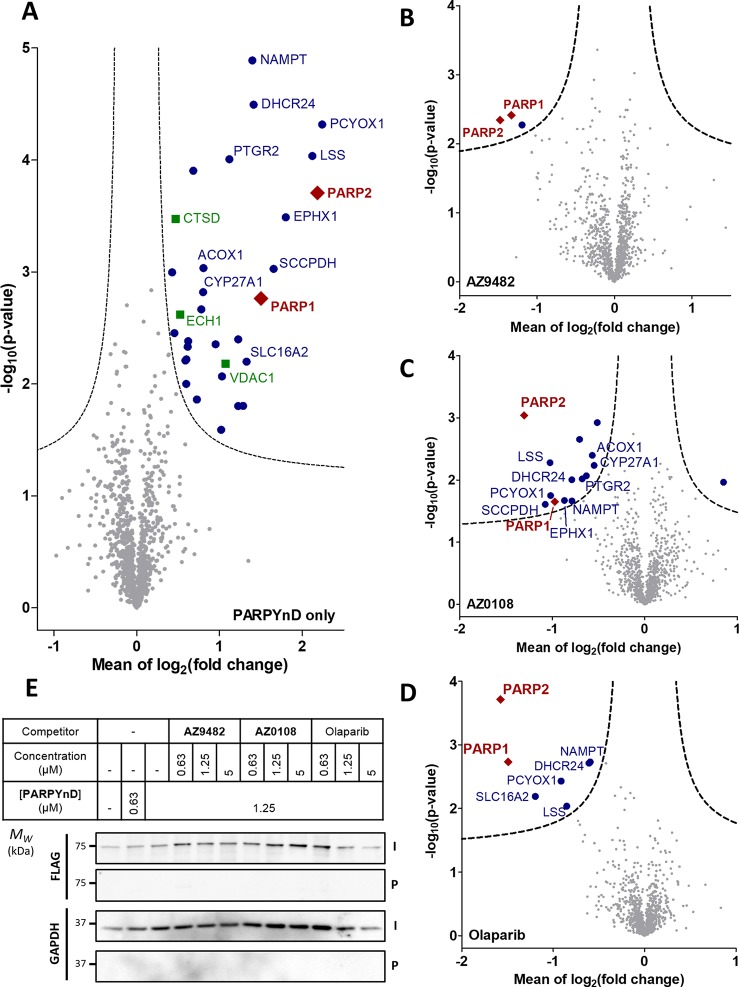
AZ9482 targets PARP1, PARP2, and PARP6. PARP1 and PARP2 are key enzymes involved in DNA repair, particularly in the base excision repair pathway. By inhibiting PARP1/2, AZ9482 disrupts the DNA repair pathway in cancer cells. PARP6 is another member of the PARP family with distinct functions. The compound's activity against PARP6 (IC50 = 640 nM) is lower than against PARP1/2.
|
|---|---|
| ln Vitro |
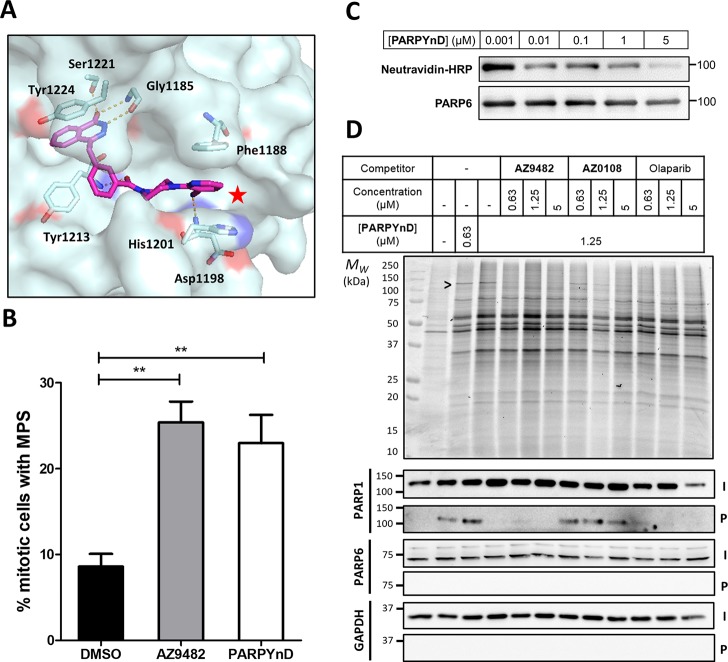
In MDA-MB-468 cells, AZ9482 has an EC50 of 24 nM[1]. Treatment with AZ0108 causes CHK1 hyperphosphorylation and inhibits MARylation, which results in MPS formation and dysregulation of the cell cycle [1].
In vitro, AZ9482 inhibits PARP1 and PARP2 with IC50 values of 1 nM each. It exhibits very potent centrosome declustering activity in HeLa cells with an EC50 < 18 nM. This activity is related to its ability to disrupt the DNA repair pathway and induce synthetic lethality in cancer cells. AZ9482 is a valuable tool for studying cellular response to DNA damage. |
| ln Vivo |
Additionally, AZ0108 shows in vivo toxicity, the molecular cause of which is still unknown, which restricts AZ0108's pharmacological assessment [1].
Specific in vivo data for AZ9482 are not detailed in the available literature. However, as a potent PARP inhibitor, it is expected to have antitumor activity in vivo. It could be used in preclinical studies to investigate the role of PARP1/2/6 in cancer and to develop targeted cancer therapies. |
| Enzyme Assay |
The enzymatic activity of AZ9482 can be assessed using PARP enzyme assays. Recombinant PARP1, PARP2, or PARP6 is incubated with its substrate, NAD+, and a DNA substrate in the presence of varying concentrations of the inhibitor. The incorporation of ADP-ribose into the acceptor protein is measured using techniques such as radioactive labeling or ELISA. The IC50 values for PARP inhibition are determined from dose-response curves.
|
| Cell Assay |
Cell viability assay [1]
Cell Types: MDA-MB-468 cells. Tested Concentrations: 0-10μM. Incubation Duration: 3 days. Experimental Results: EC50 is 24 nM. To evaluate the cellular effects of AZ9482, cells such as HeLa are treated with the compound, and centrosome declustering is assessed by microscopy. DNA repair capacity, cell viability, and proliferation are measured using standard assays. The compound's effects on PARP activity and downstream signaling pathways can also be evaluated. |
| Animal Protocol |
In vivo studies with AZ9482 would typically involve administration to tumor-bearing mice in xenograft models. The compound's effects on tumor growth, PARP activity, and other biomarkers would be measured. Pharmacokinetic parameters would also be characterized.
|
| ADME/Pharmacokinetics |
AZ9482 has a molecular formula of C26H22N6O2 and a molecular weight of 450.49. Its CAS number is 1825345-33-2. The compound is a selective and potent PARP inhibitor featuring an amide linkage to a 2-piperazinyl-3-cyano-pyridine. The purity is typically >98%.
|
| Toxicity/Toxicokinetics |
Specific toxicology data for AZ9482 are not detailed in the available literature. However, its potent PARP inhibition suggests it may have dose-dependent toxicity. As with all research compounds, standard safety precautions should be taken during handling.
|
| References | |
| Additional Infomation |
AZ9482 is a potent and selective PARP inhibitor used in cancer research. It exhibits very potent centrosome declustering activity and disrupts the DNA repair pathway in cancer cells. It is a valuable tool for studying synthetic lethality and therapeutic resistance. It is not a clinically approved drug.
|
| Molecular Formula |
C26H22N6O2
|
|---|---|
| Molecular Weight |
450.49
|
| Exact Mass |
450.18
|
| CAS # |
1825345-33-2
|
| PubChem CID |
92045137
|
| Appearance |
White to yellow solid powder
|
| LogP |
2.6
|
| Hydrogen Bond Donor Count |
1
|
| Hydrogen Bond Acceptor Count |
6
|
| Rotatable Bond Count |
4
|
| Heavy Atom Count |
34
|
| Complexity |
842
|
| Defined Atom Stereocenter Count |
0
|
| SMILES |
C1=CC=NC(=C1C#N)N1CCN(CC1)C(=O)C1=CC=CC(CC2C3=C(C(NN=2)=O)C=CC=C3)=C1
|
| InChi Key |
ZDDPBFWHZOJFHF-UHFFFAOYSA-N
|
| InChi Code |
InChI=1S/C26H22N6O2/c27-17-20-7-4-10-28-24(20)31-11-13-32(14-12-31)26(34)19-6-3-5-18(15-19)16-23-21-8-1-2-9-22(21)25(33)30-29-23/h1-10,15H,11-14,16H2,(H,30,33)
|
| Chemical Name |
2-[4-[3-[(4-oxo-3H-phthalazin-1-yl)methyl]benzoyl]piperazin-1-yl]pyridine-3-carbonitrile
|
| HS Tariff Code |
2934.99.9001
|
| Storage |
Powder -20°C 3 years 4°C 2 years In solvent -80°C 6 months -20°C 1 month |
| Shipping Condition |
Room temperature (This product is stable at ambient temperature for a few days during ordinary shipping and time spent in Customs)
|
| Solubility (In Vitro) |
DMSO : ~125 mg/mL (~277.48 mM)
|
|---|---|
| Solubility (In Vivo) |
Solubility in Formulation 1: 2.08 mg/mL (4.62 mM) in 10% DMSO + 40% PEG300 + 5% Tween80 + 45% Saline (add these co-solvents sequentially from left to right, and one by one), suspension solution; with sonication.
For example, if 1 mL of working solution is to be prepared, you can add 100 μL of 20.8 mg/mL clear DMSO stock solution to 400 μL PEG300 and mix evenly; then add 50 μL Tween-80 to the above solution and mix evenly; then add 450 μL normal saline to adjust the volume to 1 mL. Preparation of saline: Dissolve 0.9 g of sodium chloride in 100 mL ddH₂ O to obtain a clear solution. Solubility in Formulation 2: 2.08 mg/mL (4.62 mM) in 10% DMSO + 90% (20% SBE-β-CD in Saline) (add these co-solvents sequentially from left to right, and one by one), suspension solution; with ultrasonication. For example, if 1 mL of working solution is to be prepared, you can add 100 μL of 20.8 mg/mL clear DMSO stock solution to 900 μL of 20% SBE-β-CD physiological saline solution and mix evenly. Preparation of 20% SBE-β-CD in Saline (4°C,1 week): Dissolve 2 g SBE-β-CD in 10 mL saline to obtain a clear solution. View More
Solubility in Formulation 3: ≥ 2.08 mg/mL (4.62 mM) (saturation unknown) in 10% DMSO + 90% Corn Oil (add these co-solvents sequentially from left to right, and one by one), clear solution. |
| Preparing Stock Solutions | 1 mg | 5 mg | 10 mg | |
| 1 mM | 2.2198 mL | 11.0990 mL | 22.1981 mL | |
| 5 mM | 0.4440 mL | 2.2198 mL | 4.4396 mL | |
| 10 mM | 0.2220 mL | 1.1099 mL | 2.2198 mL |
*Note: Please select an appropriate solvent for the preparation of stock solution based on your experiment needs. For most products, DMSO can be used for preparing stock solutions (e.g. 5 mM, 10 mM, or 20 mM concentration); some products with high aqueous solubility may be dissolved in water directly. Solubility information is available at the above Solubility Data section. Once the stock solution is prepared, aliquot it to routine usage volumes and store at -20°C or -80°C. Avoid repeated freeze and thaw cycles.
Calculation results
Working concentration: mg/mL;
Method for preparing DMSO stock solution: mg drug pre-dissolved in μL DMSO (stock solution concentration mg/mL). Please contact us first if the concentration exceeds the DMSO solubility of the batch of drug.
Method for preparing in vivo formulation::Take μL DMSO stock solution, next add μL PEG300, mix and clarify, next addμL Tween 80, mix and clarify, next add μL ddH2O,mix and clarify.
(1) Please be sure that the solution is clear before the addition of next solvent. Dissolution methods like vortex, ultrasound or warming and heat may be used to aid dissolving.
(2) Be sure to add the solvent(s) in order.
|
|
|
Products are for research use only; We do not sell to patients
Copyright 2020 InvivoChem LLC | All Rights Reserved