| Size | Price | Stock | Qty |
|---|---|---|---|
| 1mg |
|
||
| 5mg |
|
||
| 10mg |
|
||
| 50mg |
|
||
| 100mg |
|
||
| 250mg | |||
| Other Sizes |


| Targets |
AVE-308 targets endothelial nitric oxide synthase (eNOS). It is a transcription enhancer of eNOS that increases nitric oxide (NO) production by upregulating eNOS expression. It enhances eNOS promoter activity in a concentration-dependent manner, with the responsible cis-element localized within the proximal 263 base pairs of the promoter region. By increasing NO production, it improves endothelial function and vasodilation.
|
|---|---|
| ln Vitro |
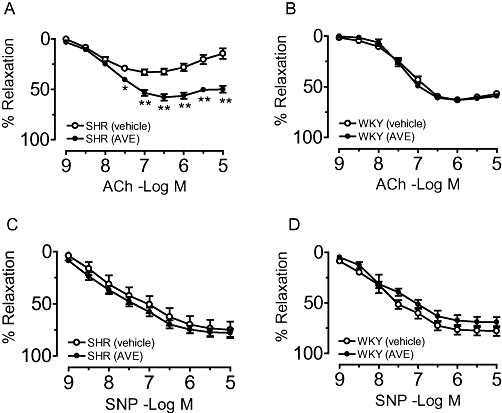
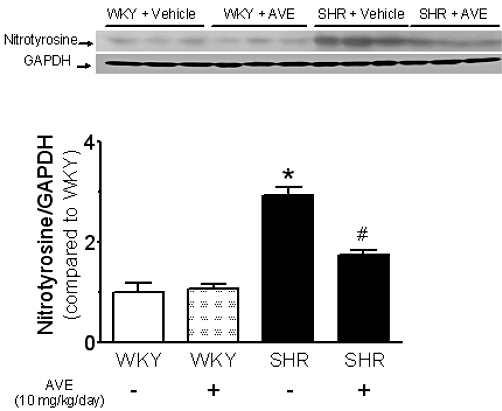
Preincubation with AVE3085 decreased the levels of p-eNOSThr495 and nitrotyrosine, reversed the lowering of p-eNOSSer1177, and restored bradykinin-induced relaxation. Bradykinin-induced NO release was markedly inhibited by ADMA; this reduction was recovered by AVE3085. Additionally, AVE3085 stops elevated O2.− and ONOO− levels in coronary arteries after ADMA exposure [2]. In addition to increasing the expression of eNOS in the WKY aorta, AVE3085 (10 μM) significantly boosted ACh-induced relaxation in the SHR aorta without influencing relaxation in the WKY aorta [3].
In vitro, preincubation with AVE3085 decreased the levels of p-eNOSThr495 and nitrotyrosine. It reverses the decrease of p-eNOSSer1177 and restores bradykinin-induced relaxation. ADMA significantly inhibits bradykinin-induced NO release; AVE3085 restored this reduction. AVE3085 stops elevated O₂⁻ and ONOO⁻ levels in coronary arteries after ADMA exposure. It enhances eNOS promoter activity in a concentration-dependent manner. |
| ln Vivo |
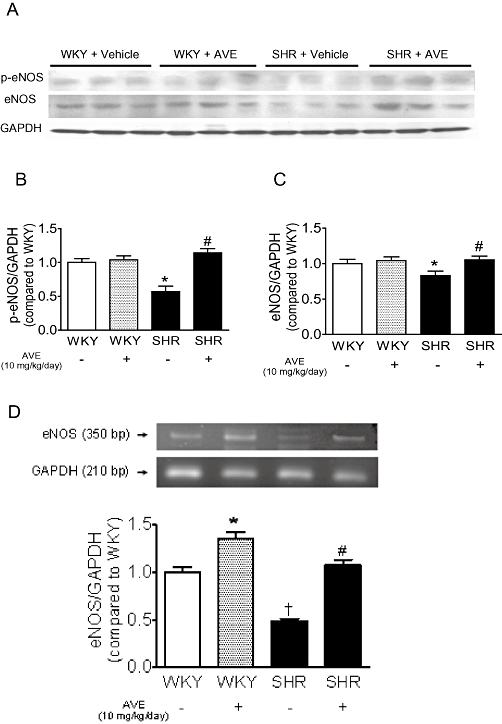
Treatment with AVE3085 (10 mg/kg/day, oral) reduced increases in mean myocyte diameter, left ventricular weight, left ventricular weight/body weight ratio, and expression of the hypertrophy markers ANP and β-MHC when compared to vehicle. Handle mice with care. Compared to mice given a vehicle, AVE 3085 therapy also resulted in lower levels of collagen volume fraction. Compared to mice treated with a vehicle, AVE3085-treated mice exhibited significantly better EF, FS, mitral E-velocity, E/A ratio, and LVDd. Treatment with AVE 3085 reduced the rise in Smad2 mRNA expression. Furthermore, AVE3085 group eNOS protein expression level was significantly higher than vehicle-treated AB group [1]. Systolic blood pressure in SHR was lowered and ACh-induced endothelium-dependent relaxation in the SHR aorta was markedly enhanced by AVE3085 (10 mg/kg, orally). Without influencing eNOS and p-eNOS levels in WKY aorta, AVE3085 therapy for four weeks raised p-eNOS and eNOS levels in SHR aorta [3].
In vivo, AVE3085 restores endothelial function and reduces blood pressure in spontaneously hypertensive rats. It is a potent enhancer of eNOS, primarily used in the treatment of cardiovascular diseases. By enhancing eNOS transcription, it leads to increased NO production, helping to preserve endothelial function and reduce oxidative stress. |
| Enzyme Assay |
The activity of AVE-308 can be assessed using cell-free eNOS enzyme assays. Recombinant or purified eNOS is incubated with its substrate (L-arginine) and cofactors (NADPH, BH4) in the presence of varying concentrations of AVE-308. The production of NO is measured using the Griess reaction or a chemiluminescence-based assay. The EC₅₀ for eNOS activation is determined from dose-response curves.
|
| Cell Assay |
To evaluate the cellular effects of AVE-308, endothelial cells are treated with the compound. The expression of eNOS is measured by Western blotting or qRT-PCR. NO production is measured using fluorescent NO indicators (e.g., DAF-FM DA) or the Griess reaction. The phosphorylation of eNOS at specific sites (Ser1177, Thr495) is assessed by Western blotting using phospho-specific antibodies.
|
| Animal Protocol |
In vivo studies with AVE-308 typically involve administration to animal models via oral or parenteral routes. In models of hypertension (e.g., spontaneously hypertensive rats), the compound's effects on blood pressure and endothelial function are assessed. In models of cardiovascular disease, its effects on vascular function, oxidative stress, and inflammation are evaluated.
|
| ADME/Pharmacokinetics |
AVE-308 has a molecular formula of C₁₇H₁₃F₂NO₃ and a molecular weight of 317.29 g/mol. Its CAS number is 450348-85-3. It is an enhancer of endothelial nitric oxide synthase. It is soluble in DMSO and other organic solvents. The purity is typically >98%. It should be stored according to the manufacturer's instructions.
|
| Toxicity/Toxicokinetics |
Specific toxicology data for AVE-308 are not extensively detailed in the available literature. However, its use in animal models at effective doses suggests a degree of tolerability. As with all research compounds, standard safety precautions should be taken when handling AVE-308. It is intended for research use only and is not for human consumption.
|
| References |
|
| Additional Infomation |
AVE-308 (AVE3085) is a potent enhancer of endothelial nitric oxide synthase (eNOS). It increases NO production by upregulating eNOS expression, improving endothelial function and vasodilation. AVE-308 restores endothelial function and reduces blood pressure in hypertensive models. It is a research tool for studying endothelial function, NO signaling, and cardiovascular diseases.
|
| Molecular Formula |
C17H13F2NO3
|
|---|---|
| Molecular Weight |
317.286831617355
|
| Exact Mass |
317.086
|
| CAS # |
450348-85-3
|
| PubChem CID |
3510704
|
| Appearance |
White to light yellow solid powder
|
| Density |
1.4±0.1 g/cm3
|
| Boiling Point |
420.3±45.0 °C at 760 mmHg
|
| Flash Point |
208.0±28.7 °C
|
| Vapour Pressure |
0.0±1.0 mmHg at 25°C
|
| Index of Refraction |
1.622
|
| LogP |
4.25
|
| Hydrogen Bond Donor Count |
1
|
| Hydrogen Bond Acceptor Count |
5
|
| Rotatable Bond Count |
2
|
| Heavy Atom Count |
23
|
| Complexity |
459
|
| Defined Atom Stereocenter Count |
0
|
| SMILES |
O=C(C1=CC=C(OC(F)(F)O2)C2=C1)NC3CC4=C(C=CC=C4)C3
|
| InChi Key |
OKCJNSDIVCXYAL-UHFFFAOYSA-N
|
| InChi Code |
InChI=1S/C17H13F2NO3/c18-17(19)22-14-6-5-12(9-15(14)23-17)16(21)20-13-7-10-3-1-2-4-11(10)8-13/h1-6,9,13H,7-8H2,(H,20,21)
|
| Chemical Name |
N-(2,3-dihydro-1H-inden-2-yl)-2,2-difluoro-1,3-benzodioxole-5-carboxamide
|
| HS Tariff Code |
2934.99.9001
|
| Storage |
Powder -20°C 3 years 4°C 2 years In solvent -80°C 6 months -20°C 1 month |
| Shipping Condition |
Room temperature (This product is stable at ambient temperature for a few days during ordinary shipping and time spent in Customs)
|
| Solubility (In Vitro) |
DMSO : ~250 mg/mL (~787.92 mM)
|
|---|---|
| Solubility (In Vivo) |
Solubility in Formulation 1: ≥ 2.08 mg/mL (6.56 mM) (saturation unknown) in 10% DMSO + 90% Corn Oil (add these co-solvents sequentially from left to right, and one by one), clear solution.
For example, if 1 mL of working solution is to be prepared, you can add 100 μL of 20.8 mg/mL clear DMSO stock solution to 900 μL of corn oil and mix evenly. (Please use freshly prepared in vivo formulations for optimal results.) |
| Preparing Stock Solutions | 1 mg | 5 mg | 10 mg | |
| 1 mM | 3.1517 mL | 15.7585 mL | 31.5169 mL | |
| 5 mM | 0.6303 mL | 3.1517 mL | 6.3034 mL | |
| 10 mM | 0.3152 mL | 1.5758 mL | 3.1517 mL |
*Note: Please select an appropriate solvent for the preparation of stock solution based on your experiment needs. For most products, DMSO can be used for preparing stock solutions (e.g. 5 mM, 10 mM, or 20 mM concentration); some products with high aqueous solubility may be dissolved in water directly. Solubility information is available at the above Solubility Data section. Once the stock solution is prepared, aliquot it to routine usage volumes and store at -20°C or -80°C. Avoid repeated freeze and thaw cycles.
Calculation results
Working concentration: mg/mL;
Method for preparing DMSO stock solution: mg drug pre-dissolved in μL DMSO (stock solution concentration mg/mL). Please contact us first if the concentration exceeds the DMSO solubility of the batch of drug.
Method for preparing in vivo formulation::Take μL DMSO stock solution, next add μL PEG300, mix and clarify, next addμL Tween 80, mix and clarify, next add μL ddH2O,mix and clarify.
(1) Please be sure that the solution is clear before the addition of next solvent. Dissolution methods like vortex, ultrasound or warming and heat may be used to aid dissolving.
(2) Be sure to add the solvent(s) in order.
|
|
|
Products are for research use only; We do not sell to patients
Copyright 2020 InvivoChem LLC | All Rights Reserved