| Size | Price | Stock | Qty |
|---|---|---|---|
| 1mg |
|
||
| 5mg |
|
||
| 10mg |
|
||
| 100mg | |||
| Other Sizes |
| Targets |
ASP-4058 targets the sphingosine-1-phosphate receptor subtype 1 (S1P1). It acts as a potent and selective agonist at this receptor. S1P1 is a G protein-coupled receptor that plays a critical role in lymphocyte trafficking. By binding to S1P1, ASP-4058 induces receptor internalization, creating a functional antagonism that prevents lymphocyte egress from lymph nodes. This mechanism reduces the number of circulating lymphocytes and their infiltration into inflamed tissues, making it effective for autoimmune diseases.
|
|---|---|
| ln Vitro |
In vitro, ASP-4058 demonstrates high potency and selectivity for S1P1 over other S1P receptor subtypes. It exhibits potent agonistic activity at S1P1 in GTPγS binding assays and functional assays measuring receptor internalization. The compound shows significant selectivity for S1P1 compared to S1P2 and S1P3, which is important for minimizing off-target cardiovascular effects associated with other S1P receptor modulators. These in vitro activities confirm its profile as a selective S1P1 modulator.
|
| ln Vivo |
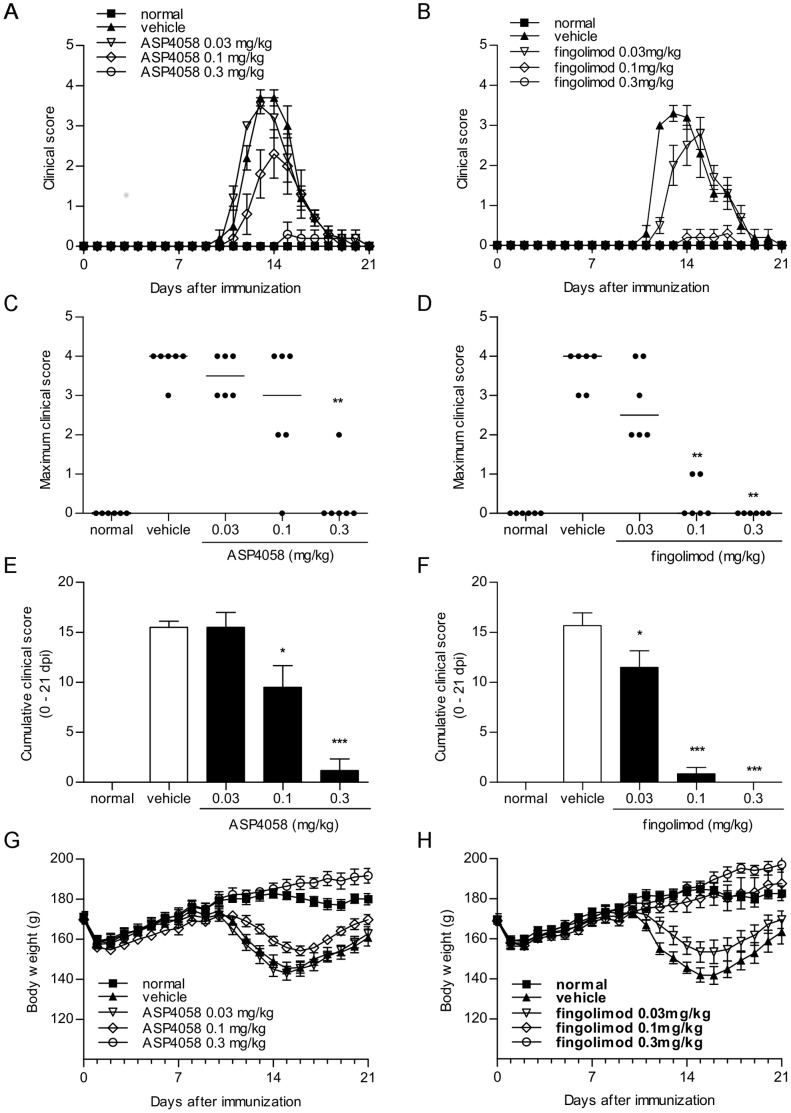
ASP4058 (oral, once daily for 21 days) lowered clinical ratings in a dose-dependent manner, with cumulative clinical scores of 15.5±1.48, 9.50±2.17 and 0.3 mg/kg from day 0 to 21 dpi, respectively. 1.17±0.619 in rats, respectively, and 15.5±0.619 in the vehicle-treated group. ASP4058 reduces weight loss in EAE rats [1]. ASP4058 (oral, daily from days 12 to 45) maintained clinical ratings at relatively low levels, with cumulative clinical scores (18-45 dpi) of 6.90 ± 2.85 and 5.60 for the 0.1 and 0.3 mg/kg dosage treatment groups, respectively. ±2.21, respectively, in mice. The ED50 value of ASP4058 is 0.063 mg/kg[1].
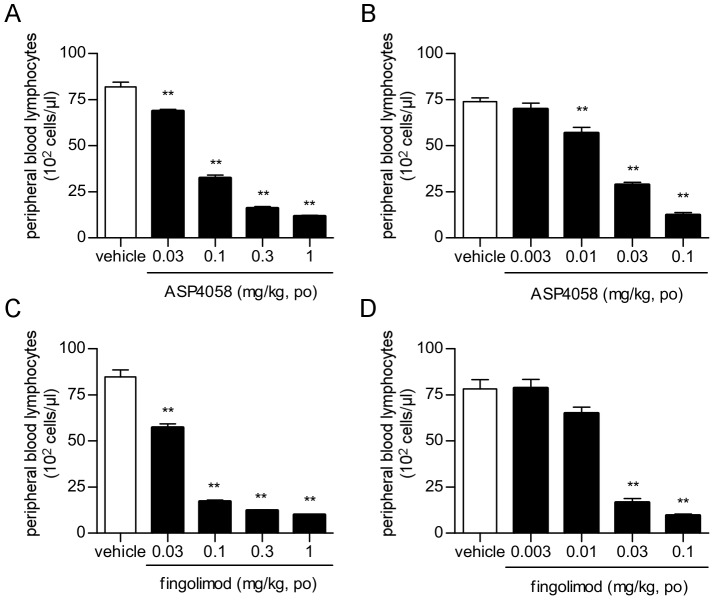
In vivo, ASP-4058 has demonstrated efficacy in several animal models of autoimmune diseases. In a rat model of experimental autoimmune encephalomyelitis (EAE), a model for multiple sclerosis, ASP-4058 significantly reduced disease severity. It effectively reduced blood lymphocyte counts in a dose-dependent manner. The compound's oral bioavailability supports its use in chronic disease models. These in vivo findings demonstrate its potential for the treatment of multiple sclerosis and other autoimmune conditions. |
| Enzyme Assay |
The in vitro receptor binding assay for ASP-4058 typically involves radioligand displacement studies using membrane preparations from cells expressing the human S1P1 receptor. The compound's affinity (Ki) is determined by measuring its ability to displace a specific radiolabeled ligand from the receptor. Functional agonism is assessed using GTPγS binding assays or assays measuring receptor internalization or downstream signaling pathways such as ERK phosphorylation. These cell-free assays provide a direct measure of the compound's binding and functional activity at S1P1.
|
| Cell Assay |
In vitro cellular assays for ASP-4058 assess its functional activity at S1P1 in a relevant cellular context. Cells expressing the S1P1 receptor are treated with the compound, and downstream signaling is measured, such as ERK phosphorylation or changes in intracellular calcium. Additionally, the compound's ability to induce S1P1 internalization can be assessed using fluorescence microscopy or flow cytometry. These assays confirm that the compound acts as a potent agonist at S1P1 in intact cells, leading to receptor modulation.
|
| Animal Protocol |
Animal/Disease Models: Male Lewis rats with induced EAE [1].
Doses: 0.03, 0.1 or 0.3 mg/kg. Route of Administration: po (po (oral gavage)) one time/day for 21 days. Experimental Results: Clinical scores and cumulative clinical scores were diminished in a dose-dependent manner. Animal/Disease Models: SJL mice immunized with PLP139-151 and boosted with pertussis toxin developed relapsing-remitting EAE[1]. Doses: 0.1 and 0.3 mg/kg Route of Administration: Orally one time/day from days 12 to 45. Experimental Results: Clinical scores and cumulative clinical scores (18-45 dpi) were maintained at relatively low levels. In vivo animal studies for ASP-4058 have been conducted in the rat EAE model to assess its efficacy in multiple sclerosis. Rats are immunized with myelin antigens to induce EAE, and ASP-4058 is administered orally. Disease severity is scored based on clinical signs such as paralysis. Blood lymphocyte counts are measured to assess the compound's pharmacodynamic effect. These studies demonstrate the compound's ability to reduce disease severity and modulate lymphocyte trafficking in vivo. |
| ADME/Pharmacokinetics |
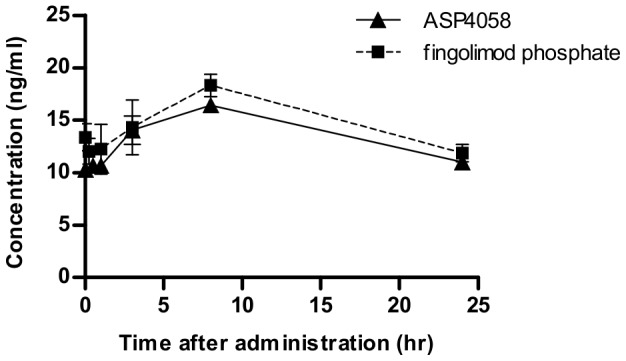
ASP-4058 free base is orally bioavailable, supporting its development as an oral therapeutic agent. As a free base, it exhibits suitable physicochemical properties for oral administration. However, detailed pharmacokinetic parameters such as half-life, Cmax, and AUC are not extensively detailed in the available literature. The compound's favorable pharmacokinetic profile, along with its selectivity for S1P1, has made it a candidate for clinical development in autoimmune diseases.
|
| Toxicity/Toxicokinetics |
Specific toxicity data for ASP-4058 free base are not extensively detailed in the available literature. As a selective S1P1 modulator, its toxicity profile is likely related to its pharmacological activity, particularly its effects on the immune system and potential cardiovascular effects. However, its selectivity for S1P1 over S1P3 may contribute to a more favorable cardiovascular safety profile compared to non-selective S1P modulators. Preclinical toxicology studies would have been conducted as part of its development.
|
| References | |
| Additional Infomation |
ASP4058 has been used in studies investigating the food effects and pharmacokinetics of ASP4058.
ASP-4058 free base is a research compound that has been investigated as a potential therapeutic agent for autoimmune diseases, particularly multiple sclerosis. It is a potent and selective S1P1 agonist that modulates lymphocyte trafficking. The compound was in clinical development, but its status is not confirmed. It is not approved for clinical use and is intended for research purposes only. It represents a next-generation S1P1 modulator with improved selectivity and safety profiles. |
| Molecular Formula |
C19H12F6N4O2
|
|---|---|
| Molecular Weight |
442.314604759216
|
| Exact Mass |
442.086
|
| CAS # |
952565-91-2
|
| Related CAS # |
952510-14-4 (HCl);
|
| PubChem CID |
16755143
|
| Appearance |
White to off-white solid powder
|
| LogP |
5.4
|
| Hydrogen Bond Donor Count |
1
|
| Hydrogen Bond Acceptor Count |
11
|
| Rotatable Bond Count |
4
|
| Heavy Atom Count |
31
|
| Complexity |
621
|
| Defined Atom Stereocenter Count |
1
|
| SMILES |
FC([C@H](C)OC1C=CC(C2=NC(C3C=CC4=C(C=3)NC=N4)=NO2)=CC=1C(F)(F)F)(F)F
|
| InChi Key |
NJNXCJPSMWKXHO-VIFPVBQESA-N
|
| InChi Code |
InChI=1S/C19H12F6N4O2/c1-9(18(20,21)22)30-15-5-3-11(6-12(15)19(23,24)25)17-28-16(29-31-17)10-2-4-13-14(7-10)27-8-26-13/h2-9H,1H3,(H,26,27)/t9-/m0/s1
|
| Chemical Name |
3-(3H-benzimidazol-5-yl)-5-[3-(trifluoromethyl)-4-[(2S)-1,1,1-trifluoropropan-2-yl]oxyphenyl]-1,2,4-oxadiazole
|
| HS Tariff Code |
2934.99.9001
|
| Storage |
Powder -20°C 3 years 4°C 2 years In solvent -80°C 6 months -20°C 1 month Note: This product requires protection from light (avoid light exposure) during transportation and storage. |
| Shipping Condition |
Room temperature (This product is stable at ambient temperature for a few days during ordinary shipping and time spent in Customs)
|
| Solubility (In Vitro) |
DMSO : ≥ 50 mg/mL (~113.04 mM)
|
|---|---|
| Solubility (In Vivo) |
Solubility in Formulation 1: ≥ 1.25 mg/mL (2.83 mM) (saturation unknown) in 10% DMSO + 40% PEG300 + 5% Tween80 + 45% Saline (add these co-solvents sequentially from left to right, and one by one), clear solution.
For example, if 1 mL of working solution is to be prepared, you can add 100 μL of 12.5 mg/mL clear DMSO stock solution to 400 μL PEG300 and mix evenly; then add 50 μL Tween-80 to the above solution and mix evenly; then add 450 μL normal saline to adjust the volume to 1 mL. Preparation of saline: Dissolve 0.9 g of sodium chloride in 100 mL ddH₂ O to obtain a clear solution. Solubility in Formulation 2: 1.25 mg/mL (2.83 mM) in 10% DMSO + 90% (20% SBE-β-CD in Saline) (add these co-solvents sequentially from left to right, and one by one), suspension solution; with ultrasonication. For example, if 1 mL of working solution is to be prepared, you can add 100 μL of 12.5 mg/mL clear DMSO stock solution to 900 μL of 20% SBE-β-CD physiological saline solution and mix evenly. Preparation of 20% SBE-β-CD in Saline (4°C,1 week): Dissolve 2 g SBE-β-CD in 10 mL saline to obtain a clear solution. View More
Solubility in Formulation 3: ≥ 1.25 mg/mL (2.83 mM) (saturation unknown) in 10% DMSO + 90% Corn Oil (add these co-solvents sequentially from left to right, and one by one), clear solution. |
| Preparing Stock Solutions | 1 mg | 5 mg | 10 mg | |
| 1 mM | 2.2609 mL | 11.3043 mL | 22.6086 mL | |
| 5 mM | 0.4522 mL | 2.2609 mL | 4.5217 mL | |
| 10 mM | 0.2261 mL | 1.1304 mL | 2.2609 mL |
*Note: Please select an appropriate solvent for the preparation of stock solution based on your experiment needs. For most products, DMSO can be used for preparing stock solutions (e.g. 5 mM, 10 mM, or 20 mM concentration); some products with high aqueous solubility may be dissolved in water directly. Solubility information is available at the above Solubility Data section. Once the stock solution is prepared, aliquot it to routine usage volumes and store at -20°C or -80°C. Avoid repeated freeze and thaw cycles.
Calculation results
Working concentration: mg/mL;
Method for preparing DMSO stock solution: mg drug pre-dissolved in μL DMSO (stock solution concentration mg/mL). Please contact us first if the concentration exceeds the DMSO solubility of the batch of drug.
Method for preparing in vivo formulation::Take μL DMSO stock solution, next add μL PEG300, mix and clarify, next addμL Tween 80, mix and clarify, next add μL ddH2O,mix and clarify.
(1) Please be sure that the solution is clear before the addition of next solvent. Dissolution methods like vortex, ultrasound or warming and heat may be used to aid dissolving.
(2) Be sure to add the solvent(s) in order.
|
|
|
Products are for research use only; We do not sell to patients
Copyright 2020 InvivoChem LLC | All Rights Reserved