| Size | Price | Stock | Qty |
|---|---|---|---|
| 5mg |
|
||
| 10mg |
|
||
| 25mg | |||
| Other Sizes |


| Targets |
EC50: 0.1 nM (FKBP, in HT1080 cells)[1] Fas receptor[1]
FKBP12 (Fv) (modified human FKBP12 with Phe36Val substitution). AP1903 binds to the modified FKBP12 domain (Fv) with high affinity, inducing homodimerization. This dimerization brings together two Fv domains, which can be used to activate signaling pathways such as Fas-mediated apoptosis or caspase-9 activation. The compound has 1000-fold lower affinity for wild-type FKBP12, ensuring specificity for the modified Fv domain. |
|---|---|
| ln Vitro |
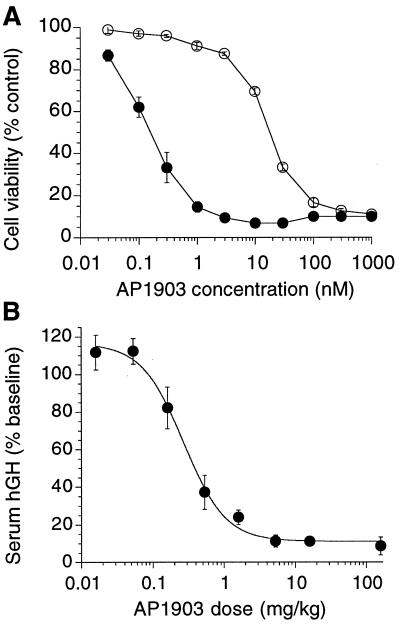
Rimiducid (AP1903) causes significant and dose-dependent apoptosis of modified cells in culture, with an EC50 of around 0.1 nM [1]. Maximum killing occurs in the presence of 3 to 10 nM Rimiducid (AP1903), with an IC50 of around 0.2 nM. LV'VFas-transduced T cells (upper panel) with high levels of CD25 were removed with an efficiency of 66%±7.5% (n=10). After CD25 expression recovered to baseline levels, Rimiducid therapy resulted in 63%±4.7% (n=9) cell death [2].
AP1903 demonstrates potent homodimerizing activity in vitro by cross-linking FKBP domains. It binds specifically to the modified FKBP12 (Fv) domain with high affinity. The compound's ability to induce dimerization has been characterized in various biochemical and cell-based assays. It is commonly used in research applications involving chemically induced dimerization (CID) systems. |
| ln Vivo |
Serum human growth hormone levels are reduced in a dosage-dependent manner by fumiducid (AP1903; iv, 0.01, 0.1, 1, 10, and 100 mg/kg); the half-maximum efficacious dose is 0.4 ± 0.1 mg/kg [1].
In vivo, AP1903 is used to induce apoptosis in cells expressing the modified FKBP12 domain and a caspase-9 fusion protein. When administered, the compound dimerizes the caspase-9 suicide switch, rapidly inducing apoptosis in targeted cells. This system is used in cell therapy and gene therapy applications to eliminate unwanted cells. The compound has been studied in various animal models. |
| Enzyme Assay |
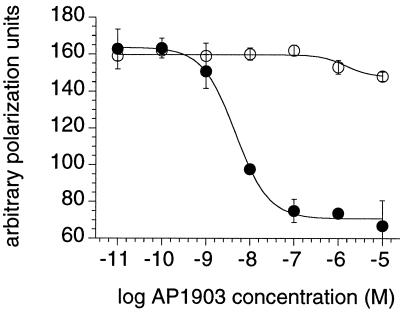
In vitro binding assays for AP1903 typically involve surface plasmon resonance or fluorescence polarization to measure binding affinity to FKBP12 (Fv) domains. The compound is incubated with purified Fv protein, and binding is detected using labeled probes. Competition assays may be performed to determine specificity. The compound's ability to induce dimerization can be assessed using size exclusion chromatography or analytical ultracentrifugation.
|
| Cell Assay |
Cloned HT1080 cell lines (ATCC CCL-121) retrovirally transduced with Fas constructs are prepared. Cell viability after overnight incubation with Rimiducid (0.01 nM, 0.1 nM, 1 nM, 10 nM, 100 nM, 1000 nM) is measured by Alamar Blue assay[1]. For annexin V assays, sorted LV′VFas-transduced T cells (2×10⁶ cells/mL) are incubated with 10 nM Rimiducid. At the indicated time, an aliquot of 2×10⁵ cells is taken, stained with annexin V-fluorescein isothiocyanate, and analyzed by flow cytometry[2]. |
| Animal Protocol |
In vivo animal studies for AP1903 are conducted in mice or other species engrafted with cells expressing the inducible system. The compound is typically administered intraperitoneally or intravenously at doses ranging from 0.1-10 mg/kg. Apoptosis of targeted cells is assessed by measuring cell death, tumor regression, or other relevant endpoints. Dosing regimens vary depending on the experimental design and the specific application.
|
| ADME/Pharmacokinetics |
AP1903 is a lipid-permeable compound with a molecular weight of 1411.63. It is typically stored lyophilized at -20°C, where it is stable for up to 36 months. In solution, it should be stored at -20°C and used within 3 months to prevent loss of potency. The compound is soluble in organic solvents such as DMSO. Detailed pharmacokinetic parameters are not extensively documented in publicly available sources.
|
| Toxicity/Toxicokinetics |
AP1903 is generally well-tolerated at research-relevant doses. However, comprehensive toxicological data are limited. The compound is intended for research use only and is not approved for human therapeutic applications. Standard laboratory safety precautions should be taken when handling the compound. It should be stored under recommended conditions to maintain stability.
|
| References | |
| Additional Infomation |
Rimiducid is a lipid-soluble tacrolimus analog and a protein dimerizing agent. It is designed to overcome the limitations of current cell immunotherapies used to treat cancer and other blood disorders by enhancing control over the activity and function of immune cells. When administered via chemically induced dimerization (CID) technology, Rimiducid binds to and dimers a switch protein, triggering a downstream signaling cascade. The combination of Rimiducid with immunotherapy is currently being investigated to enhance therapeutic efficacy. Rimiducid is a lipid-soluble tacrolimus analog with homodimerizing activity. The dimerizing agent AP1903 can homodimerize an analog of the human protein FKBP12 (Fv) containing a one-amino acid substitution (Phe36Val), thus reducing the binding affinity of AP1903 to wild-type FKBP12 by 1000-fold. This drug is used to homodimerize the drug-binding domain containing the Fv fragment of genetically engineered receptors (such as the iCD40 receptor of the autologous dendritic cell vaccine BP-GMAX-CD1), thereby activating the receptor.
Drug Indications It has been investigated for the treatment of bone marrow transplantation and graft-versus-host disease. Treatment of Graft-versus-Host DiseaseMechanism of Action Rimiducid binds to a drug-binding domain derived from the human FK506 binding protein, which is located on a modified inducible caspase-9. This binding leads to caspase-9 dimerization and subsequent activation. This system is designed as a “safety switch” in CAR-T cell therapy for hematologic malignancies. The retroviral vector used to produce these modified cells preferentially integrates this gene near a promoter associated with T cell activation. This results in increased expression levels of the modified inducible caspase-9 product in activated T cells. In effect, this allows rimiducid to specifically target these activated T cells, thereby reducing the number of circulating cells by more than 90% in cases of graft-versus-host disease. This specificity does not affect allogeneic reactive T cells and allows for the successful reconstruction of the transplanted immune system using these cells. [24753538] Furthermore, these allogeneic reactive cells remain sensitive to rimiducid. Pharmacodynamics Rimiducid is used to activate inducible caspase-9 produced by a modified gene contained in certain CAR-T cell therapies. This activation rapidly induces apoptosis in activated modified T cells and alleviates the signs and symptoms of graft-versus-host disease within 24 hours. AP1903 (Rimiducid) is a dimerizer agent that cross-links FKBP domains, inducing apoptosis through Fas signaling or caspase-9 activation. It binds specifically to the modified FKBP12 (Fv) domain with 1000-fold higher affinity than wild-type FKBP12. The compound is used in research applications involving chemically induced dimerization and cell ablation. It is not approved for clinical use and is available only for research purposes. |
| Molecular Formula |
C78H98N4O20
|
|---|---|
| Molecular Weight |
1411.63
|
| Exact Mass |
1410.677
|
| CAS # |
195514-63-7
|
| Related CAS # |
Rimiducid-d4
|
| PubChem CID |
16135625
|
| Appearance |
White to light yellow solid powder
|
| Density |
1.2±0.1 g/cm3
|
| Boiling Point |
1307.5±65.0 °C at 760 mmHg
|
| Flash Point |
744.5±34.3 °C
|
| Vapour Pressure |
0.0±0.3 mmHg at 25°C
|
| Index of Refraction |
1.566
|
| LogP |
10.39
|
| Hydrogen Bond Donor Count |
2
|
| Hydrogen Bond Acceptor Count |
20
|
| Rotatable Bond Count |
39
|
| Heavy Atom Count |
102
|
| Complexity |
2330
|
| Defined Atom Stereocenter Count |
6
|
| SMILES |
CC[C@@H](C1=CC(=C(C(=C1)OC)OC)OC)C(=O)N2CCCC[C@H]2C(=O)O[C@H](CCC3=CC(=C(C=C3)OC)OC)C4=CC(=CC=C4)OCC(=O)NCCNC(=O)COC5=CC=CC(=C5)[C@@H](CCC6=CC(=C(C=C6)OC)OC)OC(=O)[C@@H]7CCCCN7C(=O)[C@@H](CC)C8=CC(=C(C(=C8)OC)OC)OC
|
| InChi Key |
GQLCLPLEEOUJQC-WFMNNBDOSA-N
|
| InChi Code |
InChI=1S/C78H98N4O20/c1-13-57(53-43-67(93-7)73(97-11)68(44-53)94-8)75(85)81-37-17-15-25-59(81)77(87)101-61(31-27-49-29-33-63(89-3)65(39-49)91-5)51-21-19-23-55(41-51)99-47-71(83)79-35-36-80-72(84)48-100-56-24-20-22-52(42-56)62(32-28-50-30-34-64(90-4)66(40-50)92-6)102-78(88)60-26-16-18-38-82(60)76(86)58(14-2)54-45-69(95-9)74(98-12)70(46-54)96-10/h19-24,29-30,33-34,39-46,57-62H,13-18,25-28,31-32,35-38,47-48H2,1-12H3,(H,79,83)(H,80,84)/t57-,58-,59+,60+,61+,62+/m0/s1
|
| Chemical Name |
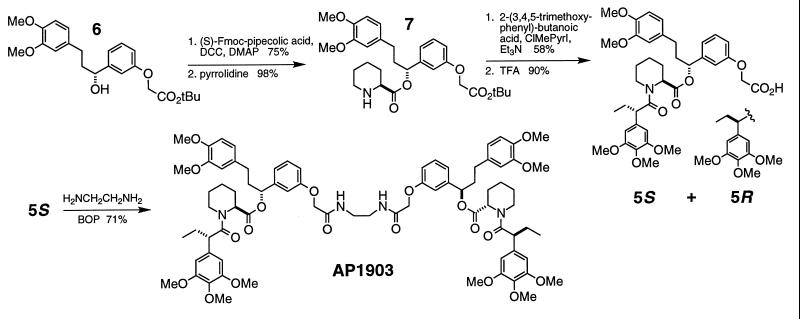
(S,2R,2'R)-(1R,1'R)-((((ethane-1,2-diylbis(azanediyl))bis(2-oxoethane-2,1-diyl))bis(oxy))bis(3,1-phenylene))bis(3-(3,4-dimethoxyphenyl)propane-1,1-diyl) bis(1-((S)-2-(3,4,5-trimethoxyphenyl)butanoyl)piperidine-2-carboxylate)
|
| Synonyms |
AP-1903 Rimiducid AP 1903 AP1903
|
| HS Tariff Code |
2934.99.9001
|
| Storage |
Powder -20°C 3 years 4°C 2 years In solvent -80°C 6 months -20°C 1 month Note: This product is not stable in solution, please use freshly prepared working solution for optimal results. |
| Shipping Condition |
Room temperature (This product is stable at ambient temperature for a few days during ordinary shipping and time spent in Customs)
|
| Solubility (In Vitro) |
DMSO : ~100 mg/mL (~70.84 mM)
|
|---|---|
| Solubility (In Vivo) |
Solubility in Formulation 1: ≥ 2.5 mg/mL (1.77 mM) (saturation unknown) in 10% DMSO + 90% Corn Oil (add these co-solvents sequentially from left to right, and one by one), clear solution.
For example, if 1 mL of working solution is to be prepared, you can add 100 μL of 25.0 mg/mL clear DMSO stock solution to 900 μL of corn oil and mix evenly. Solubility in Formulation 2: 2 mg/mL (1.42 mM) in 2% DMSO 98% Corn Oil (add these co-solvents sequentially from left to right, and one by one), suspension solution; with ultrasonication. (Please use freshly prepared in vivo formulations for optimal results.) |
| Preparing Stock Solutions | 1 mg | 5 mg | 10 mg | |
| 1 mM | 0.7084 mL | 3.5420 mL | 7.0840 mL | |
| 5 mM | 0.1417 mL | 0.7084 mL | 1.4168 mL | |
| 10 mM | 0.0708 mL | 0.3542 mL | 0.7084 mL |
*Note: Please select an appropriate solvent for the preparation of stock solution based on your experiment needs. For most products, DMSO can be used for preparing stock solutions (e.g. 5 mM, 10 mM, or 20 mM concentration); some products with high aqueous solubility may be dissolved in water directly. Solubility information is available at the above Solubility Data section. Once the stock solution is prepared, aliquot it to routine usage volumes and store at -20°C or -80°C. Avoid repeated freeze and thaw cycles.
Calculation results
Working concentration: mg/mL;
Method for preparing DMSO stock solution: mg drug pre-dissolved in μL DMSO (stock solution concentration mg/mL). Please contact us first if the concentration exceeds the DMSO solubility of the batch of drug.
Method for preparing in vivo formulation::Take μL DMSO stock solution, next add μL PEG300, mix and clarify, next addμL Tween 80, mix and clarify, next add μL ddH2O,mix and clarify.
(1) Please be sure that the solution is clear before the addition of next solvent. Dissolution methods like vortex, ultrasound or warming and heat may be used to aid dissolving.
(2) Be sure to add the solvent(s) in order.
| NCT Number | Recruitment | interventions | Conditions | Sponsor/Collaborators | Start Date | Phases |
| NCT00868595 | Completed | Biological: BPX-101 Drug: AP1903 |
Castrate Resistant Prostate Cancer (CRPC) | Bellicum Pharmaceuticals | 2009-04 | Phase 1 |
| NCT01823978 | Completed | Biological: BPX-201 vaccine plus AP1903 | Castrate Resistent Prostate Cancer | Bellicum Pharmaceuticals | 2013-04 | Phase 1 |
| NCT02487459 | Withdrawn | Biological: BPX-501 Drug: AP1903 |
Hematologic Malignancies | Bellicum Pharmaceuticals | 2016-07 | Phase 1 |
| NCT01875237 | Terminated | Drug: Fludarabine Drug: Melphalan Drug: Alemtuzumab |
Leukemia Myeloma Myeloproliferative Diseases |
M.D. Anderson Cancer Center | 2013-12-27 | Phase 1 Phase 2 |
| NCT02849886 | Unknown status | Drug: T lymphocytes iCASP9 ΔCD19 Drug: Dimerizer drug AP1903 |
Graft Versus Host Disease Hematological Malignancies |
Centre Hospitalier Universitaire de Besancon | 2019-04-10 | Phase 1 Phase 2 |
|
|
|
Products are for research use only; We do not sell to patients
Copyright 2020 InvivoChem LLC | All Rights Reserved