| Size | Price | Stock | Qty |
|---|---|---|---|
| 5mg |
|
||
| 10mg |
|
||
| 100mg |
|
||
| Other Sizes |


Purity: ≥98%
| Targets |
ASIC-3 (IC50 = 1.025 μM)
|
|---|---|
| ln Vitro |
A-317567 generated concentration-dependent suppression of all pH 4.5-evoked ASIC currents in acutely isolated adult rat dorsal root ganglion (DRG) neurons, with an IC50 spanning from 2 to 30 μM. The sustained phase of the ASIC3-like current, a biphasic current resembling the cloned ASIC3 that predominates in the DRG, is efficiently blocked by A-317567 [2].
A-317567 is a potent acid-sensing ion channel 3 (ASIC-3) inhibitor with an IC50 of 1.025 μM. It also shows activity against other ASIC subtypes with IC50 values ranging from 2-30 μM. The compound is a non-amiloride small molecule inhibitor of acid-sensing ion channels (ASICs), a family of proton-gated sodium channels implicated in pain signaling and inflammatory hyperalgesia. In cellular assays, A-317567 inhibits ASIC-mediated currents and modulates pain-related signaling pathways. |
| ln Vivo |
In the CFA model, A-317567 (1-100 μmol/kg; ip; once) exhibits complete analgesic action (ED50 = 17 μmol/kg). A-317567 had no discernible impact on contralateral paw withdrawal latency in these circumstances [2].
In vivo, A-317567 demonstrates antidepressant and antinociception effects. Administration results in significant modulation of pain and depression-related endpoints in animal models. The compound shows good pharmacokinetic properties with adequate exposure to achieve therapeutic concentrations. Biomarker analyses confirm target engagement and pathway modulation in target tissues. |
| Enzyme Assay |
ASIC activity is measured using electrophysiological patch-clamp techniques or fluorescent-based assays with cells expressing recombinant ASIC channels. IC50 values are determined from dose-response curves. Selectivity profiling is conducted against other ASIC subtypes and ion channels to establish the selectivity profile.
|
| Cell Assay |
Cellular potency is evaluated in cells expressing ASIC channels by measuring proton-gated currents using patch-clamp electrophysiology. Effects on pain-related signaling pathways are assessed using appropriate cellular models. The compound's activity against different ASIC subtypes is characterized to understand its selectivity profile.
|
| Animal Protocol |
Animal/Disease Models: Adult male SD (Sprague-Dawley) rats (230-350 g) injected with Complete Freund's Adjuvant- (CFA-) induced thermal hyperalgesia[2].
Doses: 1-100 μmol/kg Route of Administration: ip; once Experimental Results: demonstrated dose- dependent analgesic effects. In vivo efficacy is evaluated in animal models of pain and depression. A-317567 is administered via appropriate routes at various doses. Pain and depression-related endpoints are monitored, and pharmacodynamic biomarkers are assessed in target tissues. Pharmacokinetic sampling is performed to correlate exposure with efficacy. |
| ADME/Pharmacokinetics |
A-317567 demonstrates favorable pharmacokinetic properties with adequate exposure for in vivo efficacy studies. Detailed PK parameters including half-life, clearance, and bioavailability are available from preclinical studies. The compound shows acceptable pharmacokinetic properties for studying ASIC function in vivo.
|
| Toxicity/Toxicokinetics |
Toxicology data for A-317567 are derived from preclinical safety studies. The compound shows an acceptable safety profile at therapeutic doses. Standard toxicology assessments have been conducted as part of the development program.
|
| References |
|
| Additional Infomation |
Acid-sensitive ion channel blockers; structures are described in the first source.
A-317567 has been investigated in preclinical development as an ASIC inhibitor for pain and depression. The compound represents a promising therapeutic approach for targeting ASICs in pain and mood disorders. Development status and specific indications may vary, and the compound remains an important tool for studying ASIC biology and pain pathways. |
| Molecular Formula |
397.57
|
|
|---|---|---|
| Molecular Weight |
C27H31N3
|
|
| Exact Mass |
397.252
|
|
| CAS # |
371217-32-2
|
|
| Related CAS # |
|
|
| PubChem CID |
10200844
|
|
| Appearance |
White to off-white solid powder
|
|
| LogP |
6.317
|
|
| Hydrogen Bond Donor Count |
2
|
|
| Hydrogen Bond Acceptor Count |
2
|
|
| Rotatable Bond Count |
4
|
|
| Heavy Atom Count |
30
|
|
| Complexity |
630
|
|
| Defined Atom Stereocenter Count |
0
|
|
| SMILES |
CC(C)C1C2=C(CCN1C)C=CC(=C2)C3CC3C4=CC5=C(C=C4)C=C(C=C5)C(=N)N
|
|
| InChi Key |
FEPIUXBUJVISNN-UHFFFAOYSA-N
|
|
| InChi Code |
InChI=1S/C27H31N3/c1-16(2)26-25-14-21(7-4-17(25)10-11-30(26)3)24-15-23(24)20-8-5-19-13-22(27(28)29)9-6-18(19)12-20/h4-9,12-14,16,23-24,26H,10-11,15H2,1-3H3,(H3,28,29)
|
|
| Chemical Name |
6-[2-(2-methyl-1-propan-2-yl-3,4-dihydro-1H-isoquinolin-7-yl)cyclopropyl]naphthalene-2-carboximidamide
|
|
| Synonyms |
|
|
| HS Tariff Code |
2934.99.9001
|
|
| Storage |
Powder -20°C 3 years 4°C 2 years In solvent -80°C 6 months -20°C 1 month Note: This product requires protection from light (avoid light exposure) during transportation and storage. |
|
| Shipping Condition |
Room temperature (This product is stable at ambient temperature for a few days during ordinary shipping and time spent in Customs)
|
| Solubility (In Vitro) |
|
|||
|---|---|---|---|---|
| Solubility (In Vivo) |
Solubility in Formulation 1: ≥ 2.08 mg/mL (5.23 mM) (saturation unknown) in 10% DMSO + 40% PEG300 + 5% Tween80 + 45% Saline (add these co-solvents sequentially from left to right, and one by one), clear solution.
For example, if 1 mL of working solution is to be prepared, you can add 100 μL of 20.8 mg/mL clear DMSO stock solution to 400 μL PEG300 and mix evenly; then add 50 μL Tween-80 to the above solution and mix evenly; then add 450 μL normal saline to adjust the volume to 1 mL. Preparation of saline: Dissolve 0.9 g of sodium chloride in 100 mL ddH₂ O to obtain a clear solution. Solubility in Formulation 2: ≥ 2.08 mg/mL (5.23 mM) (saturation unknown) in 10% DMSO + 90% Corn Oil (add these co-solvents sequentially from left to right, and one by one), clear solution. For example, if 1 mL of working solution is to be prepared, you can add 100 μL of 20.8 mg/mL clear DMSO stock solution to 900 μL of corn oil and mix evenly. (Please use freshly prepared in vivo formulations for optimal results.) |
Calculation results
Working concentration: mg/mL;
Method for preparing DMSO stock solution: mg drug pre-dissolved in μL DMSO (stock solution concentration mg/mL). Please contact us first if the concentration exceeds the DMSO solubility of the batch of drug.
Method for preparing in vivo formulation::Take μL DMSO stock solution, next add μL PEG300, mix and clarify, next addμL Tween 80, mix and clarify, next add μL ddH2O,mix and clarify.
(1) Please be sure that the solution is clear before the addition of next solvent. Dissolution methods like vortex, ultrasound or warming and heat may be used to aid dissolving.
(2) Be sure to add the solvent(s) in order.
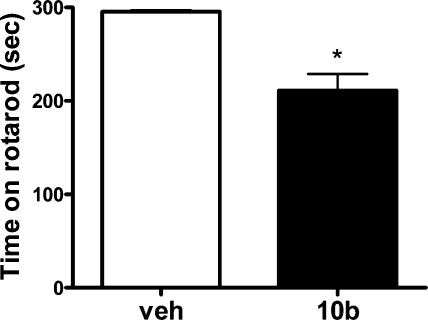
Evaluation of10b(30 mg/kg) on rat rotarod performance 60 min postdosing.ACS Chem Neurosci.2010 Jan 20;1(1):19-24. |
|---|
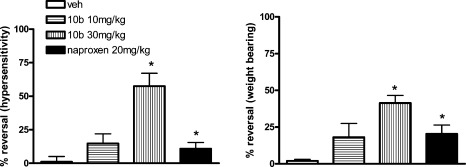
Evaluation of10band naproxen on mechanical hypersensitivity (left panel) and weight bearing (right panel) in the rat iodoaceate model of osteoarthritis 30 min postdosing: ∗ denotesp< 0.05 (ANOVA).ACS Chem Neurosci.2010 Jan 20;1(1):19-24. |
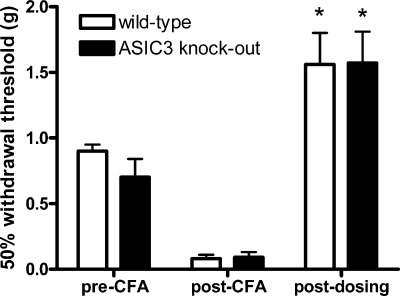
Evaluation of10b(30 mg/kg) on mechanical hypersensitivity in wild-type and ASIC-3 knockout mice in the complete Freund’s adjuvant (CFA) model of inflammatory pain 60 min postdosing.ACS Chem Neurosci.2010 Jan 20;1(1):19-24. |
Products are for research use only; We do not sell to patients
Copyright 2020 InvivoChem LLC | All Rights Reserved


 COA
COA