| Size | Price | Stock | Qty |
|---|---|---|---|
| 5mg |
|
||
| 10mg |
|
||
| 25mg |
|
||
| 50mg |
|
||
| 100mg |
|
||
| 250mg |
|
||
| Other Sizes |


Purity: ≥98%
| Targets |
SUV420H1 [1]
SUV420H2 [1] |
||
|---|---|---|---|
| ln Vitro |
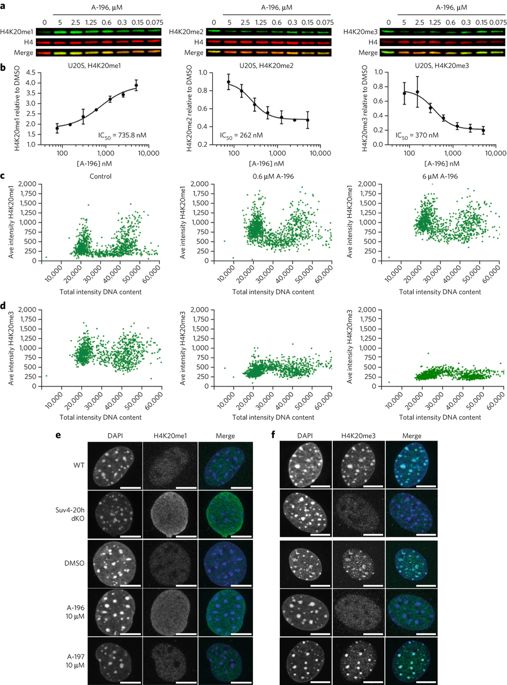
After 48 hours of treatment with A-196 (0-5 μM; U2OS cells), H4K20me1 (EC50 value of 735 nM) increases, but H4K20me2 and H4K20me3 (EC50 values of 262 and 370 nM, respectively) decrease (see reference 1). In cells from various tissue types, A-196 (10 μM; 72 hours; wild-type, Suv4-20h double knockout, and inhibitor-treated mouse embryonic fibroblasts) inhibits the SUV4-20 enzyme without showing any signs of toxicity [1].
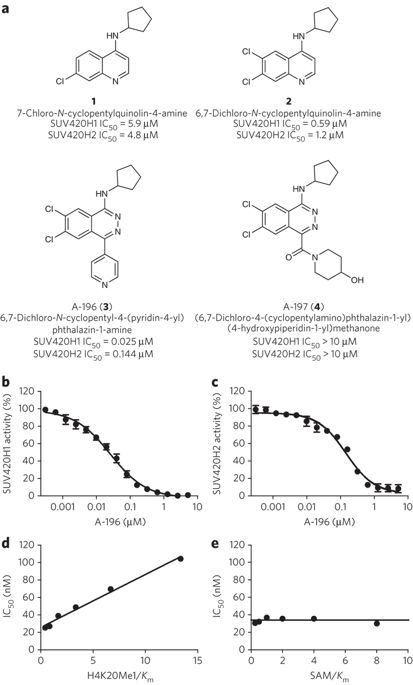
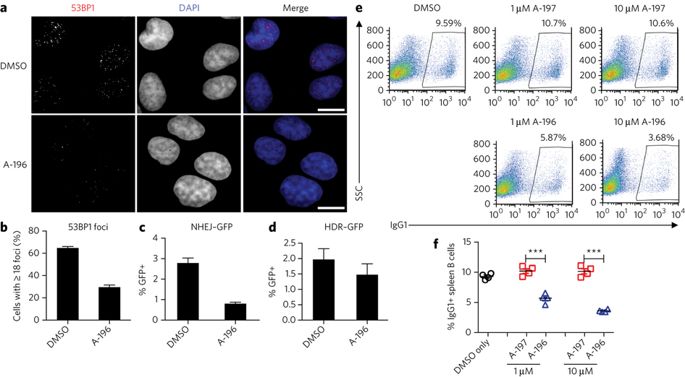
1. A-196 acts as a substrate-competitive inhibitor of SUV420H1 and SUV420H2; biochemical analyses confirmed its inhibitory specificity for these two histone-lysine N-methyltransferases [1] 2. In cellular assays, A-196 induced a global decrease in histone 4 lysine 20 dimethylation (H4K20me2) and trimethylation (H4K20me3), accompanied by a concomitant increase in H4K20 monomethylation (H4K20me1) [1] 3. A-196 inhibited the formation of 53BP1 foci in cells exposed to ionizing radiation; it reduced nonhomologous end-joining (NHEJ)-mediated DNA-break repair, while having no effect on homology-directed repair (HDR) [1] |
||
| ln Vivo |
|
||
| Enzyme Assay |
1. Biochemical activity assay for SUV420H1/SUV420H2: Recombinant SUV420H1 and SUV420H2 proteins were purified and incubated with A-196 at different concentrations, along with the natural substrate (histone H4 peptide containing lysine 20) and methyl donor (S-adenosylmethionine, SAM). The methyltransferase activity of the enzymes was measured by quantifying the level of H4K20 methylation (me2/me3) using a detection method (e.g., mass spectrometry or antibody-based assay). The assay confirmed that A-196 competes with the substrate for binding to SUV420H1/SUV420H2, thereby inhibiting their enzymatic activity [1]
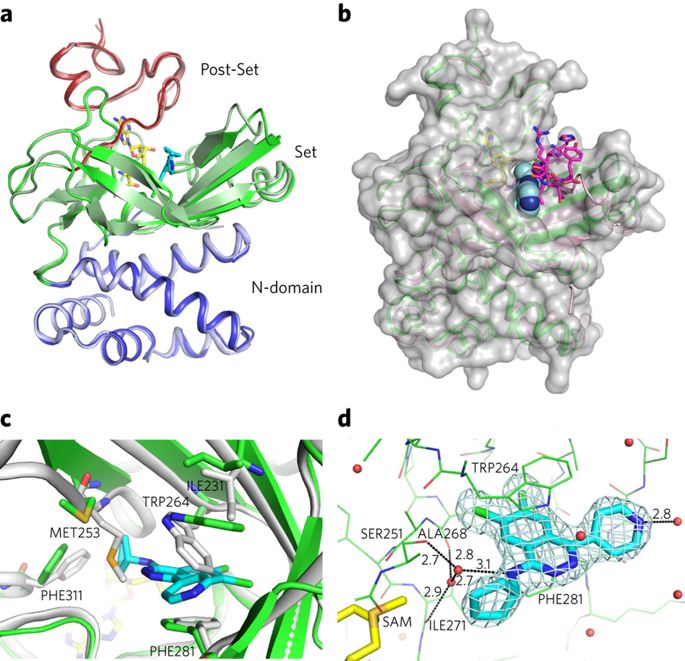
2. Co-crystallization assay for binding mode analysis: A-196 was co-crystallized with SUV420H1/SUV420H2 proteins. X-ray diffraction data of the protein-ligand crystals were collected and analyzed to determine the binding site and interaction mode of A-196 with the enzymes, verifying its substrate-competitive binding mechanism [1] |
||
| Cell Assay |
Western Blot Analysis[1]
Cell Types: U2OS cells Tested Concentrations: 0 μM, 0.075 μM, 0.15 μM, 0.3 μM, 0.6 μM, 1.25 μM, 2.5 μM, 5 μM Incubation Duration: 48 hrs (hours) Experimental Results: Increased in H4K20me1 and diminished in both H4K20me2 and H4K20me3. 1. Histone methylation detection assay: Cultured tumor cell lines (or other relevant cell lines) were treated with A-196 at different concentrations for a predetermined period. Total histones were extracted from the cells, and the levels of H4K20me1, H4K20me2, and H4K20me3 were quantified using western blot or mass spectrometry. The results showed a dose-dependent decrease in H4K20me2/me3 and an increase in H4K20me1 in A-196-treated cells [1] 2. 53BP1 foci formation assay: Cells were pretreated with A-196 and then exposed to ionizing radiation (IR). After IR exposure, cells were fixed and immunostained with an antibody against 53BP1. The number and size of 53BP1 foci (a marker of DNA double-strand break repair) were analyzed by fluorescence microscopy. The assay demonstrated that A-196 significantly inhibited the formation of 53BP1 foci induced by IR [1] 3. DNA repair pathway assay: Cells treated with A-196 were subjected to assays to evaluate NHEJ and HDR activity. For NHEJ assessment, a reporter plasmid-based assay was used to measure the efficiency of NHEJ-mediated DNA repair; for HDR assessment, a similar reporter system was employed to detect HDR activity. The results confirmed that A-196 reduced NHEJ efficiency but had no impact on HDR [1] |
||
| Animal Protocol |
|
||
| References | |||
| Additional Infomation |
1. A-196 is the first compound to selectively inhibit SUV420H1 and SUV420H2, which are two protein lysine methyltransferases (PKMTs) that catalyze the modification of H4K20me2 and H4K20me3, respectively [1]. 2. Genetic studies have shown that SUV420H1/SUV420H2 promotes efficient non-homologous end joining (NHEJ)-mediated DNA repair, and the development of A-196 aims to verify the role of these enzymes in genome integrity [1]. 3. A-196 can be used as a chemical probe to study the function of histone methyltransferases (especially SUV4-20) in maintaining genome integrity, providing a tool for studying the epigenetic regulation of DNA repair [1].
|
| Molecular Formula |
C18H16CL2N4
|
|
|---|---|---|
| Molecular Weight |
359.25244140625
|
|
| Exact Mass |
358.075
|
|
| CAS # |
1982372-88-2
|
|
| Related CAS # |
|
|
| PubChem CID |
117072548
|
|
| Appearance |
Light brown to brown solid powder
|
|
| LogP |
4.5
|
|
| Hydrogen Bond Donor Count |
1
|
|
| Hydrogen Bond Acceptor Count |
4
|
|
| Rotatable Bond Count |
3
|
|
| Heavy Atom Count |
24
|
|
| Complexity |
412
|
|
| Defined Atom Stereocenter Count |
0
|
|
| SMILES |
ClC1C(=CC2=C(C3C=CN=CC=3)N=NC(=C2C=1)NC1CCCC1)Cl
|
|
| InChi Key |
ABGOSOMRWSYAOB-UHFFFAOYSA-N
|
|
| InChi Code |
InChI=1S/C18H16Cl2N4/c19-15-9-13-14(10-16(15)20)18(22-12-3-1-2-4-12)24-23-17(13)11-5-7-21-8-6-11/h5-10,12H,1-4H2,(H,22,24)
|
|
| Chemical Name |
6,7-dichloro-N-cyclopentyl-4-pyridin-4-ylphthalazin-1-amine
|
|
| Synonyms |
|
|
| HS Tariff Code |
2934.99.9001
|
|
| Storage |
Powder -20°C 3 years 4°C 2 years In solvent -80°C 6 months -20°C 1 month |
|
| Shipping Condition |
Room temperature (This product is stable at ambient temperature for a few days during ordinary shipping and time spent in Customs)
|
| Solubility (In Vitro) |
|
|||
|---|---|---|---|---|
| Solubility (In Vivo) |
Solubility in Formulation 1: ≥ 1 mg/mL (2.78 mM) (saturation unknown) in 10% DMSO + 40% PEG300 + 5% Tween80 + 45% Saline (add these co-solvents sequentially from left to right, and one by one), clear solution.
For example, if 1 mL of working solution is to be prepared, you can add 100 μL of 10.0 mg/mL clear DMSO stock solution to 400 μL of PEG300 and mix evenly; then add 50 μL of Tween-80 to the above solution and mix evenly; then add 450 μL of normal saline to adjust the volume to 1 mL. Preparation of saline: Dissolve 0.9 g of sodium chloride in 100 mL ddH₂ O to obtain a clear solution. Solubility in Formulation 2: 1 mg/mL (2.78 mM) in 10% DMSO + 90% (20% SBE-β-CD in Saline) (add these co-solvents sequentially from left to right, and one by one), suspension solution; with ultrasonication. For example, if 1 mL of working solution is to be prepared, you can add 100 μL of 10.0 mg/mL clear DMSO stock solution to 900 μL of 20% SBE-β-CD physiological saline solution and mix evenly. Preparation of 20% SBE-β-CD in Saline (4°C,1 week): Dissolve 2 g SBE-β-CD in 10 mL saline to obtain a clear solution. View More
Solubility in Formulation 3: ≥ 1 mg/mL (2.78 mM) (saturation unknown) in 10% DMSO + 90% Corn Oil (add these co-solvents sequentially from left to right, and one by one), clear solution. |
| Preparing Stock Solutions | 1 mg | 5 mg | 10 mg | |
| 1 mM | 2.7836 mL | 13.9179 mL | 27.8358 mL | |
| 5 mM | 0.5567 mL | 2.7836 mL | 5.5672 mL | |
| 10 mM | 0.2784 mL | 1.3918 mL | 2.7836 mL |
*Note: Please select an appropriate solvent for the preparation of stock solution based on your experiment needs. For most products, DMSO can be used for preparing stock solutions (e.g. 5 mM, 10 mM, or 20 mM concentration); some products with high aqueous solubility may be dissolved in water directly. Solubility information is available at the above Solubility Data section. Once the stock solution is prepared, aliquot it to routine usage volumes and store at -20°C or -80°C. Avoid repeated freeze and thaw cycles.
Calculation results
Working concentration: mg/mL;
Method for preparing DMSO stock solution: mg drug pre-dissolved in μL DMSO (stock solution concentration mg/mL). Please contact us first if the concentration exceeds the DMSO solubility of the batch of drug.
Method for preparing in vivo formulation::Take μL DMSO stock solution, next add μL PEG300, mix and clarify, next addμL Tween 80, mix and clarify, next add μL ddH2O,mix and clarify.
(1) Please be sure that the solution is clear before the addition of next solvent. Dissolution methods like vortex, ultrasound or warming and heat may be used to aid dissolving.
(2) Be sure to add the solvent(s) in order.
A-196 is potent peptide-site competitive inhibitor of SUV420H1 and SUV420H2.Nat Chem Biol.2017 Mar;13(3):317-324. |
|---|
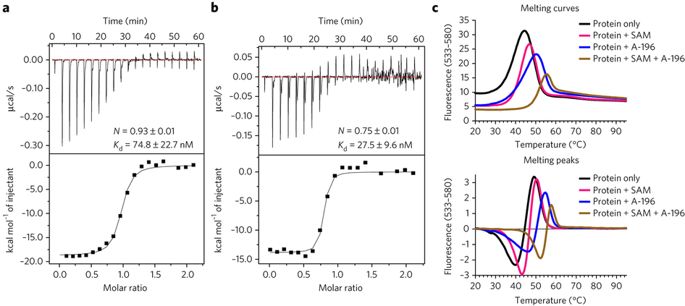
A-196 directly binds to SUV420H1.
A-196 inhibits 53BP1 foci formation and NHEJ proficiency.Nat Chem Biol.2017 Mar;13(3):317-324. |
Crystal structure of A-196 bound to SUV420H1.Nat Chem Biol.2017 Mar;13(3):317-324. |
A-196 inhibits H4K20 di- and trimethylation in cells.Nat Chem Biol.2017 Mar;13(3):317-324. |
|---|
Products are for research use only; We do not sell to patients
Copyright 2020 InvivoChem LLC | All Rights Reserved


 COA
COA