| Size | Price | Stock | Qty |
|---|---|---|---|
| 5mg |
|
||
| 10mg |
|
||
| 25mg |
|
||
| 50mg |
|
||
| 100mg |
|
||
| 250mg | |||
| 500mg | |||
| Other Sizes |


| Targets |
K-Ras(G12C)
K-Ras(G12C) inhibitor 9 targets the oncogenic K-Ras (G12C) mutant. It is an irreversible, allosteric inhibitor that binds covalently to the mutant protein. It establishes a covalent bond with the cysteine residue at position 12. By binding to the mutant protein, it locks it in an inactive state, blocking downstream signaling pathways that drive tumor growth. This mechanism makes it a promising candidate for the treatment of K-Ras G12C-mutant cancers. |
|---|---|
| ln Vitro |
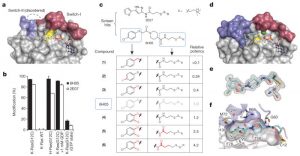
K-Ras(G12C) inhibitor 9 belongs to a class of small molecules that binds to the common oncogenic mutant K-Ras(G12C) in an irreversible way, preventing K-Ras(G12C) interactions. Some of them cause G12C-containing cancer cell lines to become less viable and more susceptible to apoptosis.[1]
In vitro, K-Ras(G12C) inhibitor 9 causes 100% modification of the K-Ras(G12C) protein when used at 10 µM for 24 hours. It is a covalent and allosteric inhibitor. Its activity has been characterized in biochemical assays measuring its binding and inhibition of the mutant protein. It is a selective inhibitor, making it a valuable tool for studying K-Ras G12C-driven cancers. However, specific IC50 values are not detailed in standard summaries. |
| ln Vivo |
In vivo studies on K-Ras(G12C) inhibitor 9 are limited, as it is primarily a research compound. However, as a potent inhibitor of the K-Ras (G12C) mutant, it has the potential for antitumor activity in vivo. Its efficacy would need to be evaluated in animal models of K-Ras G12C-mutant cancers. It is not an approved drug and is available only as a research compound for studying K-Ras biology and cancer.
|
| Enzyme Assay |
Non-cellular binding assays for K-Ras(G12C) inhibitor 9 typically involve measuring its binding affinity for the K-Ras (G12C) mutant protein. These assays may use surface plasmon resonance (SPR) or other biophysical techniques to determine the binding affinity and kinetics. The compound's ability to covalently modify the mutant protein can be assessed using mass spectrometry or other methods. These assays are essential for characterizing the compound's interaction with its target.
|
| Cell Assay |
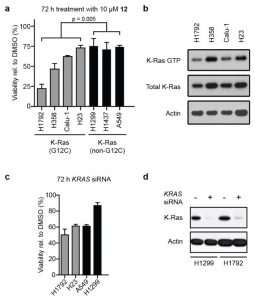
K-Ras(G12C) inhibitor 9 is a member of a class of small molecules that block the binding of B-Raf and C-Raf to K-Ras(G12C) and irreversibly compete with GTP and GDP for binding to a common oncogenic K-Ras(G12C) mutant. Lung cancer cell lines with G12C mutations (H1792, Calu-1, H358, and H23) showed increased apoptosis and decreased viability when exposed to K-Ras(G12C) inhibitor 9 (10 μM).
In vitro cell-based assays for K-Ras(G12C) inhibitor 9 are conducted using cancer cell lines harboring the K-Ras G12C mutation. Cells are treated with the compound, and its effects on cell viability, proliferation, and downstream signaling pathways (e.g., MAPK pathway) are assessed. These experiments are crucial for confirming its mechanism of action and for evaluating its potential as an anticancer agent. The compound is typically dissolved in DMSO for cell-based studies. |
| Animal Protocol |
In vivo animal studies for K-Ras(G12C) inhibitor 9 would typically involve mouse xenograft models of K-Ras G12C-mutant cancers. Tumor-bearing mice would be treated with the compound, and tumor growth would be monitored. However, specific published in vivo data for K-Ras(G12C) inhibitor 9 are not extensively documented. As a research compound, its in vivo efficacy would need to be validated in preclinical models.
|
| ADME/Pharmacokinetics |
K-Ras(G12C) inhibitor 9 has a molecular weight of 513.78 g/mol and a molecular formula of C16H21ClIN3O4S. It is a small molecule. As a research compound, its pharmacokinetic properties, such as absorption, distribution, metabolism, and excretion, are not extensively documented. It is intended for research use only. Its solubility and stability would be important factors for its use in in vitro and in vivo studies.
|
| Toxicity/Toxicokinetics |
Comprehensive toxicological data for K-Ras(G12C) inhibitor 9 are limited, as it is a research compound. It is intended for laboratory use only and is not for human consumption. As with all research chemicals, appropriate safety precautions should be taken when handling K-Ras(G12C) inhibitor 9. Its safety profile in vivo has not been extensively characterized. Standard toxicological assessments would be required for clinical development.
|
| References | |
| Additional Infomation |
K-Ras(G12C) inhibitor 9 is a novel, covalent, and allosteric inhibitor of the K-RAS G12C mutant with potential anticancer activity. It is an irreversible inhibitor that causes 100% modification of the protein at 10 µM. It establishes a covalent bond with the cysteine residue at position 12. K-Ras(G12C) inhibitor 9 is not an approved drug and is available as a research compound for studying K-Ras G12C-driven cancers.
|
| Molecular Formula |
C16H21CLIN3O4S
|
|
|---|---|---|
| Molecular Weight |
513.78
|
|
| Exact Mass |
512.999
|
|
| Elemental Analysis |
C, 37.40; H, 4.12; Cl, 6.90; I, 24.70; N, 8.18; O, 12.46; S, 6.24
|
|
| CAS # |
1469337-91-4
|
|
| Related CAS # |
|
|
| PubChem CID |
71761630
|
|
| Appearance |
White to off-white solid powder
|
|
| LogP |
3.901
|
|
| Hydrogen Bond Donor Count |
2
|
|
| Hydrogen Bond Acceptor Count |
6
|
|
| Rotatable Bond Count |
7
|
|
| Heavy Atom Count |
26
|
|
| Complexity |
593
|
|
| Defined Atom Stereocenter Count |
0
|
|
| SMILES |
C=CS(=O)(=O)NC1CCN(CC1)C(=O)CNC2=C(C=C(C(=C2)I)Cl)OC
|
|
| InChi Key |
ZGUSBCDCZNBNQT-UHFFFAOYSA-N
|
|
| InChi Code |
InChI=1S/C16H21ClIN3O4S/c1-3-26(23,24)20-11-4-6-21(7-5-11)16(22)10-19-14-9-13(18)12(17)8-15(14)25-2/h3,8-9,11,19-20H,1,4-7,10H2,2H3
|
|
| Chemical Name |
N-[1-[2-(4-chloro-5-iodo-2-methoxyanilino)acetyl]piperidin-4-yl]ethenesulfonamide
|
|
| Synonyms |
|
|
| HS Tariff Code |
2934.99.9001
|
|
| Storage |
Powder -20°C 3 years 4°C 2 years In solvent -80°C 6 months -20°C 1 month |
|
| Shipping Condition |
Room temperature (This product is stable at ambient temperature for a few days during ordinary shipping and time spent in Customs)
|
| Solubility (In Vitro) |
DMSO: ~53 mg/mL (~103.1 mM)
Water: 1 mg/mL (Insoluble) Ethanol: 1 mg/mL |
|---|---|
| Solubility (In Vivo) |
Note: Listed below are some common formulations that may be used to formulate products with low water solubility (e.g. < 1 mg/mL), you may test these formulations using a minute amount of products to avoid loss of samples.
Injection Formulations
Injection Formulation 1: DMSO : Tween 80: Saline = 10 : 5 : 85 (i.e. 100 μL DMSO stock solution → 50 μL Tween 80 → 850 μL Saline)(e.g. IP/IV/IM/SC) *Preparation of saline: Dissolve 0.9 g of sodium chloride in 100 mL ddH ₂ O to obtain a clear solution. Injection Formulation 2: DMSO : PEG300 :Tween 80 : Saline = 10 : 40 : 5 : 45 (i.e. 100 μL DMSO → 400 μLPEG300 → 50 μL Tween 80 → 450 μL Saline) Injection Formulation 3: DMSO : Corn oil = 10 : 90 (i.e. 100 μL DMSO → 900 μL Corn oil) Example: Take the Injection Formulation 3 (DMSO : Corn oil = 10 : 90) as an example, if 1 mL of 2.5 mg/mL working solution is to be prepared, you can take 100 μL 25 mg/mL DMSO stock solution and add to 900 μL corn oil, mix well to obtain a clear or suspension solution (2.5 mg/mL, ready for use in animals). View More
Injection Formulation 4: DMSO : 20% SBE-β-CD in saline = 10 : 90 [i.e. 100 μL DMSO → 900 μL (20% SBE-β-CD in saline)] Oral Formulations
Oral Formulation 1: Suspend in 0.5% CMC Na (carboxymethylcellulose sodium) Oral Formulation 2: Suspend in 0.5% Carboxymethyl cellulose Example: Take the Oral Formulation 1 (Suspend in 0.5% CMC Na) as an example, if 100 mL of 2.5 mg/mL working solution is to be prepared, you can first prepare 0.5% CMC Na solution by measuring 0.5 g CMC Na and dissolve it in 100 mL ddH2O to obtain a clear solution; then add 250 mg of the product to 100 mL 0.5% CMC Na solution, to make the suspension solution (2.5 mg/mL, ready for use in animals). View More
Oral Formulation 3: Dissolved in PEG400 (Please use freshly prepared in vivo formulations for optimal results.) |
| Preparing Stock Solutions | 1 mg | 5 mg | 10 mg | |
| 1 mM | 1.9464 mL | 9.7318 mL | 19.4636 mL | |
| 5 mM | 0.3893 mL | 1.9464 mL | 3.8927 mL | |
| 10 mM | 0.1946 mL | 0.9732 mL | 1.9464 mL |
*Note: Please select an appropriate solvent for the preparation of stock solution based on your experiment needs. For most products, DMSO can be used for preparing stock solutions (e.g. 5 mM, 10 mM, or 20 mM concentration); some products with high aqueous solubility may be dissolved in water directly. Solubility information is available at the above Solubility Data section. Once the stock solution is prepared, aliquot it to routine usage volumes and store at -20°C or -80°C. Avoid repeated freeze and thaw cycles.
Calculation results
Working concentration: mg/mL;
Method for preparing DMSO stock solution: mg drug pre-dissolved in μL DMSO (stock solution concentration mg/mL). Please contact us first if the concentration exceeds the DMSO solubility of the batch of drug.
Method for preparing in vivo formulation::Take μL DMSO stock solution, next add μL PEG300, mix and clarify, next addμL Tween 80, mix and clarify, next add μL ddH2O,mix and clarify.
(1) Please be sure that the solution is clear before the addition of next solvent. Dissolution methods like vortex, ultrasound or warming and heat may be used to aid dissolving.
(2) Be sure to add the solvent(s) in order.
| NCT Number | Recruitment | interventions | Conditions | Sponsor/Collaborators | Start Date | Phases |
| NCT06119581 | Not yet recruiting | Drug: LY3537982 Drug: Placebo |
Carcinoma, Non-Small-Cell Lung Neoplasm Metastasis |
Eli Lilly and Company | January 3, 2024 | Phase 3 |
| NCT04933695 | Active Recruiting |
Drug: Sotorasib | Non-small Cell Lung Cancer | Amgen | January 28, 2022 | Phase 2 |
| NCT04165031 | Terminated | Drug: LY3499446 Drug: Abemaciclib |
Advanced Solid Tumor Colorectal Cancer |
Eli Lilly and Company | November 28, 2019 | Phase 1 Phase 2 |
|
|---|
|
Products are for research use only; We do not sell to patients
Copyright 2020 InvivoChem LLC | All Rights Reserved