| Size | Price | Stock | Qty |
|---|---|---|---|
| 2mg |
|
||
| 25mg |
|
||
| 50mg |
|
||
| 100mg |
|
||
| 250mg |
|
||
| Other Sizes |
Purity: ≥98%
| Targets |
Varenicline Tartrate targets α4β2 nAChRs with high affinity (Ki = 0.11-0.17 nM in rat brain, human cortex, and human cloned α4β2). It also binds to α3β4 nAChRs (Ki = 83 nM, pKi=7.08±0.11), α7 nAChRs (Ki = 617 nM, pKi=6.21±0.13), and α1β1γδ nAChRs (Ki = 3,388 nM, pKi=5.47±0.17). [1]
Varenicline Tartrate targets neuronal nicotinic acetylcholine receptors, specifically the α4β2 subtype. It is a partial agonist at α4β2 nicotinic receptors. It has Ki values of 0.06 nM for α4β2 receptors, showing high selectivity. By acting as a partial agonist, it stimulates receptor-mediated activity at a level significantly lower than nicotine, while blocking nicotine's ability to fully activate the receptor. This reduces the rewarding effects of smoking and alleviates withdrawal symptoms. |
|---|---|
| ln Vitro |
Varenicline is a partial agonist with 45% of nicotines maximal efficacy atalpha4beta2 nAChRs in HEK cells expressing nAChRs. Varenicline is a potent, partial agonist at alpha4beta2 receptors, with an EC50 of 2.3 mM and an efficacy (relative to acetylcholine) of 13.4%. Varenicline has lower potency and higher efficacy at alpha3beta4 receptors, with an EC50 of 55 mM and an efficacy of 75%.
Varenicline Tartrate exhibited partial agonist activity at α4β2 nAChRs with 45% of nicotine's maximal efficacy (EC50=3.1 μM) in patch clamp studies. It stimulated [³H]-dopamine release from rat striatal slices with maximal effect 51% of nicotine (10 μM) at 1 μM. In combination with 10 μM nicotine, Varenicline Tartrate (10 μM) reduced nicotine-evoked [³H]-dopamine release by 53% to a level similar to its own maximal effect. Mecamylamine completely blocked Varenicline Tartrate-evoked release. [1] In vitro, Varenicline Tartrate is a partial agonist at α4β2 nicotinic receptors. It has Ki values of 0.06 nM for α4β2 receptors. It is a partial agonist at α3β4 nAChRs with an efficacy of 45% of the maximal effect of nicotine. These in vitro studies confirm its mechanism as a partial agonist at nicotinic receptors. Its activity has been characterized in various binding and functional assays. |
| ln Vivo |
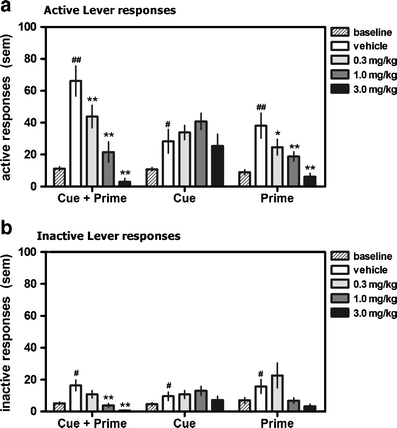
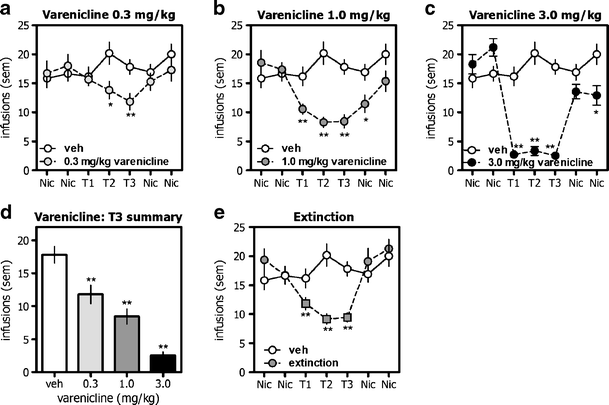
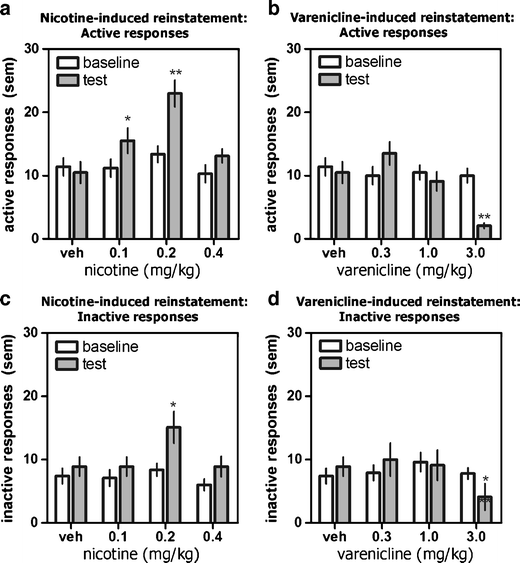
Varenicline has significantly lower (40-60%) efficacy than nicotine in stimulating [(3)H]-dopamine release from rat brain slices in vitro and in increasing dopamine release from rat nucleus accumbens in vivo, while it is more potent than Nicotine. Varenicline effectively attenuates the nicotine-induced dopamine release to the level of the effect of Varenicline alone, consistent with partial agonism. Varenicline reduces nicotine self-administration in rats and supports lower self-administration break points than nicotine. Varenicline dose-dependently reduces nicotine self-administration and attenuates both nicotine prime and combined nicotine prime plus nicotine-paired cue-induced reinstatement. Varenicline, a partial agonist at thealpha4beta2 nAChRs, reduces nicotine intake and was recently approved as a smoking cessation aid. Varenicline selectively reduces ethanol but not sucrose seeking using an operant self-administration drinking paradigm and also decreases voluntary ethanol but not water consumption in animals chronically exposed to ethanol for 2 months before Varenicline treatment.
Varenicline Tartrate (0.1 mg/kg p.o.) increased extracellular dopamine, DOPAC, and HVA in rat nucleus accumbens with slower onset and longer duration than nicotine (0.32 mg/kg s.c.). Maximal effects on dopamine turnover (40% of nicotine) and dopamine release (60% of nicotine) were observed. Varenicline Tartrate (1 mg/kg p.o.) significantly reduced nicotine (1 mg/kg s.c.)-induced dopamine turnover to varenicline alone level. It dose-dependently decreased nicotine self-administration (FR5 schedule) by up to 50% without affecting food-maintained responding. Under progressive ratio schedule, Varenicline Tartrate supported self-administration only at 56 μg/kg/inf with break point significantly lower than nicotine. In drug discrimination, Varenicline Tartrate (1 mg/kg s.c.) fully substituted for nicotine (0.4 mg/kg s.c.), blocked by mecamylamine (0.56 mg/kg). [1] In vivo, Varenicline Tartrate is used for smoking cessation. It is an orally active compound. Clinical studies have shown that varenicline therapy increased continuous abstinence rates compared with placebo or active comparator. It also reduces the urge to smoke. Its efficacy in smoking cessation has been established in clinical studies. |
| Enzyme Assay |
Binding affinities of Varenicline Tartrate to nAChRs were determined using [³H]-nicotine (for α3β4 in HEK293 cells and cortical human/rat tissue), [³H]-epibatidine (for α3β4 in HEK293 cells), and [¹²⁵I]-alpha-bungarotoxin (for α7 in IMR32 cells and α1βγδ in Torpedo electroplex membranes). Ki values were calculated as Ki = IC50 / (1 + [³H-ligand]/Kd) and expressed as pKi ± SEM (n=4). [1]
Steady-state inhibition: Nicotine (10 μM) was applied for 3 s every 30 s before and during continuous bath application of low varenicline concentrations. The amplitude of nicotine-evoked current was monitored until new steady-state level. IC50 for Varenicline Tartrate under steady-state was 6 nM (n=4). [1] Non-cellular binding assays for Varenicline Tartrate typically involve measuring its affinity for nicotinic acetylcholine receptors, particularly the α4β2 subtype. These assays use membrane preparations from cells expressing the receptors and measure the displacement of a labeled ligand, such as [3H]nicotine or [3H]epibatidine. The compound's ability to inhibit receptor binding is assessed by determining the Ki. Such assays are essential for characterizing its potency and selectivity. |
| Cell Assay |
Patch clamp electrophysiology: HEK293 cells stably expressing human α4β2 or α3β4 nAChRs, and TE671 cells (human muscle-type α1β1γδ) were voltage-clamped at -60 mV. Varying concentrations of Varenicline Tartrate or nicotine were applied for 3 s every 45 s using a multi-barrel fast perfusion system. Currents evoked by varenicline were normalized to response evoked by control nicotine (10 μM for α4β2 and α3β4, 100 μM for α1β1γδ). Data fit by logistic function, expressed as mean % of maximum nicotine response (n=4-6). [1]
Acute inhibition: Various varenicline concentrations were applied for 5 s during a 15 s challenge with 10 μM nicotine. Inhibition measured as reduction in current at end of co-application compared to current without varenicline. [1] In vitro [³H]-dopamine release: Striatal slices (300 μm) from rats were incubated with 0.1 μM [³H]-dopamine for 15 min at 37°C. Slices were superfused at 0.5 ml/min with Krebs buffer for 30 min, then 4-min fractions collected. After 16 min baseline, Varenicline Tartrate (0.03-100 μM) or with nicotine/mecamylamine perfused for 4 min, followed by 60 min buffer. Fractional release calculated; drug-evoked release expressed as % of total [³H]-DA release stimulated by 10 μM nicotine ± SEM (n=4). [1] In vitro cell-based assays for Varenicline Tartrate are conducted using cells expressing nAChRs to assess its effects on receptor signaling. Cells are treated with the compound, and changes in intracellular calcium levels or other downstream signaling pathways are measured. The compound's ability to act as a partial agonist is assessed by comparing its efficacy to that of nicotine. These experiments are crucial for confirming its mechanism of action. |
| Animal Protocol |
In vivo dopamine turnover: Varenicline Tartrate administered with vehicle or nicotine to rats at 1 h (s.c.) or 2 h (p.o.) before nucleus accumbens tissue removal. Tissue homogenized in cold 0.1 N perchloric acid, centrifuged. Dopamine, DOPAC, HVA measured electrochemically after C18 column separation. Dopamine turnover = ([DOPAC]+[HVA])/[DA] expressed as % control. [1]
In vivo microdialysis: Probes with 2 mm tip implanted into nucleus accumbens (AP +1.7, ML +1.5, DV -6.2) under anesthesia. Perfused at 2 μl/min with artificial CSF. Samples collected online, injected onto C18 column. Mobile phase: 75 mM NaAc pH4.3, 8% MeOH, 0.1 mM EDTA, 2.3 mM heptanesulfonic acid at 0.4 ml/min. Dopamine, DOPAC, HVA detected amperometrically at 650 mV. Effects of Varenicline Tartrate (p.o.), nicotine (s.c.), and combination monitored; expressed as % baseline ± SEM (n=3-6). [1] Nicotine self-administration (FR5): Long-Evans rats trained to lever press under FR1 then VI30 schedule. Jugular catheters implanted. Nicotine (30 μg/kg/inf) used to maintain responding under FR5. Varenicline Tartrate pretreatment (s.c. or p.o. 15 min before session) effects tested. Food-maintained control group on VI30 schedule. Data expressed as % baseline. [1] Progressive ratio: Response requirement elevated after each infusion (log 0.2 progression, starting FR1). Break point defined as highest ordinal infusion attained within 3 h session. Varenicline Tartrate substituted for nicotine for 4 days; first day excluded, mean break point of last 3 days reported. [1] Drug discrimination: Sprague-Dawley rats trained to discriminate nicotine (0.4 mg/kg s.c.) from saline using two-lever procedure with FR30 food delivery. Tests with nicotine or Varenicline Tartrate prior to session; responses on either lever reinforced. Full substitution if ≥80% nicotine-lever responding. Mecamylamine (0.56 mg/kg) combined with varenicline (1 mg/kg). [1] In vivo animal studies for Varenicline Tartrate are typically conducted in animal models of nicotine addiction to evaluate its efficacy in reducing nicotine self-administration and withdrawal symptoms. The compound is administered orally or intraperitoneally, and its effects on nicotine-seeking behavior and dopamine release are assessed. These studies are essential for validating its in vivo efficacy. |
| ADME/Pharmacokinetics |
Varenicline Tartrate is well absorbed, has linear pharmacokinetics, elimination half-life of 24 h, low plasma protein binding, and is almost completely renally excreted as unchanged drug. [1]
Varenicline Tartrate has a molecular weight of 361.35 g/mol. It is an orally active compound. It is well-absorbed from the gastrointestinal tract and is excreted primarily unchanged in the urine. Its pharmacokinetic properties have been studied in clinical settings. It is a prescription drug for smoking cessation. |
| Toxicity/Toxicokinetics |
Varenicline Tartrate has an established safety profile from its clinical use. Common side effects include nausea, headache, and insomnia. It can also cause abnormal dreams and gastrointestinal disturbances. Comprehensive toxicological data are available from its clinical use. Varenicline Tartrate is an approved drug for smoking cessation.
|
| References |
Neuropharmacology.2007 Mar;52(3):985-94;Psychopharmacology (Berl).2010 Feb;208(3):365-76.
|
| Additional Infomation |
A benzozazepine derivative that acts as a partial agonist of the α4β2 nicotine receptor. Used for smoking cessation.
See also: Varenicline tartrate (note moved here). Drug Indications Changpi is indicated for smoking cessation in adults. Varenicline Tartrate is an α4β2 nAChR partial agonist developed for smoking cessation. It produces a ceiling effect on dopamine release, stabilizing mesolimbic dopaminergic status in presence or absence of nicotine. Clinical trials demonstrated efficacy and safety; approved as prescription drug Champix (Chantix in the USA) for smoking cessation treatment. [1] Varenicline Tartrate (CP 526555-18, Chantix) is an orally active, subtype-selective partial agonist at α4β2 nicotinic receptors. It is used for smoking cessation. Varenicline Tartrate is an approved drug. |
| Molecular Formula |
C13H13N3.C4H6O6
|
|
|---|---|---|
| Molecular Weight |
361.35
|
|
| Exact Mass |
361.127
|
|
| CAS # |
375815-87-5
|
|
| Related CAS # |
Varenicline;249296-44-4
|
|
| PubChem CID |
6918678
|
|
| Appearance |
Off-white to yellow solid powder
|
|
| Boiling Point |
400.6ºC at 760 mmHg
|
|
| Melting Point |
206-208ºC
|
|
| LogP |
4.495
|
|
| Hydrogen Bond Donor Count |
5
|
|
| Hydrogen Bond Acceptor Count |
9
|
|
| Rotatable Bond Count |
3
|
|
| Heavy Atom Count |
26
|
|
| Complexity |
388
|
|
| Defined Atom Stereocenter Count |
4
|
|
| SMILES |
C1[C@@H]2CNC[C@H]1C3=CC4=NC=CN=C4C=C23.[C@@H]([C@H](C(=O)O)O)(C(=O)O)O
|
|
| InChi Key |
TWYFGYXQSYOKLK-CYUSMAIQSA-N
|
|
| InChi Code |
InChI=1S/C13H13N3.C4H6O6/c1-2-16-13-5-11-9-3-8(6-14-7-9)10(11)4-12(13)15-1;5-1(3(7)8)2(6)4(9)10/h1-2,4-5,8-9,14H,3,6-7H2;1-2,5-6H,(H,7,8)(H,9,10)/t8-,9+;1-,2-/m.1/s1
|
|
| Chemical Name |
(6R,10S)-7,8,9,10-tetrahydro-6H-6,10-methanoazepino[4,5-g]quinoxaline (2R,3R)-2,3-dihydroxysuccinate
|
|
| Synonyms |
|
|
| HS Tariff Code |
2934.99.9001
|
|
| Storage |
Powder -20°C 3 years 4°C 2 years In solvent -80°C 6 months -20°C 1 month Note: Please store this product in a sealed and protected environment, avoid exposure to moisture. |
|
| Shipping Condition |
Room temperature (This product is stable at ambient temperature for a few days during ordinary shipping and time spent in Customs)
|
| Solubility (In Vitro) |
|
|||
|---|---|---|---|---|
| Solubility (In Vivo) |
Solubility in Formulation 1: ≥ 1.43 mg/mL (3.96 mM) (saturation unknown) in 10% DMSO + 40% PEG300 + 5% Tween80 + 45% Saline (add these co-solvents sequentially from left to right, and one by one), clear solution.
For example, if 1 mL of working solution is to be prepared, you can add 100 μL of 14.3 mg/mL clear DMSO stock solution to 400 μL PEG300 and mix evenly; then add 50 μL Tween-80 to the above solution and mix evenly; then add 450 μL normal saline to adjust the volume to 1 mL. Preparation of saline: Dissolve 0.9 g of sodium chloride in 100 mL ddH₂ O to obtain a clear solution. Solubility in Formulation 2: ≥ 1.43 mg/mL (3.96 mM) (saturation unknown) in 10% DMSO + 90% (20% SBE-β-CD in Saline) (add these co-solvents sequentially from left to right, and one by one), clear solution. For example, if 1 mL of working solution is to be prepared, you can add 100 μL of 14.3 mg/mL clear DMSO stock solution to 900 μL of 20% SBE-β-CD physiological saline solution and mix evenly. Preparation of 20% SBE-β-CD in Saline (4°C,1 week): Dissolve 2 g SBE-β-CD in 10 mL saline to obtain a clear solution. View More
Solubility in Formulation 3: 10 mg/mL (27.67 mM) in PBS (add these co-solvents sequentially from left to right, and one by one), clear solution; with ultrasonication (<60°C). |
| Preparing Stock Solutions | 1 mg | 5 mg | 10 mg | |
| 1 mM | 2.7674 mL | 13.8370 mL | 27.6740 mL | |
| 5 mM | 0.5535 mL | 2.7674 mL | 5.5348 mL | |
| 10 mM | 0.2767 mL | 1.3837 mL | 2.7674 mL |
*Note: Please select an appropriate solvent for the preparation of stock solution based on your experiment needs. For most products, DMSO can be used for preparing stock solutions (e.g. 5 mM, 10 mM, or 20 mM concentration); some products with high aqueous solubility may be dissolved in water directly. Solubility information is available at the above Solubility Data section. Once the stock solution is prepared, aliquot it to routine usage volumes and store at -20°C or -80°C. Avoid repeated freeze and thaw cycles.
Calculation results
Working concentration: mg/mL;
Method for preparing DMSO stock solution: mg drug pre-dissolved in μL DMSO (stock solution concentration mg/mL). Please contact us first if the concentration exceeds the DMSO solubility of the batch of drug.
Method for preparing in vivo formulation::Take μL DMSO stock solution, next add μL PEG300, mix and clarify, next addμL Tween 80, mix and clarify, next add μL ddH2O,mix and clarify.
(1) Please be sure that the solution is clear before the addition of next solvent. Dissolution methods like vortex, ultrasound or warming and heat may be used to aid dissolving.
(2) Be sure to add the solvent(s) in order.
|
|---|
|
|
Products are for research use only; We do not sell to patients
Copyright 2020 InvivoChem LLC | All Rights Reserved


 COA
COA